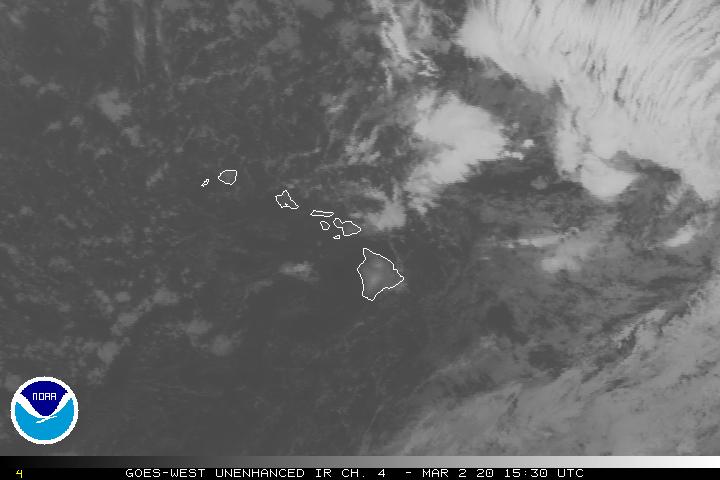
Air Temperatures – The following maximum temperatures were recorded across the state of Hawaii Tuesday afternoon:
Lihue, Kauai – 77
Honolulu airport, Oahu – 81
Molokai airport – 81
Kahului airport, Maui – 82
Kona airport – 83
Hilo airport, Hawaii – 81
Air Temperatures ranged between these warmest and coolest spots near sea level – and on the highest mountain tops around the state…as of 730pm Tuesday evening:
Kailua Kona – 77
Kahului, Maui – 73
Haleakala Summit – M (near 10,000 feet on Maui)
Mauna Kea Summit – 27 (near 13,800 feet on the Big Island)
Hawaii’s Mountains – Here’s a link to the live web cam on the summit of near 13,800 foot Mauna Kea on the Big Island of Hawaii. This web cam is available during the daylight hours here in the islands…and when there’s a big moon shining down during the night at times. Plus, during the nights you will be able to see stars, and the sunrise and sunset too…depending upon weather conditions. Here's the Haleakala Crater webcam on Maui.
Tropical Cyclone activity in the eastern and central Pacific – Here’s the latest weather information coming out of the National Hurricane Center, covering the eastern north Pacific. You can find the latest tropical cyclone information for the central north Pacific (where Hawaii is located) by clicking on this link to the Central Pacific Hurricane Center. A satellite image, which shows the entire ocean area between Hawaii and the Mexican coast…can be found here. The 2012 hurricane season is over in the eastern and central Pacific…resuming on May 15th and June 1st 2013.
Aloha Paragraphs

Clear to partly cloudy, cloudy periods, passing showers
windward sides at times…some along the
leeward sides here and there
Blustery trade winds…easing up slightly
Small craft wind advisory…all marine zones
High surf advisory for east shores of all islands
The following numbers represent the most recent top wind gusts (mph), along with directions as of Tuesday evening:
31 Lihue, Kauai – NE
42 Makua Range, Oahu – ESE
42 Molokai – NNE
45 Kahoolawe – NE
39 Lipoa, Maui – NE
33 Lanai – NE
42 PTA Kipuka Alala, Big Island – ENE
Here are the latest 24-hour precipitation totals (inches) for each of the islands as of Tuesday evening:
4.21 Kilohana, Kauai
1.26 Oahu Forest NWR, Oahu
0.30 Molokai
0.00 Kahoolawe
0.07 Kaupo Gap, Maui
0.54 Pahoa, Big Island
We can use the following links to see what’s going on in our area of the north central Pacific Ocean. Here's the latest NOAA satellite picture – the latest looping satellite image…and finally the latest looping radar image for the Hawaiian Islands.
~~ Hawaii weather commentary ~~
Strong and gusty trade winds will continue to blow across our islands. We currently have two strong, near 1037 millibar high pressure systems (weather map), located to the north and northeast of Hawaii Tuesday evening. We found strong and gusty winds starting off our day again today. This morning before sunrise, there was a gust of 44 mph on the small island of Kahoolawe. The rest of the islands were showing gusts well up into the 30+ mph range…with only Lanai down in the more normal upper teen realms. ~~~ As we got into the early afternoon hours, we found our blustery winds gusting well up into the 30 mph range on every island. Then, with that being said, we had two gusts that were over 40 mph, on Molokai and at the Kaupo Gap area of east Maui. Finally, the top gusts had spiked all the way up to 51 mph at Kahoolawe…and an even more impressive 56 mph gust on the Kohala Ranch down on the Big Island! ~~~ This evening, as shown above, there were four islands that had 40+ mph gusts, with the rest of the islands all above 30 mph. These didn't quite match the incredible 61 mph gust we saw Monday afternoon at the Kaupo Gap here on Maui.
The robust high pressure systems to our north, will keep our trade wind going for the next several days…likely through Friday. The outlooks calls for a slight reduction in our gusty trade winds, likely going from the strong proportions now…back into the moderately strong category through the end of the work week. As we get into Saturday and Sunday, our winds may become considerably lighter, as a trough of low pressure sets up shop either to the northwest, west or even southwest of Kauai.
The current forecast shows off and on, generally light showers for our windward sides through the end of the work week. This will be the result of loosely organized cloud bands, bringing moisture into the state, on the gusty trade wind flow. Here's a satellite image, showing a rather limited supply of low clouds upstream of our islands. As the winds are so strong now, and will continue in that fashion, a few showers may be able to travel over into the leeward sides at times too.
Looking even further ahead, even as far as the Christmas holiday, a week from today…the models are pointing out a possible threat. Threat may be too heavy a word, lets just say a threat of showers. Let's back track a bit here, and first point out that we'll finally see an end to our blustery trade winds. As we get into the weekend, we'll see a trough of low pressure edging into our area, or more specifically…over the ocean to the west or northwest of Kauai. This is still a bit of a wild card, although the models have been trying to lock onto this prospect for a couple of days now. I was a little reluctant to begin talking about it, since it may influence Christmas, although here goes.
The first influence we'll see will be much lighter winds during the weekend, likely from the southeast, or even south by Sunday. As many of you know, these southeast breezes are infamous for dragging volcanic haze (vog) up over the smaller islands…from the Big Island vents. As we get into early next week, which of course is Christmas Eve day, and Christmas itself on Tuesday, we may see a more drastic change. This occurs as a trough of low pressure, or even a Kona Low moves into the area west of us, which would prompt south to southwest winds, bringing increasing showers from the deeper tropics. Then again, it may be a cold front that swings down through the state then, stay tuned. I'm still holding this quite lightly, this prospect that is, although if the models continue to chew on this type of weather solution, we may need to take it more seriously. I'll have more about this longer range outlook on Wednesday. I hope you have a great Tuesday night wherever you happen to be spending it! Aloha for now…Glenn.
World-wide tropical cyclone activity:
Atlantic Ocean/Caribbean Sea: There are no active tropical cyclones
Gulf of Mexico: There are no active tropical cyclones
Eastern Pacific Ocean: There are no active tropical cyclones
Central Pacific Ocean: There are no active tropical cyclones
Western Pacific Ocean: There are no active tropical cyclones
South Pacific Ocean: Tropical cyclone Evan (04P) remains active in the south Pacific Ocean…located approximately 335 NM south of Nadi, Fiji. Sustained winds are near 45 knots, with gusts to near 55 knots. Tropical cyclone Evan will be losing strength from here on out over the open ocean. Here's the Joint Typhoon Warning Center (JTWC) graphical track map, along with a satellite image.
North and South Indian Oceans: There are no active tropical cyclones
Interesting: The Canadian city of Vancouver is using innovative materials to pave its new roads: asphalt made up of wax from recycled plastic. The city is calling the asphalt mix a "warm mix" paving process, according to Fast Coexist. Using a warm mix, as Fast Coexist explains, allows asphalt to be "produced and transported at lower temperatures."
Using lower temperatures means that 20 percent less gas is used to heat the warm mix asphalt. Produced by GreenMantra Technologies, a Toronto-based company, the warm mix asphalt is made from 100 percent post-consumer recycled plastic waste. Karyn Magnusson from the city's engineering services told Gizmag that warm mix asphalt is not a new concept.
"What is unique in our application is using a wax that was derived from recycled plastics," Magnusson said. "We have been trialing warm mix since 2008 with different kinds of additives designed to reduce the viscosity to make placement easier at lower temperatures. We have now paved three sections of Vancouver roads with this latest trial."
Magnusson said that in the spring the city will do "some more trails." The city has "some work to do yet evaluating this trial, but if our testing continues to show the benefits we were anticipating then we would love to embrace this as the norm rather than as a special mix." She added that the city would like to "see somebody begin to produce this wax locally."
Using recycled materials to pave its roads will help Vancouver to reach its goal of becoming the greenest city in the world by 2020. The city developed the Green City Action Plan developed for just that purpose, called Greenest City 2020. The city of Vancouver's website describes the plan as a "bold initiative that will address Vancouver's environmental challenges."
The plans consist of 10 small plans that have either long term goals (2050) or medium term goals (2020). The ten plans address three main areas: carbon, waste and ecosystems.
Green City Action Plan Goals:
– Reduce "community-based" greenhouse gas emissions by 5% from 1990 levels
– Develop "neighborhood-scale" renewable energy projects
– Create "compact neighborhoods with higher density"
– Plan and implement a comprehensive corporate waste reduction and diversion program for all city facilities
– Develop a procurement policy and practice that supports the purchase and use of local food in city-run facilities, including community centers and Park Board restaurants and concessions Vancouver is well on its way to achieve its goal.
The city already gets 93 percent of its electricity from renewable energy projects. It has what it touts as the “greenest building code” in North America. Bottled water sales have been phased out at the city hall and other city-owned facilities.
 Email Glenn James: