Air Temperatures – The following maximum temperatures were recorded across the state of Hawaii Friday afternoon:
Lihue, Kauai – 78
Honolulu airport, Oahu – 81
Molokai airport – 80
Kahului airport, Maui – 80
Kona airport – 81
Hilo airport, Hawaii – 79
Air Temperatures ranged between these warmest and coolest spots near sea level – and on the highest mountain tops around the state…as of 510pm Friday evening:
Barking Sands, Kauai – 80
Hana airport, Maui – 75
Haleakala Summit – 43 (near 10,000 feet on Maui)
Mauna Kea Summit – 35 (near 13,800 feet on the Big Island)
Hawaii’s Mountains – Here’s a link to the live web cam on the summit of near 13,800 foot Mauna Kea on the Big Island of Hawaii. This web cam is available during the daylight hours here in the islands…and when there’s a big moon shining down during the night at times. Plus, during the nights you will be able to see stars, and the sunrise and sunset too…depending upon weather conditions. Here's the Haleakala Crater webcam on Maui.
Tropical Cyclone activity in the eastern and central Pacific – Here’s the latest weather information coming out of the National Hurricane Center, covering the eastern north Pacific. You can find the latest tropical cyclone information for the central north Pacific (where Hawaii is located) by clicking on this link to the Central Pacific Hurricane Center. A satellite image, which shows the entire ocean area between Hawaii and the Mexican coast…can be found here. The 2012 hurricane season is over in the eastern and central Pacific…resuming on May 15th and June 1st 2013.
Aloha Paragraphs

Blustery trade winds…easing up slightly Saturday
Clear to partly cloudy, cloudy periods, some passing
showers at times windward sides
Small craft wind advisory all marine zones
High surf advisory for east shores of all islands
Wind advisory for strong easterly winds atop
the Haleakala summit on Maui
The following numbers represent the most recent top wind gusts (mph), along with directions as of Friday evening:
31 Lihue, Kauai – NE
37 Kahuku Trng, Oahu – NE
35 Molokai – ENE
45 Kahoolawe – NE
38 Kahului, Maui – NE
42 Lanai – NE
45 Kawaihae, Big Island – E
Here are the latest 24-hour precipitation totals (inches) for each of the islands as of Friday afternoon:
1.22 Mount Waialeale, Kauai
0.61 Waiawa, Oahu
0.60 Molokai
0.00 Kahoolawe
2.24 Puu Kukui, Maui
0.78 Kawainui Stream, Big Island
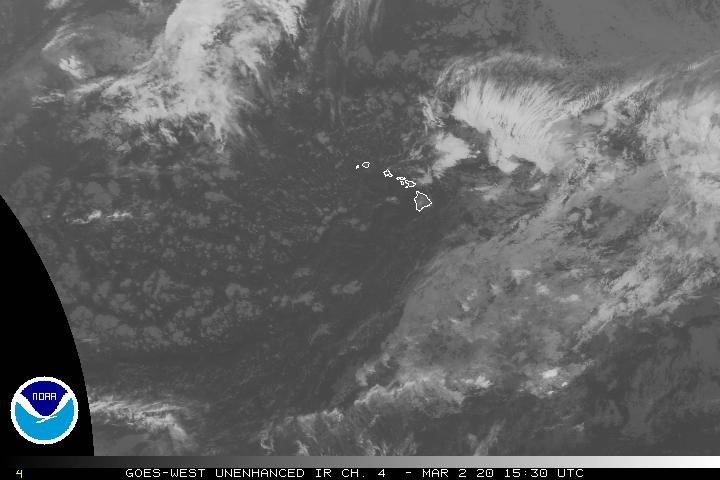
We can use the following links to see what’s going on in our area of the north central Pacific Ocean. Here's the latest NOAA satellite picture – the latest looping satellite image…and finally the latest looping radar image for the Hawaiian Islands.
~~ Hawaii weather commentary ~~
Strong and gusty trade winds continued to blow today, although will be easing up slightly this weekend…then surging again Monday-Tuesday. We currently have a near 1032 millibar high pressure system (weather map), located to the north of Hawaii this evening. We found strong and gusty winds starting off our day today, even well before sunrise. They continued through the day, although not quite reaching the 50 mph mark. We've seen several gusts up to 45 mph during the day, which will likely reach 40 mph or a bit more on Saturday.
Here on Friday evening, our winds are still gusting way up there, as shown just above, to over 40 mph on Kahoolawe, Lanai, and parts of the Big Island. Our trade winds will ease up a little Saturday and Sunday, although another surge of stronger than normal trade winds are expected to arrive by Monday or Tuesday, which could be at least as strong as what we've seen this week. It looks as though our abnormally strong trade winds…will continue well into the future.
As for precipitation, there will be some, primarily along our windward sides, and over the lower mountains on the smaller islands…with a few stretching over into the leeward sides here and there. Looking ahead, there will be more showers at times, although nothing out of the ordinary through Sunday. Even further ahead, the models show some increase in showers for our windward sides generally in the Monday through Wednesday time frame. Here's a satellite image, showing that yesterday's cirrus clouds have shifted offshore to the south of the state.
We saw lots of sunshine along our leeward and windward beaches both today. We'll likely see a few showers arriving along our windward coast later tonight into early Saturday morning. At this point, the weekend looks good from a weather perspective, with no major changes in our current trade wind weather pattern, well into the new work week ahead. ~~~ I'll be back Saturday morning with your next new weather narrative. I hope you have a great Friday night wherever you're spending it! Aloha for now…Glenn.
Extra: cute youtube video…of an active cat
Friday evening film: This week I'm seeing a film that I almost let pass. It's called Lincoln, starring Daniel Day-Lewis, Sally Field, Tommy Lee Jones, Joseph Gordon-Levitt, Gloria Reuben…among many many others. The synopsis: In a nation divided by war and the strong winds of change, Lincoln pursues a course of action designed to end the war, unite the country and abolish slavery. With the moral courage and fierce determination to succeed, his choices during this critical moment will change the fate of generations to come. This film is getting good reviews from the critics, and is being billed as a drama, biopic, adaptation. I'll of course let you know what I think in the morning, and until then…here's the trailer.
World-wide tropical cyclone activity:
Atlantic Ocean/Caribbean Sea: There are no active tropical cyclones
Gulf of Mexico: There are no active tropical cyclones
Eastern Pacific Ocean: There are no active tropical cyclones
Central Pacific Ocean: There are no active tropical cyclones
Western Pacific Ocean: There are no active tropical cyclones
South Pacific Ocean: Typhoon Evan (04P) remains active in the south Pacific Ocean…located approximately 495 NM northeast of Nadi, Fiji. Sustained winds are near 90 knots, with gusts to near 110 knots. Tropical cyclone Evan will increase in strength…through the next 24 hours. Here's the JTWC graphical track map, along with a satellite image.
North and South Indian Oceans: There are no active tropical cyclones
Interesting: It will take tens of billions of dollars to repair the damage of Super storm Sandy. Will this be the norm of the future as climate changes and the sea level rises? If it is the new norm then repairs though necessary are not enough and a change in planning is necessary. Coastal storms will more likely cause flooding.
How do you then spend limited funds to both repair New York and its environs and to improve coastal defenses against flooding? This is not just physical barriers but how people live in the area they want to live in.
"Storms today are different," says Jane Lubchenco, who heads the National Oceanic and Atmospheric Administration, which includes the National Weather Service. "Because of sea level rise, the storm surge was much more intense, much higher than it would have been in a non-climate changed world." Some of the problems are where we like to live and build.
It is nice and convenient to build near the beach but is that a good place to be? Some things are a given. You can see this as you drive through Staten Island's shore neighborhoods. Many of these houses are painfully near the sea and just above sea level. Sandy knocked homes off their foundations and flooded the rest.
This is not the only place of course. In New Jersey Long Beach Island was completely devastated. This was extensive construction on a barrier island. Barrier Islands, a coastal land form and a type of barrier system, are relatively narrow strips of sand that are parallel to the mainland coast. They usually occur in chains, consisting of anything from a few islands to more than a dozen.
Excepting the tidal inlets that separate the islands, a barrier chain may extend uninterrupted for over a hundred miles. These are the first to be hit in a major storm and the mostly likely to be damaged. The net result after Sandy was that many of these homes became uninhabitable and condemned. Marit Larson, with the city's parks and recreation department, says most of the OK ones were built after the late 1990s, when building codes changed.
In between many houses you can see wetlands — tall reeds and twisted trees in standing water. Larson says normally they slow runoff from rainstorms. But Sandy's 10-foot-high surge overwhelmed them. It also shows where people built and questions why they were built in or near wetlands.
"Just simply the amount of water that came in and inundated these people's property — that couldn't be held back by these wetlands," Larson says. She says wetlands could be useful for future storms, however, if you put them in the right place and make them big enough. So future planning should have this in mind as well as wide beaches and barrier islands.
Sand dunes and sea walls are another option to help control flooding. Engineer Franco Montalto of Drexel University says beaches could be improved by building up with sand or sediment to create dunes that hold back the water. "And the evidence seems to be that places that had rehabilitated beaches suffered less damage than places that didn't," Montalto says.
"You know, a beach nourishment project could have value in terms of protecting houses, it could add habitat and could sort of enhance the value of this beach," Montalto says. New York is seeking about $10 billion to prepare for the next big storm.
Some experts, like Montalto, say you get more bang for your buck with a "distributed" defense — dunes, wetlands, bigger storm water culverts, even urban parks in the right area that slow down the flow of water. It is all about planning and then executing.
New York city officials are contemplating plans to build huge sea walls — across the mouths of the Hudson and East rivers, for example, and even one from New Jersey to New York. Each would cost $6 billion or more.
Of course a sea wall is fine for one place but may complicate matters for another place. Klaus Jacob, a geo-scientist at Columbia University's Lamont-Doherty laboratory in New York, says: "The only thing that barriers do is prevent storm surges," he says. "Now that's wonderful. It would have taken care of Sandy and will take care of future storm surges up to a point."
That point being when sea levels rise enough to push a storm surge over the top of the sea wall. Since no one knows how high levels will go, a sea wall could become obsolete in a few decades. Moreover, a sea wall is open most of the time to let traffic through. So as the ocean rises, it will raise the river level, too.
A more proper response may be to abandon some area prone to flooding and use them as natural barriers rather than putting up a large wall. In conclusion, a cost benefit approach is an effective way to determine whether a seawall is appropriate and if the benefits are worth the expense.
Besides controlling erosion, consideration must be given to the effects of hardening a shoreline upon natural coastal ecosystems and human property or activities. Overall, a holistic approach to planning is ideal. It is important to remember that a seawall is a static feature, it will conflict with the dynamic nature of the coast and impede the exchange of sediment between land and sea.
Interesting2: African elephants are known for hanging around rivers and mashes in the savanna and the edge of jungles. However, their range actually extends well into the north, all the way up to the Sahara desert. In Mali's Gourma region, around the city of Timbuktu, there exists a species of desert-adapted African elephant (Loxodonta Africana).
Every year, they undertake an amazing migration across an area of over 12,000 square miles in search of food and water. This annual journey was recently recorded by researchers from the group Save the Elephants, University of British Columbia, and Oxford University, who attached GPS collars to nine of the elephants and tracking them by satellite.
Their report documents the elephants' record-breaking trek to survive in the largest and harshest elephant range in the world. 'It's incredible these elephants have survived. They have a truly stressful life with the lack of water and food, and their giant range reflects that,' said Jake Wall of Save the Elephants, Kenya and the University of British Columbia, lead author of the study.
They found that the greatest threat to the Gourma elephants is not the difficult environment, but the threat from humans. Mali is a large nation in Western Africa which is undergoing tremendous upheaval.
Earlier this year, a group of soldiers seized the presidential palace and declared the government dissolved and constitution suspended. The nation is currently being led by an interim government. Rebels from the north, associated with radical Islamists like Al-Qaeda, declared secession.
Plans are underway to take back this northern territory with international assistance. The lawlessness of this area makes the possibility for widespread poaching even greater. For the relatively poor people of Mali, ivory and other elephant products can be very appealing to sell. Just this year, three of the desert elephants were killed.
More death is sure to follow if the government cannot take back control of its natural conservation. Nonetheless, the Gourma elephants continue their annual migrations because it is what they do. They overcome the extreme heat and drought of the Sahara in order to make it to their water and food destinations.
According to Iain Douglas-Hamilton of Oxford University and founder of Save the Elephants, "We now fear that they may become victims of civil disturbance in the North of Mali due to the uprising currently taking place."
A new anti-poaching initiative by the WILD foundation and International Conservation Fund of Canada has been established to engage local communities and foresters in defense of the elephants. At this point, this is the only effort being made to keep the poachers at bay.
 Email Glenn James: