Air Temperatures – The following maximum temperatures were recorded across the state of Hawaii Tuesday afternoon:
Lihue, Kauai – 79
Honolulu airport, Oahu – 82
Molokai airport – 81
Kahului airport, Maui – 83
Kona airport – 83
Hilo airport, Hawaii – 79
Air Temperatures ranged between these warmest and coolest spots near sea level – and on the highest mountain tops around the state…as of 730pm Tuesday evening:
Kailua Kona – 78
Molokai airport – 73
Haleakala Summit – M (near 10,000 feet on Maui)
Mauna Kea Summit – 32 (near 13,800 feet on the Big Island)
Hawaii’s Mountains – Here’s a link to the live web cam on the summit of near 13,800 foot Mauna Kea on the Big Island of Hawaii. This web cam is available during the daylight hours here in the islands…and when there’s a big moon shining down during the night at times. Plus, during the nights you will be able to see stars, and the sunrise and sunset too…depending upon weather conditions. Here's the Haleakala Crater webcam on Maui.
Tropical Cyclone activity in the eastern and central Pacific – Here’s the latest weather information coming out of the National Hurricane Center, covering the eastern north Pacific. You can find the latest tropical cyclone information for the central north Pacific (where Hawaii is located) by clicking on this link to the Central Pacific Hurricane Center. A satellite image, which shows the entire ocean area between Hawaii and the Mexican coast…can be found here. The 2012 hurricane season is over in the eastern and central Pacific…resuming on May 15th and June 1st 2013.
Aloha Paragraphs

Clear to partly cloudy, cloudy periods, just a
few passing showers for the moment
Blustery trade winds…Small craft wind
advisory all marine zones
Wind advisory/strong trades, near South Point
on the Big Island, over Kahoolawe…and near
Upolu Point-Waikoloa and the Kamuela area –
active between noon and 6pm this evening
High surf advisory for east shores of all islands
The following numbers represent the most recent top wind gusts (mph), along with directions as of Tuesday evening:
35 Lihue, Kauai – NE
38 Kahuku Trng, Oahu – ESE
38 Molokai – ENE
42 Kahoolawe – E
36 Kahului, Maui – NE
38 Lanai – NE
39 Waikoloa, Big Island – NE
Here are the latest 24-hour precipitation totals (inches) for each of the islands as of Tuesday evening:
0.52 Mount Waialeale, Kauai
0.24 Tunnel RG, Oahu
0.00 Molokai
0.00 Kahoolawe
0.04 Kaupo Gap, Maui
0.82 Saddle Quarry, Big Island
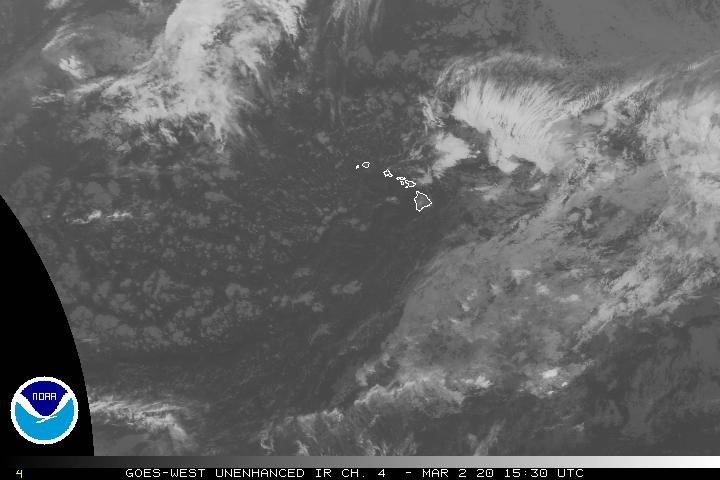
We can use the following links to see what’s going on in our area of the north central Pacific Ocean. Here's the latest NOAA satellite picture – the latest looping satellite image…and finally the latest looping radar image for the Hawaiian Islands.
~~ Hawaii weather commentary ~~
Strong and gusty trade winds will prevail through the rest of the week. We currently have a strong, near 1041 millibar high pressure system (weather map), located far to the north-northeast of Hawaii. Meanwhile, we find a weakening low pressure system to our west…moving away to the southwest. Here's a satellite image, showing high cirrus, and middle level clouds to our west…with still several embedded thunderstorms. These clouds are associated with the low pressure system over the ocean to our west.
Meanwhile, another smaller area of high cirrus is over some parts of the state…which will dim and filter our Hawaiian sunshine. These cirrus will give a nice sunset this evening, and if they are around again early Wednesday morning…will give us another treat then. At the same time we have lower level clouds riding in on the trade winds. Those clouds will provide just a few passing showers at times along our windward coasts and slopes. As we move into Wednesday evening, we may find a modest increase in windward showers then into Thursday.
The blustery trade winds remain active over all of the state now. The source of all this air in a hurry, is a stronger than usual high pressure cell far to our north, which is reaching 1041 millibars…stronger than usual for the Pacific. Small craft wind advisories remain up over the entire state this evening, and will likely remain active well into the future. At the same time we have a wind advisory in force over some parts of the islands too…for winds peaking near 50 mph at times locally.
These trades have been reaching the 40 mph mark over the last several days, and even above that yesterday…topping out at 49 mph at one spot. I expect more of the same over the next several days, perhaps even making it up towards 50 mph, in one or two of our windiest areas during the afternoon hours on Wednesday. Meanwhile, relatively dry weather prevails, which is limiting greatly any precipitation…even along our windward sides at the moment at least. ~~~ I'll be back early Wednesday morning with your next new weather narrative. I hope you have a great Tuesday night wherever you're spending it! Aloha for now…Glenn.
World-wide tropical cyclone activity:
Atlantic Ocean/Caribbean Sea: There are no active tropical cyclones
Gulf of Mexico: There are no active tropical cyclones
Eastern Pacific Ocean: There are no active tropical cyclones
Central Pacific Ocean: There are no active tropical cyclones
Western Pacific Ocean: There are no active tropical cyclones
South Pacific Ocean: Tropical cyclone 04P is now active in the south Pacific Ocean…located approximately 290 NM west of Pago Pago, American Samoa. Sustained winds are near 35 knots, with gusts to near 45 knots. 04P will gradually increase in strength…until reaching the typhoon level between 24-36 hours. Here's the JTWC graphical track map…along with a satellite image.
North and South Indian Oceans: Tropical storm Claudia (03S) remains active in the South Indian Ocean…located approximately 870 NM south of Diego Garcia. Sustained winds are near 50 knots, with gusts to near 65 knots. 03S will gradually decrease in strength throughout the remainder of her life cycle. Here's the JTWC graphical track map…along with a satellite image.
Interesting: Trees can live hundreds, even thousands of years. But the problem is that these trees aren’t making it to old age and according to a new study, big, old trees are in decline throughout the world which can have detrimental impacts to forest ecosystems. Old trees are crucial organisms for many ecosystems: they provide homes for animals, provide space for other plants to grow, and they produce seeds, leaves, and nuts that serve as food.
They also store large amounts of carbon and continue to sequester it as they grow, said study co-author David Lindenmayer, a researcher at Australian National University. One study published in PLoS ONE in May found that although big trees (with a diameter of more than 3 feet at chest height) made up only 1 percent of trees in a study plot in California's Yosemite National Park, they accounted for 50 percent of the area's biomass.
Another study found that huge mountain ash trees in southern Australia and Tasmania provide homes for more than 40 species of animals, Lindenmayer said. "Large old trees are declining rapidly in all kinds of ecosystems worldwide — forests, rainforests, boreal forests, woodlands, agricultural areas, cities and savannahs," Lindenmayer told OurAmazingPlanet.
While forest fires or clear-cutting are often blamed for the loss of these trees, their disappearance is usually less apparent, said Nate Stephenson, an ecologist with the Western Ecological Research Center in Three Rivers, California. "Losses of big, old trees can take place over decades, generally too slowly for people to notice," said Stephenson.
"The next generation may not know that big old trees were once common in the nearby forest." Different regions around the world have different tree problems Lindenmayer said. "It might be elephants plus fire plus fungi in [South Africa's] Kruger National Park, versus fire plus logging plus climate change in the wet forests of Victoria," in Australia, he said.
From logging to clearing land for development or agriculture, to non-native insects or pathogens, trees are constantly being faced with potential threats. "But the problem manifests in broadly the same way in all systems: rapid loss of existing large old trees and often a failure to recruit new big trees, leading to a massive vacuum."
To prevent the loss of more forest giants, people need to protect these individuals and the places where they are more likely to grow, Lindenmayer said. It's also important that land managers realize the importance of big old trees. "Many managers have no idea about this," he said.
Interesting2: A five-day meeting on fisheries ended last week (6 December) amid complaints that big fishing nations have blocked efforts to curb tuna overfishing and ignored scientific advice. The accusations were made following the ninth regular session of the Western and Central Pacific Fisheries Commission, which is the governing body for an international fisheries agreement that seeks to ensure the conservation and sustainable use of highly migratory fish, such as tuna, in parts of the Pacific Ocean.
Nanette Malsol, chair of the Parties to the Nauru Agreement (PNA), a management body for sustainable fisheries that represents eight nations in the Oceania region, said the commission had "failed to take its responsibilities seriously regarding the fate of tuna". The PNA had called for a stop to the overfishing of bigeye tuna, an important food fish.
Speaking to SciDev.Net, Gerry Leape, the head of the US-based Pew Environment Group's delegation, added: "The commission has ignored the scientific advice that we need to stop overfishing and chose instead to protect its individual interests".
Leape was disappointed that delegates preferred to discuss "how much overfishing to allow, rather than how to end it". Unless overfishing in the tropical seas can be controlled, global tuna stocks will continue to decline, he said. Malsol said: "The big fishing nations did not make any significant commitments to cut their overfishing of bigeye tuna.
It is the big fishing nations of the EU, and the US and Japan that have historically over-fished this tuna," noting that the bigeye is fished at 40 per cent above the sustainable level. Other members such as Taiwan and South Korea agreed to voluntarily cut their long line catch by ten per cent and two per cent respectively, she said.
But this is way below the 30 per cent reduction in the total catch by all methods that the PNA and conservation groups were calling on every country to make. Every year, thousands of vessels catch more than four million tonnes of tuna, with at least 60 per cent being taken from the western and central Pacific regions, according to Pew.
Japan catches and eats more tuna than any other nation, it said. But overfishing due to growing consumer demand and harmful fishing practices have depleted tuna stocks, according to Pew. The International Union for Conservation of Nature has put yellowfin and albacore tuna in the "near threatened" category and classified bigeye as "vulnerable".
 Email Glenn James: