Air Temperatures – The following maximum temperatures were recorded across the state of Hawaii Monday afternoon:
Lihue, Kauai – 81
Honolulu airport, Oahu – 83
Molokai airport – 83
Kahului airport, Maui – 82
Kona airport – 83
Hilo airport, Hawaii – 80
Air Temperatures ranged between these warmest and coolest spots near sea level – and on the highest mountain tops around the state…as of 610pm Monday evening:
Barking Sands, Kauai – 77
Hilo, Hawaii – 73
Haleakala Summit – 45 (near 10,000 feet on Maui)
Mauna Kea Summit – 36 (near 13,800 feet on the Big Island)
Hawaii’s Mountains – Here’s a link to the live web cam on the summit of near 13,800 foot Mauna Kea on the Big Island of Hawaii. This web cam is available during the daylight hours here in the islands…and when there’s a big moon shining down during the night at times. Plus, during the nights you will be able to see stars, and the sunrise and sunset too…depending upon weather conditions. Here's the Haleakala Crater webcam on Maui.
Tropical Cyclone activity in the eastern and central Pacific – Here’s the latest weather information coming out of the National Hurricane Center, covering the eastern north Pacific. You can find the latest tropical cyclone information for the central north Pacific (where Hawaii is located) by clicking on this link to the Central Pacific Hurricane Center. A satellite image, which shows the entire ocean area between Hawaii and the Mexican coast…can be found here. The 2012 hurricane season is over in the eastern and central Pacific…resuming on May 15th and June 1st 2013.
Aloha Paragraphs

Clear to partly cloudy, cloudy periods, just a
few passing showers for the moment
Blustery trade winds…Small craft wind
advisory all marine zones
High surf advisory for east shores of all islands
Red Flag warning for leeward areas…due
to strong winds and dry conditions – critical
fire weather conditions through 6pm
The following numbers represent the most recent top wind gusts (mph), along with directions as of Monday evening:
32 Port Allen, Kauai – NE
35 Kahuku Trng, Oahu – ESE
35 Molokai – E
43 Kahoolawe – E
38 Kahului, Maui – NE
31 Lanai – NE
31 South Point, Big Island – NE
Here are the latest 24-hour precipitation totals (inches) for each of the islands as of Monday evening:
1.98 Mount Waialeale, Kauai
0.37 Moanalua RG, Oahu
0.00 Molokai
0.00 Kahoolawe
0.09 Puu Kukui, Maui
1.71 Waiakea Uka, Big Island
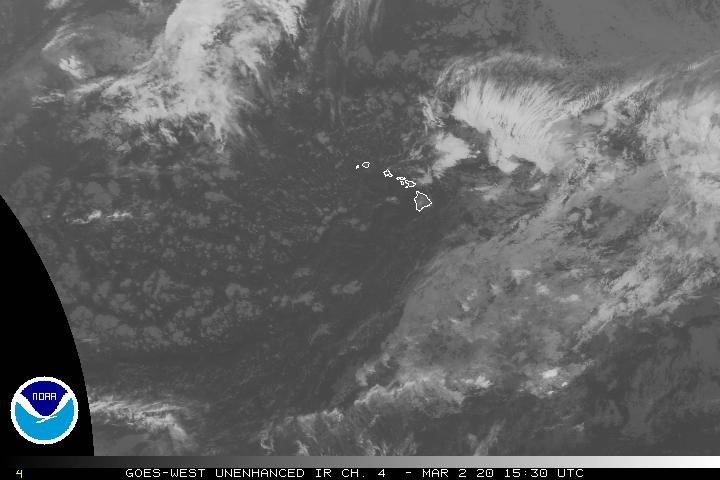
We can use the following links to see what’s going on in our area of the north central Pacific Ocean. Here's the latest NOAA satellite picture – the latest looping satellite image…and finally the latest looping radar image for the Hawaiian Islands.
~~ Hawaii weather commentary ~~
Stiff trade winds will prevail through the rest of this week…likely right on into next week. We currently have near 1035 millibar high pressure systems (weather map), located far to the northeast of Hawaii, and a new high pressure cell to our north. Meanwhile, we find a Kona low pressure system to our west, with its associated trough dangling to the south from its center…although its moving away to the southwest. Here's a satellite image, showing high cirrus, and middle level clouds to our west through northwest…with a few embedded thunderstorms as well. These clouds are associated with the low pressure system over the ocean to our west. Meanwhile, there is another area of high cirrus to our south, which is bringing high clouds into the state now. At the same time we have very few lower level clouds riding in on the trade winds. Those clouds will provide just a few passing showers at times along our windward coasts and slopes. As we get into the mid-week time frame, we may find an slight increase in windward showers.
The low pressure system to our west, called a Kona Low…will be moving away now. As this low migrates away, we'll see those thunderstorms over the ocean, moving even further away from Kauai, taking the threat of heavy rain away. The main thing this week will be the blustery trade winds. Small craft wind advisories are up over the entire state this evening. These trades have been reaching the 40 mph mark the last couple of days, and even above that yesterday…topping out at 45 mph at one spot. Monday saw at least one wind gust reach 49 mph on the small, often windy island of Kahoolawe. There were several other spots around the state that topped 40 mph, which will likely happen many times this week…a windy week coming up. ~~~ I'll be back early Tuesday morning with your next new weather narrative. I hope you have a great Monday night wherever you're spending it! Aloha for now…Glenn.
World-wide tropical cyclone activity:
Atlantic Ocean/Caribbean Sea: There are no active tropical cyclones
Gulf of Mexico: There are no active tropical cyclones
Eastern Pacific Ocean: There are no active tropical cyclones
Central Pacific Ocean: There are no active tropical cyclones
Western Pacific Ocean: There are no active tropical cyclones
South Pacific Ocean: There are no active tropical cyclones
North and South Indian Oceans: Typhoon Claudia (03S) remains active in the South Indian Ocean…located approximately 775 NM south of Diego Garcia. Sustained winds are near 65 knots, with gusts to near 80 knots. 03S will gradually decrease in strength throughout the remainder of her life cycle. Here's the JTWC graphical track map…along with a satellite image.
Interesting: Poor countries have won historic recognition of the plight they face from the ravages of climate change, wringing a pledge from rich nations that they will receive funds to repair the "loss and damage" incurred. Poor countries have won historic recognition of the plight they face from the ravages of climate change, wringing a pledge from rich nations that they will receive funds to repair the "loss and damage" incurred.
This is the first time developing countries have received such assurances, and the first time the phrase "loss and damage from climate change" has been enshrined in an international legal document.
Developing countries had been fighting hard for the concession at the fortnight-long UN climate change talks among 195 nations in Qatar, which finished after a marathon 36-hour final session. Ronald Jumeau, negotiating for the Seychelles, scolded the US negotiator: "If we had had more ambition [on emissions cuts from rich countries], we would not have to ask for so much [money] for adaptation.
If there had been more money for adaptation [to climate change], we would not be looking for money for loss and damage. What's next? Loss of our islands?" Ruth Davis, political adviser at Greenpeace, said: "This is a highly significant move — it will be the first time the size of the bill for failing to take on climate change will be part of the UN discussions. Countries need to understand the risks they are taking in not addressing climate change urgently."
Ed Davey, the UK energy and climate secretary, said: "It's about helping the most vulnerable countries, and looking at how they can be more resilient." But the pledges stopped well short of any admission of legal liability or the need to pay compensation on the part of the rich world. The US had strongly opposed the initial "loss and damage" proposals, which would have set up a new international institution to collect and disperse funds to vulnerable countries.
US negotiators also made certain that neither the word "compensation", nor any other term connoting legal liability, was used, to avoid opening the floodgates to litigation — instead, the money will be judged as aid. Key questions remain unanswered, including whether funds devoted to "loss and damage" will come from existing humanitarian aid and disaster relief budgets.
The US is one of the world's biggest donor of humanitarian aid and disaster relief, from both public and private sources. It will be difficult to disentangle damage inflicted by climate change from other natural disasters.
 Email Glenn James: