Air Temperatures – The following maximum temperatures were recorded across the state of Hawaii Tuesday afternoon:
Lihue, Kauai – 81
Honolulu airport, Oahu – 79
Molokai airport – 83
Kahului airport, Maui – 82
Kona airport – 83
Hilo airport, Hawaii – 72
Air Temperatures ranged between these warmest and coolest spots near sea level – and on the highest mountain tops around the state…as of 730pm Tuesday afternoon:
Kailua-kona – 78
Hilo, Hawaii – 70
Haleakala Summit – 45 (near 10,000 feet on Maui)
Mauna Kea Summit – 36 (near 13,800 feet on the Big Island)
Hawaii’s Mountains – Here’s a link to the live web cam on the summit of near 13,800 foot Mauna Kea on the Big Island of Hawaii. This web cam is available during the daylight hours here in the islands…and when there’s a big moon shining down during the night at times. Plus, during the nights you will be able to see stars, and the sunrise and sunset too…depending upon weather conditions. Here's the Haleakala Crater webcam on Maui.
Tropical Cyclone activity in the eastern and central Pacific – Here’s the latest weather information coming out of the National Hurricane Center, covering the eastern north Pacific. You can find the latest tropical cyclone information for the central north Pacific (where Hawaii is located) by clicking on this link to the Central Pacific Hurricane Center. A satellite image, which shows the entire ocean area between Hawaii and the Mexican coast…can be found here.
Aloha Paragraphs

Hawaiian Owl…also called Pueo
Trade winds lighter into mid-week…locally voggy.
High and middle level clouds statewide
A few windward showers here and there…
with couple elsewhere too at times.
As this weather map shows…we find near 1023 millibar high pressure systems to the north…and far to the east-northeast of the Hawaiian Islands. These high pressure cells will continue our trade winds into Wednesday, after which they will slack off and veer southeast.
The following numbers represent the most recent top wind gusts (mph), along with directions as of Tuesday evening:
20 Port Allen, Kauai – ESE
27 Kahuku Trng, Oahu – ESE
27 Molokai – E
36 Kahoolawe – NE
36 Kahului, Maui – NE
31 Lanai – SE
27 Upolu airport, Big Island – NE
We can use the following links to see what’s going on in our area of the north central Pacific Ocean. Here's the latest NOAA satellite picture – the latest looping satellite image…and finally the latest looping radar image for the Hawaiian Islands.
Here are the latest 24-hour precipitation totals (inches) for each of the islands as of Tuesday evening:
1.24 Mount Waialeale, Kauai
0.47 Poamoho RG 1, Oahu
0.10 Molokai
0.00 Lanai
0.00 Kahoolawe
0.41 Puu Kukui, Maui
0.73 Kawainui Stream, Big Island
~~ Hawaii evening commentary ~~
Our trade winds will become lighter during the second half of this week. We currently find near 1023 millibar high pressure systems (weather map), located to the north, and far to the east-northeast of the islands. A new small craft wind advisory remains active for the time being, over those windiest coasts and slopes around Maui County and the Big Island. The trades should remain active through mid-week, although become lighter from the southeast thereafter. Our atmosphere will turn somewhat more showery, at least locally at times, and especially Thursday and Friday. This off and on showery weather pattern may remain active into the weekend…especially during the afternoon hours. An approaching cold front from the northwest late this weekend, may get driven down through the state early next week.
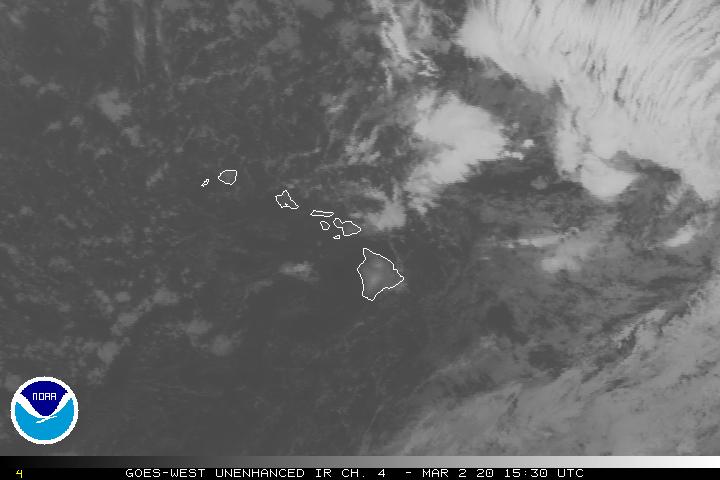
As we look at this satellite image, we see high and middle level clouds being carried over the islands…on an arm of the subtropical jet stream. There will continue to be a few passing windward biased showers arriving at times, with the leeward sides remaining generally dry. We'll find those occasional passing windward biased showers through mid-week…with a few dropping along our leeward sides here and there too. Our trade winds will falter by Thursday, and remain quite light into the weekend. At the same time, we'll find available moisture to the south of the state, which may help to fuel shower activity in places. The combination of this tropical moisture, lighter winds, and daytime heating of the islands, may lead to an increase in showers…lasting at times into the weekend. The Big Island and Maui appear to be likely candidates for most of the heavier showers.
What is being described above indicates what we call a convective weather pattern. This typically manifests as relatively clear cool mornings, giving way to afternoon clouds and showers. These showers usually fall most generously over our leeward upcountry slopes, and over higher terrain in general. There's a chance that some of these afternoon showers could turn out to be localized downpours. Clouds often clear during the night, with the clouds increasing again the next day. I should note however, that the persistent high and middle level clouds may limit the daytime heating aspect of this outlook…which would in turn interrupt this forecast for afternoon showers.
If the winds shift to the southeast, as the models suggest, we could see hazy conditions develop, some of which could be volcanic haze (vog). Already today, at least here in Maui County, we've seen moderately hazy skies already. After all of this has been said, there's still quite a bit of uncertainty around what exactly will happen through the rest of this week. This suggests that there is still uncertainty involved, and additional changes are quite likely…so let's hold the current forecast outlook lightly for the time being. I'll be monitoring all of the above carefully, and will have more to say about this as we move into Wednesday. I hope you have a great Tuesday night wherever you happen to be spending it! Aloha for now…Glenn.
World-wide tropical cyclone activity:
Atlantic Ocean/Caribbean Sea: There are no active tropical cyclones
Gulf of Mexico: There are no active tropical cyclones
Eastern Pacific Ocean: There are no active tropical cyclones
Central Pacific Ocean: There are no active tropical cyclones
Western Pacific Ocean: There are no active tropical cyclones
South Pacific Ocean: There are no active tropical cyclones
North and South Indian Oceans: There are no active tropical cyclones
Interesting: Airlines and airports could soon be relying on nature for a unique way to reduce noise pollution after researchers found owl feathers are designed to minimize sound while in flight. Owls have long been known to have the uncanny ability to fly silently, relying on specialized plumage to reduce noise so they can hunt in acoustic stealth.
Now researchers from the University of Cambridge, England, are studying the owl's wing structure to better understand how it mitigates noise so they can apply that information to the design of conventional aircraft. They present their findings at the American Physical Society's (APS) Division of Fluid Dynamics meeting, held this week in San Diego.
"Many owl species have developed specialized plumage to effectively eliminate the aerodynamic noise from their wings, which allows them to hunt and capture their prey using their ears alone," said Justin Jaworski with the department of applied mathematics and theoretical physics at the University of Cambridge.
"No one knows exactly how owls achieve this acoustic stealth, and the reasons for this feat are largely speculative based on comparisons of owl feathers and physiology to other not-so-quiet birds such as pigeons." All wings, either natural or engineered, create turbulent eddies as they cut through the air.
When these eddies hit the trailing edge of the wing, they are amplified and scattered as sound. Conventional aircraft, which have hard trailing edges, are particularly noisy in this regard. Owls, however, possess no fewer than three distinct physical attributes that are thought to contribute to their silent flight capability: a comb of stiff feathers along the leading edge of the wing; a soft downy material on top of the wing; and a flexible fringe at the trailing edge of the wing.
At present it is not known whether it is a single attribute or the combination of attributes that are the root cause of the noise reduction. The researchers attempted to unravel this mystery by developing a theoretical basis for the owl's ability to mitigate sound from the trailing edge of its wing, which is typically an airfoil's dominant noise source.
Earlier owl noise experiments suggest that their wing noise is much less dependent on air speed and that there is a large reduction of high frequency noise across a range where human ears are most sensitive. Using mathematical models, the researchers demonstrated that elastic and porous properties of a trailing edge could be tuned so that aerodynamic noise would depend on the flight speed as if there were no edge at all.
"This implied that the dominant noise source for conventional wings could be eliminated," said Nigel Peake also of the University of Cambridge. "The noise signature from the wing could then be dictated by otherwise minor noise mechanisms such as the roughness of the wing surface."
 Email Glenn James: