











Air Temperatures – The following maximum temperatures were recorded across the state of Hawaii Wednesday afternoon:
Lihue, Kauai – 83
Honolulu airport, Oahu – 83
Molokai airport – 81
Kahului airport, Maui – 83
Kona airport – 85
Hilo airport, Hawaii – 81
Air Temperatures ranged between these warmest and coolest spots near sea level – and on the highest mountain tops around the state…as of 530pm Wednesday evening:
Barking Sands, Kauai – 84
Hana, Maui – 72
Haleakala Summit – 46 (near 10,000 feet on Maui)
Mauna Kea Summit – 36 (near 13,800 feet on the Big Island)
Hawaii’s Mountains – Here’s a link to the live web cam on the summit of near 13,800 foot Mauna Kea on the Big Island of Hawaii. This web cam is available during the daylight hours here in the islands…and when there’s a big moon shining down during the night at times. Plus, during the nights you will be able to see stars, and the sunrise and sunset too…depending upon weather conditions. Here's the Haleakala Crater webcam on Maui…although this webcam is not always working correctly.
Tropical Cyclone activity in the eastern and central Pacific – Here’s the latest weather information coming out of the National Hurricane Center, covering the eastern north Pacific. You can find the latest tropical cyclone information for the central north Pacific (where Hawaii is located) by clicking on this link to the Central Pacific Hurricane Center. A satellite image, which shows the entire ocean area between Hawaii and the Mexican coast…can be found here.
Aloha Paragraphs

Strong and gusty trade winds, some
passing windward showers…high
cirrus clouds approaching from west
Red flag warning Thursday afternoon…
which means heightened fire danger
along our leeward sides
As this weather map shows, we have a strong near 1036 high pressure system located to the north-northwest of the islands. At the same time, we have a weak near 1009 millibar low pressure system to our northeast, with its short associated cold front draping down to the east of the state. Our local winds will be trade winds, strengthening into Friday.
The following numbers represent the most recent top wind gusts (mph), along with directions as of Wednesday evening:
30 Lihue, Kauai – NE
44 Kuaokala, Oahu – NE
35 Molokai – NE
44 Kahoolawe – ENE
36 Kaupo Gap, Maui – NE
44 Lanai – NE
40 PTA Keamuku, Big Island – NE
We can use the following links to see what’s going on in our area of the north central Pacific Ocean. Here's the latest NOAA satellite picture – the latest looping satellite image…and finally the latest looping radar image for the Hawaiian Islands.
Here are the latest 24-hour precipitation totals (inches) for each of the islands as of Wednesday evening:
0.56 Mount Waialeale, Kauai
0.71 Pupukea Road, Oahu
0.30 Molokai
0.00 Lanai
0.00 Kahoolawe
0.72 Puu Kukui, Maui
0.87 Pahoa, Big Island
~~ Hawaii Evening Commentary ~~
Our local winds will remain strong and gusty through Friday, and then gradually weaken during the weekend…into early next week. We find a strong near 1036 millibar high pressure system (weather map), located to the north-northeast of the islands at mid-week. At the same time we find a near 1009 millibar low pressure system well to our northeast…with its associated cold front far offshore east of the Big Island.
As we look at this satellite image, it shows a fragmented cold front over the ocean to the northeast of the windward sides. The associated showers with this band of clouds, will be carried into the state on the surging trade winds. This larger image shows this old frontal band extends from far east and east-northeast, by the islands to our north…and then well offshore to our west. It appears that the atmosphere is becoming somewhat more stable now, which limit the showery aspects of this band to some extent. The trade winds are strong enough now, that a few showers will likely be carried over into the leeward sides on Molokai, Oahu and Kauai.
Here in Kula, Maui at 515pm Wednesday evening, it was clear to partly cloudy, with lightly breezy trades…and an air temperature of 67.5F degrees. Our gusty trades are the headline weather news for the moment, and will remain so through the next couple of days. Winds are already gusting up well into the 40+ mph range, just below 50 mph at times here and there. It wouldn't surprise me to see a few gusts topping the 50 mph mark locally through Friday. We have small craft wind advisory flags up over those windiest coastal and channel waters around Oahu, Maui County and the Big Island, which may be needed over other parts of the island chain with time during the next 24-48 hours.
~~~ As far as showers go, there will be a few, which will fall most generously along our windward coasts and slopes. As mentioned above, the leeward sides may see a few too, although nothing heavy is expected. The local air mass will gradually turn more dry and stable, certainly by the weekend time frame. I was just looking at the latest computer forecast models, and found no active cold fronts impacting our local island scene through the next week. So, nice weather, albeit it with stiff trade winds over the next 2-3 days are in the forecast.
~~~ I'm back, yes…after a wonderful six week vacation on the mainland. You can read about what I was up to by clicking here, which is a sort of travelogue. I must admit, I continue to be in love with the west Sonoma County area of northern California, especially around Sebastopol. I've been going there at times during the past 35+ years, and have no plans to break this pattern. It feels so good to be back here on Maui though, with my soul refreshed and rejuvenated! There's a part of my heart that will always remain devoted to the area north of San Francisco however, no doubt about it. I hope you have been well in my absence, and can forgive me (in a sense) for leaving at times. Here we are together again, during this last part of 2012, keeping a close eye on our Hawaiian Island weather patterns. I will do my utmost to keep you abreast of the changes, as we head into the holiday season. Aloha for now…Glenn.
Extra: Youtube video…How to Get to Mars – very cool High Definition (HD)!
World-wide tropical cyclone activity:
Atlantic Ocean/Caribbean Sea: There are no active tropical cyclones
Gulf of Mexico: There are no active tropical cyclones
Eastern Pacific Ocean: There are no active tropical cyclones
Central Pacific Ocean: There are no active tropical cyclones
Western Pacific Ocean: There are no active tropical cyclones
South Pacific Ocean: There are no active tropical cyclones
North and South Indian Oceans: There are no active tropical cyclones
Interesting: The world is warming up…but not always evenly. So how much warmer are the summers? Analysis of 90 years of observational data has revealed that the world summer climates in regions across the globe are changing — mostly, but not always, warming —according to a new study led by a scientist from the Cooperative Institute for Research in Environmental Sciences headquartered at the University of Colorado Boulder.
The world is warming up but not always evenly. So how much warmer are the summers? Analysis of 90 years of observational data has revealed that the world summer climates in regions across the globe are changing — mostly, but not always, warming —according to a new study led by a scientist from the Cooperative Institute for Research in Environmental Sciences headquartered at the University of Colorado Boulder.
The comparison used statistics to assess whether the test interval differed from the base period beyond what would be expected due to yearly temperature variability for that geographical area.
Their analysis found that some changes began to appear as early as the 1960s, and the observed changes were more prevalent in tropical areas. In these regions, temperatures varied little throughout the years, so the scientists could more easily detect any changes that did occur, Mahlstein said.
The scientists found significant summer temperature changes in 40 percent of tropical areas and 20 percent of higher-latitude areas. In the majority of cases, the researchers observed warming summer temperatures, but in some cases they observed cooling summer temperatures.
The study is in press in the journal Geophysical Research Letters, a publication of the American Geophysical Union.
The study’s findings are consistent with other approaches used to answer the same question, such as modeling and analysis of trends, Mahlstein said. But this technique uses only observed data to come to the same result. "Looking at the graphs of our results, you can visibly see how things are changing," she said.
In particular the scientists were able to look at the earlier time periods, note the temperature extremes, and observe that those extreme values have become more frequent. "You see how the extreme events of the past have become a normal event," Mahlstein said.
So the weather extremes are getting more often even as local temperatures are getting cooler and warmer depending on where you are located.
 Email Glenn James: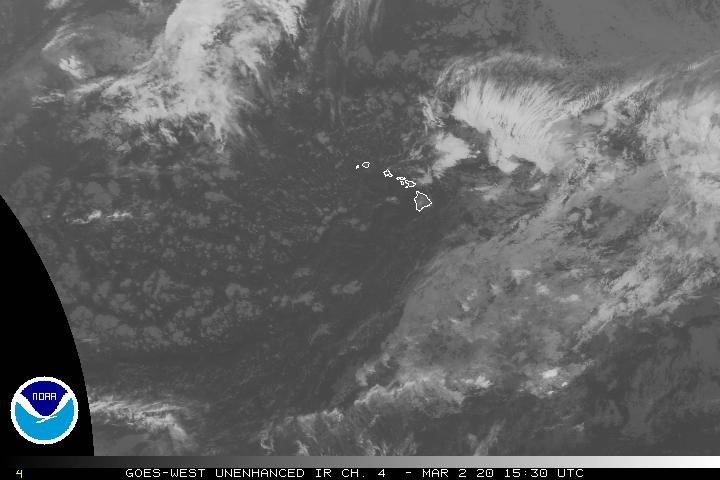
Doug Warne Says:
Gawd — you were gone a long time. Stop leaving. We have abandonment issues.
Selfishly yours,
D.~~~Doug, I hear you, I’ll try and rein myself in…its just that I like cool weather…that’s why I enjoy Kula, Maui so much. Aloha, Glenn
Tim Says:
Welcome back Glenn! I've felt meteorologically naked in your absence, but I'm glad to hear you had a great trip!! As always, thank you for your efforts and I'm keeping my fingers crossed for some substantial leeward showers at soooooome point in the future! ~~~ Hi Tim, naked isn’t a bad thing I suppose, although I know what you mean. I did have a great trip, and by the way, the leeward sides WILL get a good rain storm before too long, guaranteed! Aloha, Glenn
mike Says:
Glenn; You speak highly of the northern California Coast, but heaven is on Maui. As I grow older the warm weather suits me best and I am returning next spring to Maui for the eleventh time…eighth since 2005. Laterly we try to spend 1-2 months there in the spring. Welcome back to paradise! Mike, I love both northern California, likely because of the cool weather, and Hawaii too…for the warm weather. Come on back to paradise, stay warm this winter! Thanks for your note, Aloha, Glenn