











Air Temperatures – The following maximum temperatures were recorded across the state of Hawaii Thursday afternoon:
Lihue, Kauai – 84
Honolulu airport, Oahu – 89
Molokai airport – 85
Kahului airport, Maui – 86
Kona airport – 85
Hilo airport, Hawaii – 83
Air Temperatures ranged between these warmest and coolest spots near sea level – and on the highest mountain tops around the state…as of 530pm Thursday evening:
Honolulu Hawaii – 82
Hana airport, Maui – 75
Haleakala Summit – 48 (near 10,000 feet on Maui)
Mauna Kea Summit – M (near 13,800 feet on the Big Island)
Hawaii’s Mountains – Here’s a link to the live web cam on the summit of near 13,800 foot Mauna Kea on the Big Island of Hawaii. This web cam is available during the daylight hours here in the islands…and when there’s a big moon shining down during the night at times. Plus, during the nights you will be able to see stars, and the sunrise and sunset too…depending upon weather conditions. Here's the Haleakala Crater webcam on Maui…although this webcam is not always working correctly.
Tropical Cyclone activity in the eastern and central Pacific – Here’s the latest weather information coming out of the National Hurricane Center, covering the eastern north Pacific. You can find the latest tropical cyclone information for the central north Pacific (where Hawaii is located) by clicking on this link to the Central Pacific Hurricane Center. A satellite image, which shows the entire ocean area between Hawaii and the Mexican coast…can be found here.
Aloha Paragraphs

Easing wind speeds into Saturday, showers
at times into the weekend, locally heavy…
possible thunderstorms around Kauai, and
leeward Big Island slopes
As this weather map shows, we have a strong near 1034 millibar high pressure system located far to the northeast of the islands. Our local trade winds will be moderately strong and gusty…gradually easing up some into the weekend.
The following numbers represent the most recent top wind gusts (mph), along with directions as of Thursday evening:
31 Lihue, Kauai – NE
32 Kuaokala, Oahu – NE
33 Molokai – NE
36 Kahoolawe – NE
31 Kahului, Maui – NE
31 Lanai – NE
27 South Point, Big Island – NE
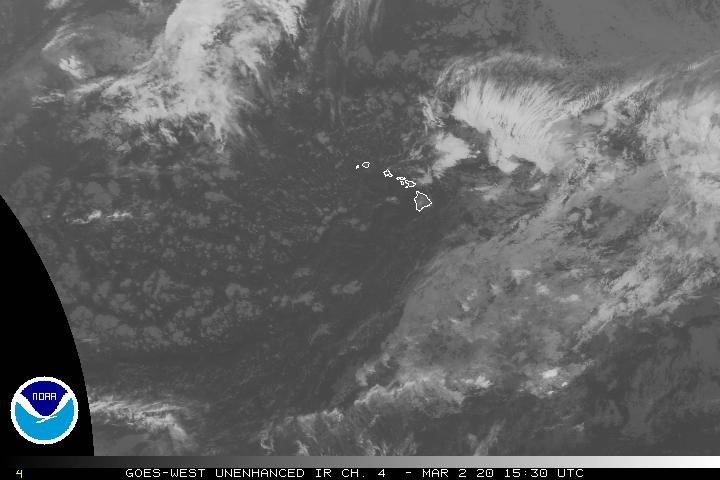
We can use the following links to see what’s going on in our area of the north central Pacific Ocean. Here's the latest NOAA satellite picture – the latest looping satellite image…and finally the latest looping radar image for the Hawaiian Islands.
Here are the latest 24-hour precipitation totals (inches) for each of the islands as of Thursday evening:
1.07 Mount Waialeale, Kauai
0.20 Wilson Tunnel, Oahu
0.04 Molokai
0.00 Lanai
0.00 Kahoolawe
1.62 Puu Kukui, Maui
0.24 Hilo airport, Big Island
~~ Hawaii Sunset Commentary ~~
Our trade winds will gradually turn lighter through the first part of the weekend…and then strengthen Sunday into early next week. The NWS forecast office in Honolulu has canceled the small craft wind advisory over those marine zones around Maui County and the Big Island. We find a rather strong near 1034 millibar high pressure system (weather map), located far to the northeast of the islands Thursday evening. Windward showers will fall locally…although not many at the moment. The forecast is still calling for increased showers over the Kauai end of the state later Friday into Saturday. There will also be a chance that the moisture associated with former tropical cyclone Ileana…may bring tropical showers to the eastern parts of the state later this coming weekend too. As Monday rolls around, a fairly typical trade wind weather pattern will return into the new work week ahead.
Here in Kula, Maui at 525pm Thursday evening, it was partly to mostly cloudy, with a light shower…and an air temperature of 69.4F degrees. As an upper level trough of low pressure moves into the area west and northwest of Kauai, our local winds will trend downwards in strength Friday into Saturday. These winds will likely veer around to the east-southeast or even southeast…becoming light and variable in some locations through Saturday. This of course implies that we could see some volcanic haze shifting from the Big Island vents…over Maui County perhaps. This trough will make Kauai more shower prone, and perhaps Oahu as well, for a few days starting tomorrow into Saturday. Then, as noted above, an area of tropical moisture may move into the state on the southeast breezes later this weekend as well. We'll have to keep an eye on how all of this pans out, and make fine adjustments as we move into the weekend.
As we look at this satellite image, it shows patches of low clouds upstream of the windward sides of the islands. These lower level clouds will bring a few off and on passing windward showers locally tonight into Friday. At the same time, we see an area of high cirrus clouds moving over Kauai. If we switch to this larger satellite view, we can see this area of high and middle level clouds to our west and northwest…associated with the upper level trough of low pressure mentioned above. ~~~ In sum, our winds will become lighter over the next several days, and windward showers arriving at times. As the trough of low pressure to our northwest gets even closer, we should see an increase in showers around Kauai and Oahu…some of which could be quite generous here and there. Then, yet another possible increase in clouds and showers later this weekend, when the moisture from an old tropical cyclone (Ileana), that was active in the eastern Pacific, may move towards us from the east and southeast on Sunday. Monday onwards looks like a return to our more normal late summer weather conditions. I'll be back early Friday morning with your next new weather narrative, I hope you have a great Thursday night wherever you happen to be spending it! Aloha for now…Glenn.
World-wide tropical cyclone activity:
Atlantic Ocean/Caribbean Sea: Tropical storm Leslie (12L) is active in the Atlantic…located 410 miles south-southeast of Bermuda. Sustained winds were 70 mph, nearly stationary. Here's the NHC graphical track map for Leslie, and a satellite image. Here's the hurricane models output for this storm. There are no land areas in the projected path of this tropical cyclone at the moment…although Bermuda will see Leslie moving by to the east later this weekend. High surf, gusty winds, and rain may impact Bermuda, although the storm's path continued to edge more to the easat of Bermuda as time goes on. High surf is pounding the east coast of the United States in places too.
Meanwhile, Hurricane Michael (13L) remains active in the central Atlantic. It's located about 930 miles west-southwest of the Azores, moving northwest at only 3 mph…with sustained winds of 105 mph…making it a category 2 hurricane. Here's the NHC graphical, track map. Here's what the hurricane models are showing.
Here's a satellite image showing storm Leslie, and hurricane Michael above…and the disturbance noted below.
Gulf of Mexico: There are no active tropical cyclones
An area of low pressure remains active over the north-central Gulf of Mexico. It has a low 20% chance of developing during the next 48 hours.
Eastern Pacific Ocean: There are no active tropical cyclones
Central Pacific Ocean: There are no active tropical cyclones
Western Pacific Ocean: There are no active tropical cyclones
South Pacific Ocean: There are no active tropical cyclones
North and South Indian Oceans: There are no active tropical cyclones
Interesting: From regulating climate systems to offering food and medicines, to being home to many plants, animals, and indigenous people, rainforests are not only a local ecosystem but their benefits extend globally. Adding to its effects is new research that shows rainforests have a huge impact on rainfall. A team from the University of Leeds and the NERC Center for Ecology & Hydrology found that air passing over tropical forests produces at least twice as much rain as air passing over little vegetation and can impact rainfall thousands of miles away.
Scientists have long debated whether vegetation increases rainfall. When it comes to the water cycle, plants absorb rainfall, and then put moisture back into the air through evaporation and transpiration, replenishing water molecules that will be used for precipitation. However, the quantity and geographical reach of the rainfall generated by large forests has been unclear until now.
Lead author Dr Dominick Spracklen from the School of Earth and Environment at the University of Leeds said: ''We were surprised to find that this effect occurs strongly across more than half of the tropics. We found that the Amazon and Congo forests maintain rainfall over the periphery of the forest basins – regions where large numbers of people live and rely on rainfall for their livelihoods.''
Researchers used NASA satellite observations of rainfall and vegetation, along with a model that predicts atmospheric wind flow patterns, to explore the impact of the Earth’s tropical forests. The team studied the air masses route over the forest and noted the amount of leaf cover it passed in addition to the amount of vegetation it was over when it rained.
They concluded that the more vegetation the air had traveled over, the more moisture it carried and the more rain was produced. Researchers estimate that deforestation of tropical forests would reduce rain across the Amazon basin by up to 21 percent in the dry season by 2050. This will have significant effects on farmers in outlying regions near the Amazon and Congo forests and others whose livelihood depends on rainfall.
The results of this study put emphasis on the fact that deforestation can have a significant effect on tropical rainfall and therefore needs to be curtailed to lessen the impact. Dr Stephen Arnold from the University of Leeds, a co-author on the paper, said: ''This has significant implications for how policy makers should consider the environmental impacts of deforestation, since its effects on rainfall patterns may be felt not only locally, but on a continental scale.''
 Email Glenn James: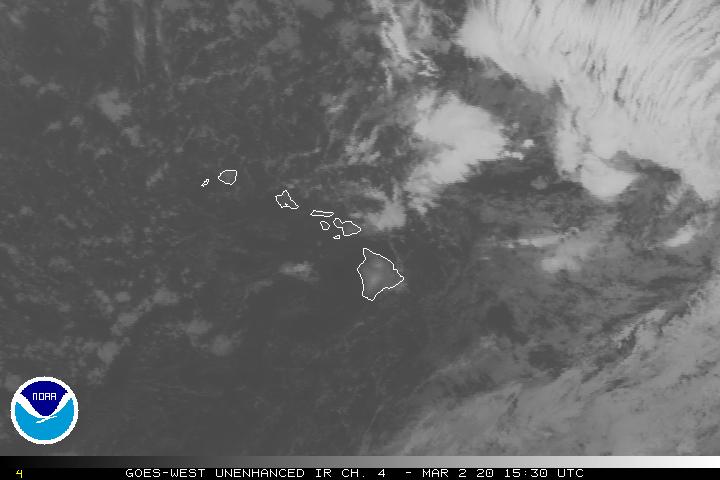



mark albers Says:
A loha Glenn…! what a GREAT photo today …! please tell me where that is ? Looks like 3D Tahiti…!
Mahalo & keep up the GREAT work….!
mark albers : omwao@cox.net~~~Hi Mark, I totally agree, that is a great shot. I don’t know exactly, although I thought it was along the north shore of Kauai myself. Thanks for checking in, Aloha, Glenn