Air Temperatures – The following maximum temperatures were recorded across the state of Hawaii Wednesday afternoon:
Lihue, Kauai – 84
Honolulu airport, Oahu – 86
Molokai airport – 84
Kahului airport, Maui – 86
Kona airport – 85
Hilo airport, Hawaii – 80
Air Temperatures ranged between these warmest and coolest spots near sea level – and on the highest mountain tops around the state…as of 530pm Wednesday evening:
Barking Sands, Kauai – 85
Hilo, Hawaii – 75
Haleakala Summit – 54 (near 10,000 feet on Maui)
Mauna Kea Summit – M (near 13,800 feet on the Big Island)
Hawaii’s Mountains – Here’s a link to the live web cam on the summit of near 13,800 foot Mauna Kea on the Big Island of Hawaii. This web cam is available during the daylight hours here in the islands…and when there’s a big moon shining down during the night at times. Plus, during the nights you will be able to see stars, and the sunrise and sunset too…depending upon weather conditions. Here's the Haleakala Crater webcam on Maui…although this webcam is not always working correctly.
Tropical Cyclone activity in the eastern and central Pacific – Here’s the latest weather information coming out of the National Hurricane Center, covering the eastern north Pacific. You can find the latest tropical cyclone information for the central north Pacific (where Hawaii is located) by clicking on this link to the Central Pacific Hurricane Center. A satellite image, which shows the entire ocean area between Hawaii and the Mexican coast…can be found here.
Aloha Paragraphs

Easing trade winds Thursday into the weekend…
windward showers and elsewhere at times…
into the weekend
As this weather map shows, we have a strong near 1035 millibar high pressure system located far to the northeast of the islands. Our local trade winds will be moderately strong and gusty…gradually easing up some Thursday into the weekend.
The following numbers represent the most recent top wind gusts (mph), along with directions as of Wednesday evening:
30 Lihue, Kauai – NE
35 Kuaokala, Oahu – NE
30 Molokai – NE
35 Kahoolawe – NE
36 Kahului, Maui – NE
32 Lanai – NE
28 South Point, Big Island – NE
We can use the following links to see what’s going on in our area of the north central Pacific Ocean. Here's the latest NOAA satellite picture – the latest looping satellite image…and finally the latest looping radar image for the Hawaiian Islands.
Here are the latest 24-hour precipitation totals (inches) for each of the islands as of Wednesday evening:
1.37 Mount Waialeale, Kauai
0.63 Manoa Lyon Arboretum, Oahu
0.25 Molokai
0.01 Lanai
0.00 Kahoolawe
1.82 Puu Kukui, Maui
0.55 Kawainui Stream, Big Island
~~ Hawaii Sunset Commentary ~~
Our trade winds will gradually turn lighter Thursday through most of the weekend. The NWS forecast office in Honolulu is keeping the small craft wind advisory over just those marine zones around Maui County and the Big Island. We find a rather strong, near 1036 millibar high pressure system (weather map) located far to the northeast of the islands Wednesday evening. Windward showers will fall later tonight into early Thursday morning…becoming drier during the day. The models are still showing increased showers over the Kauai end of the state later Thursday into Sunday. There will also be a chance that the moisture associated with former tropical cyclone Ileana, may bring tropical showers to the state this weekend too…stay tuned.
Here in Kula, Maui at 645pm Wednesday evening, it was clear to partly cloudy and near calm…with an air temperature of 75.4F degrees. As a trough of low pressure moves into the area west of Kauai, our local winds will trend downwards in strength starting Thursday…into the weekend. Depending on how things work out, these winds may veer around to the east-southeast or even southeast…or could even become light and variable in some locations by the weekend. This of course implies that we could see some volcanic haze shifting from the Big Island vents…over other areas in the chain with time. This trough will make Kauai more shower prone too, for a few days starting later tomorrow into Saturday. Then, as noted above, an area of tropical moisture may move into the state on the southeast breezes this weekend as well. This could provide showers to a broader area of the state. We'll have to keep an eye on how all of this pans out over the next day or two.
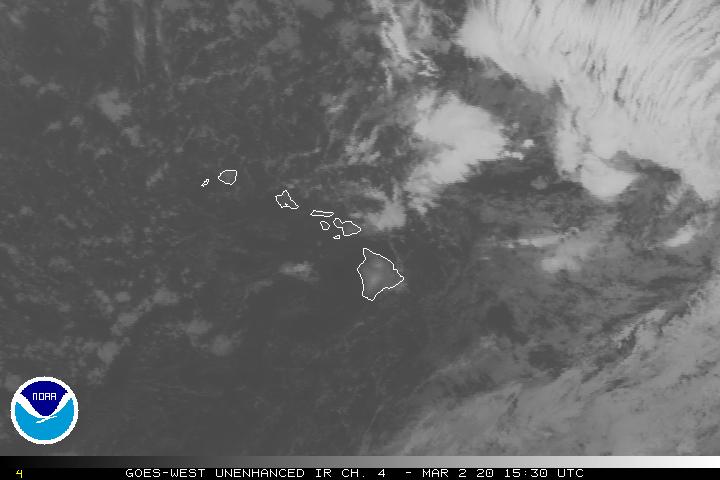
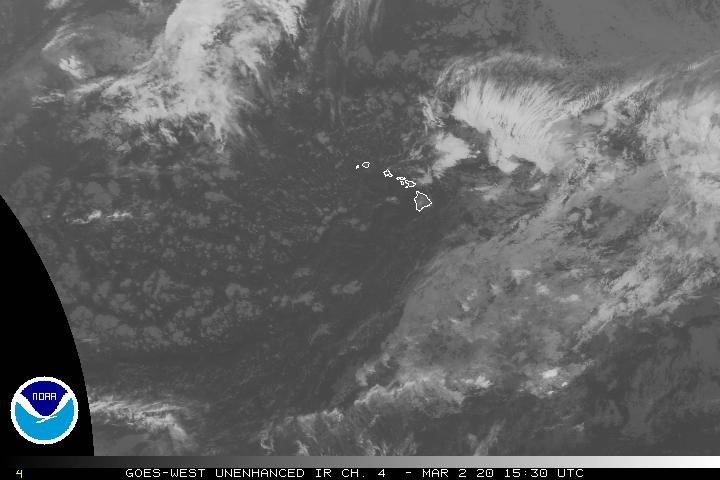
As we look at this satellite image, it shows bands and patches of low clouds upstream of the windward sides of the islands. These lower level clouds will bring off and on passing windward showers tonight into the early morning hours. At the same time, we see an area of high cirrus clouds moving over the eastern islands from the southwest. If we switch to this larger satellite view, we can see this large area of high clouds, and another far to our northwest…associated with that trough of low pressure mentioned above. ~~~ In sum, gusty trade winds easing up over the next several days, and windward showers arriving at times. As the trough of low pressure to our northwest gets closer, we should see an increase in showers around Kauai and perhaps Oahu. Then, yet another possible increase in clouds and showers this weekend, when the moisture from an old tropical cyclone, that was active in the eastern Pacific, moves towards us from the east and southeast. I'll be back early Thursday morning with your next new weather narrative from paradise! I hope you have a great Wednesday night wherever you're spending it! Aloha for now…Glenn.
World-wide tropical cyclone activity:
Atlantic Ocean/Caribbean Sea: Hurricane Leslie (12L) is active in the Atlantic…located 430 miles south-southeast of Bermuda. Sustained winds were 75 mph, moving north at a very slow 2 mph. Here's the NHC graphical track map for category 1 hurricane Leslie, and a satellite image. Here's the hurricane models output for this storm. There are no land areas in the projected path of this tropical cyclone at the moment…although Bermuda may see Leslie moving by to the east later this weekend.
Meanwhile, Hurricane Michael (13L) remains active in the central Atlantic. It's located about 980 miles west-southwest of the Azores, moving northeast at 7 mph…with sustained winds of 115 mph..making it a category 3 major hurricane. Here's the NHC graphical, track map. Here's what the hurricane models are showing.
Here's a satellite image showing hurricane Leslie…and hurricane Michael.
Gulf of Mexico: There are no active tropical cyclones
An area of low pressure remains over the north-central Gulf of Mexico. It has a medium 40% chance of developing during the next 48 hours.
Here's a satellite image showing Leslie, Michael and this tropical disturbance noted above.
Eastern Pacific Ocean: There are no active tropical cyclones
Central Pacific Ocean: There are no active tropical cyclones
Western Pacific Ocean: There are no active tropical cyclones
South Pacific Ocean: There are no active tropical cyclones
North and South Indian Oceans: There are no active tropical cyclones
Interesting: The Union of Concerned Scientists (UCS) has recently released a report, "Wood for Good: Solutions for Deforestation-Free Wood Products," analyzing tropical wood production’s effect on deforestation and offering solutions for sustainable production. According to the report, governments and businesses must begin using sustainably established plantation forests to minimize the toll logging is taking on tropical forests.
Many of the products used every day by American businesses and consumers are made from tropical wood, including paper, furniture, building material and shipping supplies. The destruction of virginal tropical forests for forestry products should be replaced with sustainable and repeatable plantation forests.
A tropical rainforest is an ecosystem type that occurs roughly within the latitudes 28 degrees north or south of the equator (in the equatorial zone between the Tropic of Cancer and Tropic of Capricorn). This ecosystem experiences high average temperatures and a significant amount of rainfall.
Tropical rainforests are unique[citation needed] in the high levels of biodiversity they exhibit. Around 40% to 75% of all biotic species are indigenous to the rainforests. Rainforests are home to half of all the living animal and plant species on the planet. Two-thirds of all flowering plants can be found in rainforests.
A single hectare of rainforest may contain 42,000 different species of insect, up to 807 trees of 313 species and 1,500 species of higher plants. "The demand for tropical wood is growing globally, while more and more of the world’s tropical forests are disappearing," said Pipa Elias, UCS consultant and the report’s author. "It is 100 percent possible to harvest timber in the tropics profitably and sustainably.
The main roadblock is a lack of political will. Businesses and consumers must demand responsibly manufactured products giving governments and wood producers an incentive to expand sustainability efforts." The report outlines a threefold solution.
Firstly, wood producers and businesses should turn to responsible plantation forests to harvest wood. Plantation forests established on previously degraded lands should be used for wood production and sustainable forest management practices — such as protecting water and wildlife — should be followed. Plantations forests tend to grow faster than timber in natural forests and more of the wood can be harvested. Using already-cleared areas would help meet market demand for wood, while protecting primary forests.
Secondly, the report also calls on governments to institute policies that make sustainable forest management practice attractive to businesses. Finally, governments, businesses and consumers should demand products certified by programs such as the Forest Stewardship Council and the Programme for the Endorsement of Forest Certification.
While these programs do not prohibit logging from old growth forests, they are the best option currently available for maintaining the profitability of the wood industry while protecting forests. "Consumers certainly have an important role to play in safeguarding tropical forests," said Elias. "Small, everyday choices like recycling and reducing the demand for new wood absolutely help to protect tropical forests."
In addition to purchasing products that were made, packaged and transported using sustainably sourced wood, decreasing paper use at home helps reduce demand, Elias said. Consumers should buy in bulk to reduce packaging waste, swap paper towels for washcloths, pay bills electronically, and request to be removed from unwanted mailing lists.
Tropical forests are not only home to plants, animals and indigenous communities, but these habitats also purify air and water, and provide food and medicine for millions of people. Cutting down natural forests also contributes to climate change. Tropical deforestation is responsible for about 15 percent of the world’s heat-trapping emissions — more carbon pollution than the emissions from every car, truck, plane, ship and train on Earth.
"Tropical forests should be filled with the sound of howling monkeys and chirping birds, but when these resources are unmanaged, such sounds are replaced with buzzing chainsaws and falling trees," said Elias. "To reverse the damage caused by deforestation, governments and businesses must work together to integrate sustainability and profitability."
 Email Glenn James: