











Air Temperatures – The following maximum temperatures were recorded across the state of Hawaii Tuesday afternoon:
Lihue, Kauai – 84
Honolulu airport, Oahu – 87
Molokai airport – 86
Kahului airport, Maui – 88
Kona airport – 85
Hilo airport, Hawaii – 82
Air Temperatures ranged between these warmest and coolest spots near sea level – and on the highest mountain tops around the state…as of 810pm Tuesday evening:
Barking Sands, Kauai – 82
Hilo, Hawaii – 72
Haleakala Summit – 48 (near 10,000 feet on Maui)
Mauna Kea Summit – M (near 13,800 feet on the Big Island)
Hawaii’s Mountains – Here’s a link to the live web cam on the summit of near 13,800 foot Mauna Kea on the Big Island of Hawaii. This web cam is available during the daylight hours here in the islands…and when there’s a big moon shining down during the night at times. Plus, during the nights you will be able to see stars, and the sunrise and sunset too…depending upon weather conditions. Here's the Haleakala Crater webcam on Maui…although this webcam is not always working correctly.
Tropical Cyclone activity in the eastern and central Pacific – Here’s the latest weather information coming out of the National Hurricane Center, covering the eastern north Pacific. You can find the latest tropical cyclone information for the central north Pacific (where Hawaii is located) by clicking on this link to the Central Pacific Hurricane Center. A satellite image, which shows the entire ocean area between Hawaii and the Mexican coast…can be found here.
Aloha Paragraphs

Gusty trade winds, easing up Thursday into the
weekend…windward showers at night /possible
more widespread increase locally Thursday-Sunday
Nice Sunrise Wednesday morning!
As this weather map shows, we have a strong near 1035 millibar high pressure system located far to the northeast of the islands. Our local trade winds will be moderately strong and gusty…gradually easing up some Friday into the weekend.
The following numbers represent the most recent top wind gusts (mph), along with directions as of Tuesday evening:
25 Port Allen, Kauai – NE
35 Kuaokala, Oahu – NE
30 Molokai – NE
37 Kahoolawe – ESE
35 Kahului, Maui – NE
31 Lanai – NE
29 Waikoloa, Big Island – NE
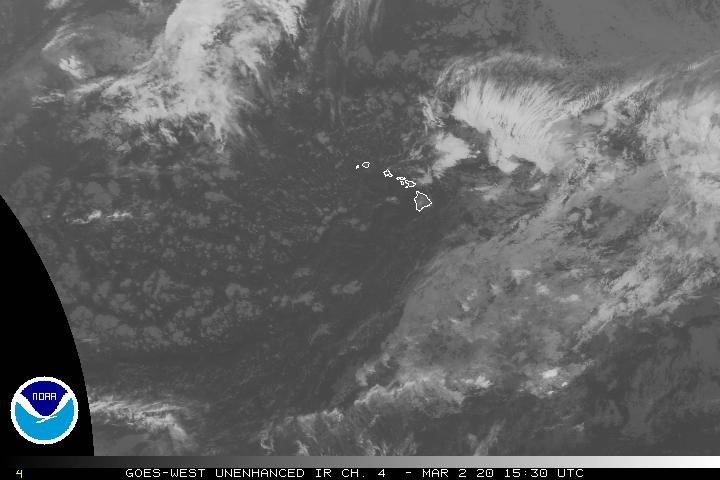
We can use the following links to see what’s going on in our area of the north central Pacific Ocean. Here's the latest NOAA satellite picture – the latest looping satellite image…and finally the latest looping radar image for the Hawaiian Islands.
Here are the latest 24-hour precipitation totals (inches) for each of the islands as of Tuesday evening:
0.55 Kilohana, Kauai
0.08 Luluku, Oahu
0.07 Molokai
0.00 Lanai
0.00 Kahoolawe
0.02 Haiku, Maui
0.19 Glenwood, Big Island
~~ Hawaii Sunset Commentary ~~
Our trade winds will remain rather strong and gusty, at least locally here in the islands…and then gradually turn lighter Thursday through Saturday. The NWS forecast office in Honolulu is continuing the small craft wind advisory over all of the marine zones around the state. We find a rather strong, near 1035 millibar high pressure system (weather map) located far to the northeast of the islands Tuesday evening…as the source of this quick paced trade flow. Windward showers will fall tonight and then again later Wednesday night into Thursday. The models are showing increased showers over the western islands Thursday into Saturday, with the chance that the moisture associated with former tropical cyclone in the eastern Pacific, called Ileana, may bring tropical showers to the state this weekend too…state tuned.
Here in Kula, Maui at 625pm Tuesday evening, it was clear to partly cloudy and near calm…with an air temperature of 71.6F degrees. The trades are forecast to continue across our islands through mid-week. These trade winds will blow generally in the moderately strong realms, although there will be those stronger gusts at times. As a trough of low pressure edges in our direction in a few days, our local winds will trend downwards in strength starting Thursday…into the upcoming weekend. Depending on how things work out, they may veer around to the east-southeast or even southeast. This will occur because of a trough of low pressure moving into the area just west of the state, which is unusual for this time of year.
As we look at this satellite image, it shows bands of low clouds upstream of the windward sides of the islands. These lower level clouds will bring off and on passing windward showers over the next few days…mostly during the night and morning hours. At the same time, we see an area of high cirrus clouds just to the south of the state, which is now edging up over the Big Island, and I can now see them in the skies here on Maui too. If we switch to this larger satellite view, we can see this large area of high clouds to the south, and another far to our west as well. In sum, gusty trade winds easing up starting Thursday, windward showers arriving at times during the nights, especially Thursday night. As a trough of low pressure arrives later this week, we may see a more pronounced increase in showers along our windward sides, and perhaps elsewhere too. I'll be back early Wednesday morning with your next new weather narrative. I hope you have a great Tuesday night wherever you're spending it! Aloha for now…Glenn.
World-wide tropical cyclone activity:
Atlantic Ocean/Caribbean Sea: Tropical storm Leslie (12L) is active in the tropical Atlantic…located 470 miles south-southeast of Bermuda. Sustained winds were 70 mph, moving north at a very slow 2 mph. Here's the NHC graphical track map for Leslie, and a satellite image. Here's the hurricane models output for this storm. Look for Leslie to become a hurricane later today. There are no land areas in the projected path of this tropical cyclone at the moment…although Bermuda may see Leslie move very near, or right overhead later this weekend.
Meanwhile, tropical storm Michael (13L) remains active in the central Atlantic. It's located about 1155 miles west-southwest of the Azores, moving northeast at 6mph…with sustained winds of 50 mph. Here's the NHC graphical, track map. Here's what the hurricane models are showing.
Here's a satellite image showing tropical storm Leslie…and tropical storm Michael.
Gulf of Mexico: There are no active tropical cyclones
An area of low pressure along the coast of the western Florida panhandle, is expected to move generally southward into the north-central Gulf of Mexico later today. Environmental conditions appear marginally conducive for slow development of this disturbance once it moves over the Gulf. It has a low 20% chance of developing during the next 48 hours.
Here's a satellite image showing Leslie, Michael and this tropical disturbance noted above.
Eastern Pacific Ocean: There are no active tropical cyclones
Central Pacific Ocean: There are no active tropical cyclones
Western Pacific Ocean: There are no active tropical cyclones
South Pacific Ocean: There are no active tropical cyclones
North and South Indian Oceans: There are no active tropical cyclones
Interesting: Scientists say this year's record declines in Arctic sea ice extent and volume are powerful evidence that the giant cap of ice at the top of the planet is on a trajectory to largely disappear in summer within a decade or two, with profound global consequences. As the northern summer draws to a close, two milestones have been reached in the Arctic Ocean — record-low sea ice extent, and an even more dramatic new low in Arctic sea ice volume.
This extreme melting offers dramatic evidence, many scientists say, that the region’s sea ice has passed a tipping point and that sometime in the next decade or two the North Pole will be largely ice-free in summer. NASA and U.S. ice experts announced earlier this week that the extent of Arctic sea ice has dropped to 1.58 million square miles — breaking the previous record set in 2007 — and will likely continue to fall even farther until mid-September.
As the summer melt season ends, the Arctic Ocean will be covered with 45 percent less ice than the average from 1979 to 2000. Even more striking is the precipitous decline in the volume of ice in the Arctic Ocean. An analysis conducted by the University of Washington’s Pan Arctic Ice Ocean Model Assimilation System (PIOMAS) estimates that sea ice volumes fell in late August to roughly 3,500 cubic kilometers — a 72-percent drop from the 1979-2010 mean.
Peter Wadhams, who heads the Polar Ocean Physics Group at the University of Cambridge and who has been measuring Arctic Ocean ice thickness from British Navy submarines, says that earlier calculations about Arctic sea ice loss have grossly underestimated how rapidly the ice is disappearing. He believes that the Arctic is likely to become ice-free before 2020 and possibly as early as 2015 or 2016 — decades ahead of projections made just a few years ago.
Mark Drinkwater, mission scientist for the European Space Agency’s CryoSat satellite and the agency’s senior advisor on polar regions, said he and his colleagues have been taken aback by the swiftness of Arctic sea ice retreat in the last 5 years. “If this rate of melting [in 2012] is sustained in 2013, we are staring down the barrel and looking at a summer Arctic which is potentially free of sea ice within this decade,” Drinkwater said in an e-mail interview.
 Email Glenn James: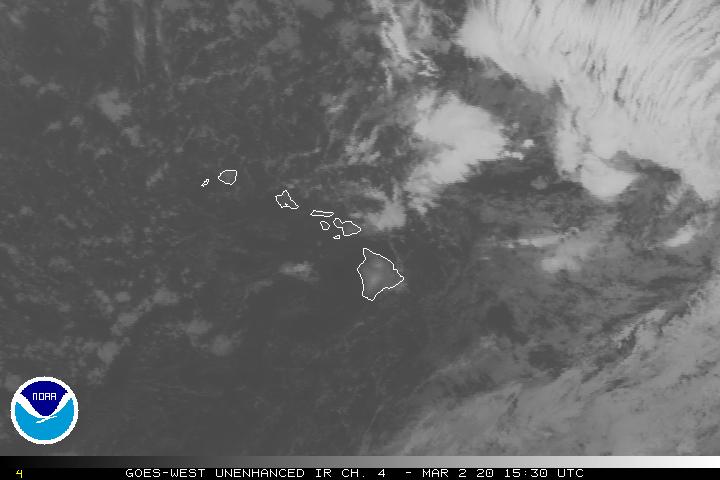



peter mac Says:
But no mention of climate change in the Presidential campaign.~~~ Hi Peter, I guess that’s a hot potato! Aloha, Glenn
Kashika Vohra Says:
This design is wicked! You definitely know how to keep a reader entertained.
Between your wit and your videos, I was almost moved
to start my own blog (well, almost…HaHa!
) Excellent job. I really enjoyed what you had to say, and more
than that, how you presented it. Too cool! ~~~ Hi Kashika, well…that’s quite a positive comment, thanks. Aloha, Glenn