











Air Temperatures – The following maximum temperatures were recorded across the state of Hawaii Monday afternoon:
Lihue, Kauai – 85
Honolulu airport, Oahu – 87
Molokai airport – 84
Kahului airport, Maui – 87
Kona airport – 85
Hilo airport, Hawaii – 84
Air Temperatures ranged between these warmest and coolest spots near sea level – and on the highest mountain tops around the state…as of 730pm Monday evening:
Barking Sands, Kauai – 81
Hilo, Hawaii – 75
Haleakala Summit – 50 (near 10,000 feet on Maui)
Mauna Kea Summit – M (near 13,800 feet on the Big Island)
Hawaii’s Mountains – Here’s a link to the live web cam on the summit of near 13,800 foot Mauna Kea on the Big Island of Hawaii. This web cam is available during the daylight hours here in the islands…and when there’s a big moon shining down during the night at times. Plus, during the nights you will be able to see stars, and the sunrise and sunset too…depending upon weather conditions. Here's the Haleakala Crater webcam on Maui…although this webcam is not always working correctly.
Tropical Cyclone activity in the eastern and central Pacific – Here’s the latest weather information coming out of the National Hurricane Center, covering the eastern north Pacific. You can find the latest tropical cyclone information for the central north Pacific (where Hawaii is located) by clicking on this link to the Central Pacific Hurricane Center. A satellite image, which shows the entire ocean area between Hawaii and the Mexican coast…can be found here.
Aloha Paragraphs

Gusty trade winds, a few
windward showers at times
Red flag warning leeward areas: elevated
fire danger today through 6pm
As this weather map shows, we have moderately strong near 1032 millibar high pressure systems located far to the northeast of the islands. Our local trade winds will be moderately strong and gusty…gradually easing up some Friday into the weekend.
The following numbers represent the most recent top wind gusts (mph), along with directions as of Monday evening:
35 Lihue, Kauai – NE
43 Kuaokala, Oahu – NE
33 Molokai – NE
39 Kahoolawe – NE
40 Kahului, Maui – NE
35 Lanai – NE
36 PTA Keamuku, Big Island – NE
We can use the following links to see what’s going on in our area of the north central Pacific Ocean. Here's the latest NOAA satellite picture – the latest looping satellite image…and finally the latest looping radar image for the Hawaiian Islands.
Here are the latest 24-hour precipitation totals (inches) for each of the islands as of Monday afternoon:
0.63 Mount Waialeale, Kauai
0.35 Wheeler Airfield, Oahu
0.20 Molokai
0.01 Lanai
0.00 Kahoolawe
0.29 Puu Kukui, Maui
0.45 Waiakea Uka, Big Island
~~ Hawaii Sunset Commentary ~~
Our trade winds will continue to be the primary weather influence here in the islands over the next few days…and then gradually turn a bit lighter Thursday into the upcoming weekend. The NWS forecast office in Honolulu is continuing the small craft wind advisory over all of the marine zones around the state, as the trade winds remain rather strong and gusty. We find moderately strong, near 1032 millibar high pressure systems (weather map) located to the northeast of the islands Monday evening…as the source of this quick paced trade flow. Windward showers will fall at times into Tuesday…with a few traveling over into the leeward areas here and there on the gusty trades.
Here in Kula, Maui at 520pm Monday evening, it was clear to partly cloudy and lightly breezy…with an air temperature of 77.7F degrees. The trades are forecast to continue across our islands through the new week at least. These trade winds will blow generally in the moderately strong realms, although there will be those stronger gusts at times. These trades were gusting up to 40+ mph in a few of those windier locations around Maui County and the Big Island Monday…and may do so again during the day Tuesday.
If we look at this satellite image, it shows a fairly minor amount of low clouds surrounding the islands…mostly offshore. These lower level clouds will bring a few passing showers over the next few days…perhaps increasing somewhat later this week into the weekend. At the same time, we see areas of high cirrus clouds in some directions. We've been having some nice sunrise and sunset colors lately, and as long as these high icy clouds remain in our vicinity, they may bring more color our way. In sum, gusty trade winds, and not many showers for the time being, evening along our windward sides. I'll be back early Tuesday morning with your next new weather narrative, I hope you have a great Monday night! Aloha for now…Glenn.
World-wide tropical cyclone activity:
Atlantic Ocean/Caribbean Sea: Tropical storm Leslie (12L) is active in the tropical Atlantic…located 525 miles south-southeast of Bermuda. Sustained winds were 65 mph, moving north at a very slow 3 mph. Here's the NHC graphical track map for Leslie, and a satellite image. Here's the hurricane models output for this storm. Look for Leslie to become a hurricane within 48-72 hours or so. Leslie will move in a generally northward direction, later in the forecast cycle, it will be attaining hurricane strength early Friday. There are no land areas in the projected path of this tropical cyclone at the moment…although Bermuda may see a very close pass from Leslie later this weekend.
Meanwhile, tropical storm Michael (13L) remains active in the central Atlantic. It's located about 1220 miles southwest of the Azores. It's moving north-northwest at a slow 5 mph, with sustained winds of 40 mph. This storm isn't expected to attain hurricane status. Here's the NHC graphical, track map. Here's what the hurricane models are showing.
Here's a satellite image showing tropical storm Leslie…and tropical storm Michael.
Gulf of Mexico: There are no active tropical cyclones
Eastern Pacific Ocean: Tropical depression John (10E) remains active, and is quickly weakening in the eastern north Pacific, located about 420 miles west of the southern tip of Baja, California. It has 35 mph sustained winds, and is moving northwest at 14 mph. Here's the NHC graphical track map, along with a satellite image of this storm. John is expected to become a remnant low pressure later today. There will be no threat to Mexico from this system.
Here's a satellite image showing tropical depression John (10E).
Central Pacific Ocean: There are no active tropical cyclones
Western Pacific Ocean: There are no active tropical cyclones
South Pacific Ocean: There are no active tropical cyclones
North and South Indian Oceans: There are no active tropical cyclones
Interesting: Increased capture of natural gas from oil fields probably accounts for up to 70 percent of the dramatic leveling off seen in atmospheric methane at the end of the 20th century, according to new UC Irvine research being published in the journal Nature. "We can now say with confidence that, based on our data, the trend is largely a result of changes in fossil fuel use," said chemistry professor Donald Blake, senior author on the paper.
Methane has 20 times the global warming potential of carbon dioxide, although CO2 is filling the atmosphere in far larger amounts. After decades of increases due to worldwide industrial and agricultural activity, the tapering off of methane from the 1980s through 2005 was remarkable.
Scientists have long wrestled with the cause. Blake and his team, who have conducted the world's longest continuous methane and ethane sampling, said close scrutiny of their data shows that the major factor was most likely the trapping and sale of natural gas for use as a fuel source, which sharply reduced the skyward venting and flaring of methane from oil fields. Methane is the main ingredient in natural gas.
"It used to just be burned off as a waste product," said lead author Isobel Simpson, a UCI research associate. "The reason this is important is because methane is a potent greenhouse gas, second in importance only to carbon dioxide. We can't make real progress on climate change without tackling carbon dioxide, but bringing methane under control would certainly help."
 Email Glenn James: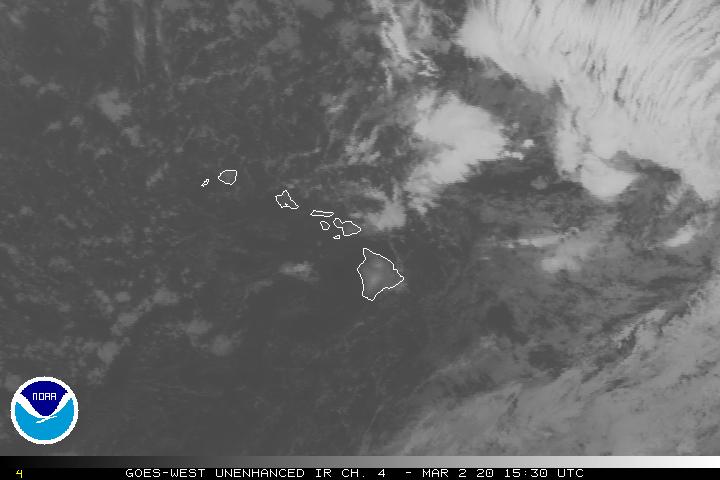


Nancy Says:
Aloha Glenn,
Thought you might like this blog post from photojournalist Kent Porter. http://weather.blogs.pressdemocrat.com/13413/cloud-nine/ ~~~ Hi Nancy, thanks for forwarding these cool pictures, great stuff! Aloha, Glenn
Bill Alpenfels Says:
Aloha Glenn
I enjoy your website most every day. Why is there often a broad arc of rain just south of the big island?~~~Hi Bill, thanks for letting me know you like my website! That arc is actually the low beam of the radar picking up salt spray in the gusty trade winds. Good question, Aloha, Glenn