











Air Temperatures – The following maximum temperatures were recorded across the state of Hawaii Thursday afternoon:
Lihue, Kauai – 84
Honolulu airport, Oahu – 86
Molokai airport – 84
Kahului airport, Maui – 86
Kona airport – 83
Hilo airport, Hawaii – 83
Air Temperatures ranged between these warmest and coolest spots near sea level – and on the highest mountain tops around the state…as of 730pm Thursday evening:
Barking Sands, Kauai – 81
Hilo, Hawaii – 75
Haleakala Summit – 50 (near 10,000 feet on Maui)
Mauna Kea Summit – 37 (near 13,800 feet on the Big Island)
Hawaii’s Mountains – Here’s a link to the live web cam on the summit of near 13,800 foot Mauna Kea on the Big Island of Hawaii. This web cam is available during the daylight hours here in the islands…and when there’s a big moon shining down during the night at times. Plus, during the nights you will be able to see stars, and the sunrise and sunset too…depending upon weather conditions. Here's the Haleakala Crater webcam on Maui…although this webcam is not always working correctly.
Tropical Cyclone activity in the eastern and central Pacific – Here’s the latest weather information coming out of the National Hurricane Center, covering the eastern north Pacific. You can find the latest tropical cyclone information for the central north Pacific (where Hawaii is located) by clicking on this link to the Central Pacific Hurricane Center. A satellite image, which shows the entire ocean area between Hawaii and the Mexican coast…can be found here.
Aloha Paragraphs
One more day of normal trade winds, then
a change towards lighter winds during the
weekend…into early next week
Some afternoon interior showers starting
Saturday… and potentially voggy by Sunday
into early next week
Rough surf south shores Friday…
high surf advisory for those beaches
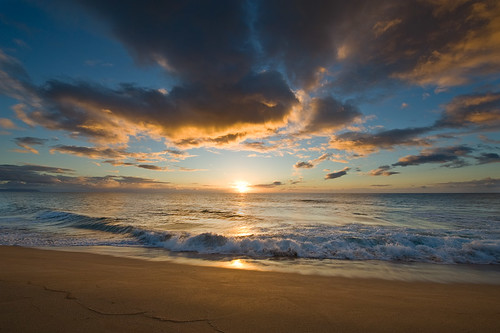
Good sunrise colors some parts of the state Friday
As this weather map shows, we have moderately strong high pressure systems located far to the northwest and to the northeast of the islands. Our local trade winds will be moderately strong, then easing up later Friday into the weekend…into the first half of next week.
The following numbers represent the most recent top wind gusts (mph), along with directions as of Thursday evening:
29 Port Allen, Kauai – NE
33 Kuaokala, Oahu – N
23 Molokai – NE
31 Kahoolawe – NE
33 Kaupo Gap, Maui – N
32 Lanai – NE
35 Pali 2, Big Island – NE
We can use the following links to see what’s going on in our area of the north central Pacific Ocean. Here's the latest NOAA satellite picture – the latest looping satellite image…and finally the latest looping radar image for the Hawaiian Islands.
Here are the latest 24-hour precipitation totals (inches) for each of the islands as of Thursday evening:
0.21 Kilohana, Kauai
0.09 Oahu Forest NWR, Oahu
0.20 Molokai
0.00 Lanai
0.00 Kahoolawe
0.66 Puu Kukui, Maui
1.25 Kawainui Stream, Big Island
~~ Hawaii Sunset Commentary ~~
Our trade winds will remain active through Friday…then turn south to southeast and become lighter Sunday into early next week. We find moderately strong high pressure systems (weather map), located to the northwest through northeast of the islands this evening. There will be off and on showers falling along our windward sides, with just a few elsewhere…mostly during the night and early morning hours. A fairly typical trade wind weather pattern will continue through Friday. A low pressure system, and its associated cold front, will enter our weather picture to the northwest this weekend. It will turn our winds south and southeast into early next week…although the Big Island may still be in a light trade wind flow. We may see the southeast breezes carry volcanic haze over parts of the island chain then. At the same time, aided by daytime heating of the islands…we'll likely see a few afternoon showers in the leeward upcountry areas each afternoon Saturday through next Tuesday or so. The cold front won't quite reach our islands by next Monday, although will come relatively close to Kauai…perhaps close enough to bring a few showers to that island then.
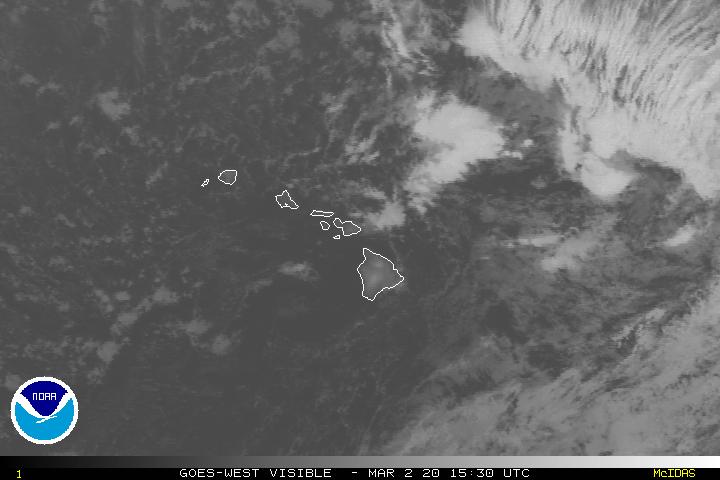
As we look at this satellite image, it shows scattered clouds upwind to the east and northeast, which will bring a few showers our way at times tonight into Friday morning. These lower level clouds will bring a few light showers to our leeward sides, on the smaller islands here and there too. There will be breaks in those clouds, and their off and on passing showers at times. At the same time, there's a swath of high cirrus clouds over the Big Island Maui County too – there will good sunset and sunrise colors around those areas this evening and again early Friday morning too.
Here in Kula, Maui at 545pm Thursday evening, it was partly cloudy with light breezes…with an air temperature of 74.5F degrees. As mentioned above, we'll see windward showers falling at times, mostly during the night and early morning hours. A typical early autumn trade wind weather pattern will continue through Friday. As we get into the weekend, we'll experience a noticeable change in our local weather conditions. Our winds will veer to the south and southeast and become lighter, in response to an area of low pressure to our northwest, with its associated cold front approaching Kauai later Sunday into Monday. These lighter winds, and the daytime heating of the islands, will trigger at least a few afternoon clouds and showers over the upcountry leeward slopes. There's a decent chance of volcanic haze spreading up from the Big Island vents to Maui County, or even further into the chain by Sunday into the first part of next week. This lighter wind regime, with locally hazy skies, afternoon upcountry showers…will prevail perhaps until the middle of next week. I'll be back again early Friday morning with your next new weather narrative, I hope you have a great Thursday night wherever you're spending it! Aloha for now…Glenn.
World-wide tropical cyclone activity:
Atlantic Ocean/Caribbean Sea: Hurricane Nadine remains active, located about 730 miles southwest of the Azores. Sustained winds were 75 mph, moving northwest at 8 mph. Here's the NHC graphical track map, along with the satellite image showing Nadine's position.
Gulf of Mexico: There are no active tropical cyclones
Eastern Pacific Ocean: Tropical storm Norman (14E) is now active off the west coast of Mexico…located about 145 miles west of Mazatlan, Mexico. Sustained winds are 45 mph, moving north at 16 mph. Here's the NHC graphical track map, and a satellite image of Norman.
Central Pacific Ocean: There are no active tropical cyclones
Western Pacific Ocean: Typhoon Jelawat (19W) remains active…located about 290 NM southeast of Tokyo, Japan. This tropical cyclone currently has sustained winds of 110 knots, with gusts to near 135 knots. The JTWC shows Jelawat has peaked in strength, and continues to slowly weaken from here on out. Here's a graphical track map, along with a satellite image.
Tropical storm Ewiniar (19W) is active in the western Pacific…located about 270 NM south-southeast of Tokyo, Japan. Sustained winds are 45 knots, with gusts to near 50 knots. The current JTWC forecast keeps it over the open ocean, away from land through the remainder of its life cycle. Here's the JTWC graphical track map, and a satellite image for Ewiniar.
South Pacific Ocean: There are no active tropical cyclones
North and South Indian Oceans: There are no active tropical cyclones
Interesting: Make a loud enough noise in the Earth and the whole Earth will shake. Large earthquakes can alter seismicity patterns across the globe in very different ways, according to two new studies by U.S. Geological Survey seismologists. Both studies shed light on more than a decade of debate on the origin and prevalence of remotely triggered earthquakes.
Until now, distant but damaging aftershocks have not been included in hazard assessments, yet in each study, changes in seismicity were predictable enough to be included in future evaluations of earthquake hazards. In a study published in this week’s issue of Nature, USGS seismologist Fred Pollitz and colleagues analyzed the unprecedented increase in global seismic activity triggered by the Magnitude-8.6 East Indian Ocean quake of April 11, 2012, and in a recently published study in the Proceedings of the National Academy of Sciences, seismologist Volkan Sevilgen and his USGS colleagues investigated the near-cessation of seismic activity up to 250 miles away caused by the 2004 M9.2 Sumatra earthquake.
While aftershocks have traditionally been defined as those smaller earthquakes that happen after and nearby the main fault rupture, scientists now recognize that this definition is wrong. Instead, aftershocks are simply earthquakes of any size and location anywhere in the world that would not have taken place had the main shock not struck.
An extraordinary number of earthquakes of M4.5 and greater were triggered worldwide in the six days after the M8.6 East Indian Ocean earthquake in April 2012. These large and potentially damaging quakes, occurring as far away as Mexico and Japan, were triggered within days of the passage of seismic waves from the main shock that generated stresses in Earth’s crust.
The East Indian Ocean event was the largest — by a factor of 10 — strike-slip earthquake ever recorded (the San Andreas is perhaps the most famous strike-slip fault). "Most great earthquakes occur along subduction zones and involve large vertical motions. No other recorded earthquake triggered as many large earthquakes elsewhere around the world as this one," said Pollitz, "probably because strike-slip faults around the globe were more responsive to the seismic waves produced by a giant strike-slip temblor."
Another clue in the six days of global aftershocks following the M8.6 quake is that the rate of global quakes during the preceding 6-12 days was extremely low. "Imagine an apple tree, with apples typically ripening and then falling at some steady rate," Stein said. "If a week goes by without any falling, there will be more very ripe apples on the tree. Now shake the trunk, and many more than normal might drop."
While global triggering of large aftershocks appears very rare, regional triggering is common and important to understand for post-main shock emergency response and recovery. Sevilgen and his USGS colleagues studied the largest quake to strike in 40 years to understand just how great the reach is on aftershock occurrence.
After the M9.2 earthquake in Sumatra in 2004, aftershocks larger than M4.5 ceased for five years along part of a distant series of linked faults known as the Andaman back arc fault system. Along a larger segment of the same system, the sideways-slipping transform earthquakes decreased by two-thirds, while the rate of rift events — earthquakes that happen on a spreading center — increased by 800 percent, according to Sevilgen and his colleagues at the USGS.
These very large, but distant seismicity rate changes are unprecedented. Incorporating the probability of aftershocks into the hazard assessment of an area is important because the damage of even a moderate aftershock sometimes exceeds that wrought by the main event. For example, a M6.3 aftershock five months after the M7.1 New Zealand earthquake in 2010 hit a more populated area, causing 181 deaths and tripling the insured property damage of the main event.
 Email Glenn James: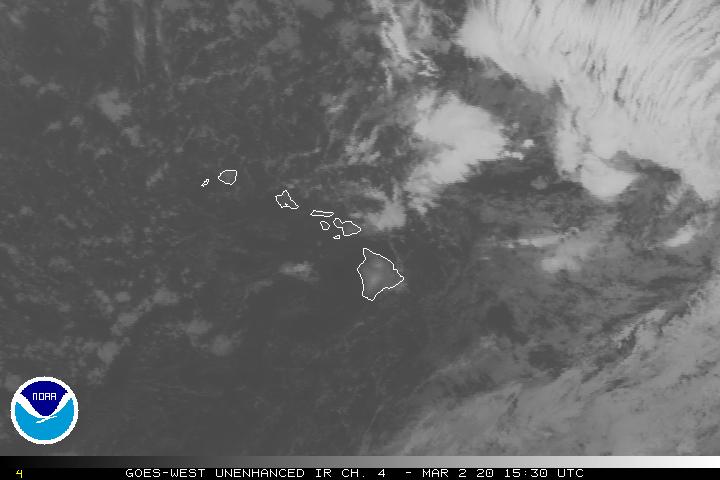



dick cohen Says:
keep an eye out for the disturbance SE of us ~~~ Hi Dick, I see that spot of convection to the south-southeast of the Big Island. I will keep an eye on that area, thanks for your good eye! Aloha, Glenn