Air Temperatures – The following maximum temperatures were recorded across the state of Hawaii Wednesday afternoon:
Lihue, Kauai – 84
Honolulu airport, Oahu – 86
Molokai airport – 84
Kahului airport, Maui – 85
Kona airport – 83
Hilo airport, Hawaii – 85
Air Temperatures ranged between these warmest and coolest spots near sea level – and on the highest mountain tops around the state…as of 830pm Wednesday evening:
Barking Sands, Kauai – 80
Hilo, Hawaii – 72
Haleakala Summit – 48 (near 10,000 feet on Maui)
Mauna Kea Summit – 37 (near 13,800 feet on the Big Island)
Hawaii’s Mountains – Here’s a link to the live web cam on the summit of near 13,800 foot Mauna Kea on the Big Island of Hawaii. This web cam is available during the daylight hours here in the islands…and when there’s a big moon shining down during the night at times. Plus, during the nights you will be able to see stars, and the sunrise and sunset too…depending upon weather conditions. Here's the Haleakala Crater webcam on Maui…although this webcam is not always working correctly.
Tropical Cyclone activity in the eastern and central Pacific – Here’s the latest weather information coming out of the National Hurricane Center, covering the eastern north Pacific. You can find the latest tropical cyclone information for the central north Pacific (where Hawaii is located) by clicking on this link to the Central Pacific Hurricane Center. A satellite image, which shows the entire ocean area between Hawaii and the Mexican coast…can be found here.
Aloha Paragraphs

Typical early autumn trade wind weather
pattern continues…changing this weekend
Rising surf south shores Thursday-Friday…
High surf advisory for those beaches
As this weather map shows, we have moderately strong high pressure systems located to the northwest and northeast of the islands. Our local trade winds will be moderately strong through Thursday, then easing up later Friday into the weekend…into the first half of next week.
The following numbers represent the most recent top wind gusts (mph), along with directions as of Wednesday evening:
25 Port Allen, Kauai – NE
33 Kahuku Trng, Oahu – NE
30 Molokai – NE
33 Kahoolawe – ENE
33 Kahului, Maui – NE
30 Lanai – NE
31 Kealakomo, Big Island – NE
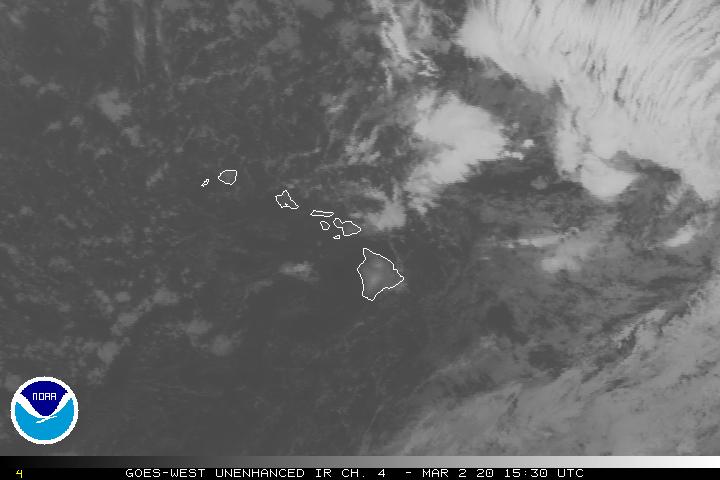
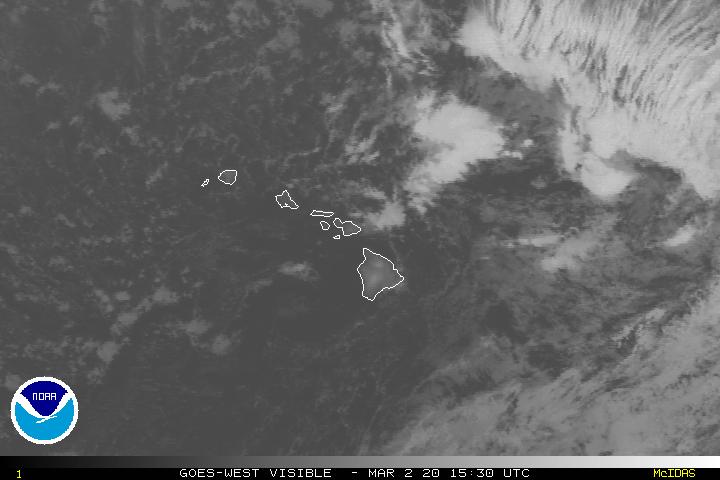
We can use the following links to see what’s going on in our area of the north central Pacific Ocean. Here's the latest NOAA satellite picture – the latest looping satellite image…and finally the latest looping radar image for the Hawaiian Islands.
Here are the latest 24-hour precipitation totals (inches) for each of the islands as of Wednesday evening:
0.28 Mount Waialeale, Kauai
0.34 Manoa Lyon Arboretum, Oahu
0.29 Molokai
0.00 Lanai
0.00 Kahoolawe
0.56 Puu Kukui, Maui
0.47 Glenwood, Big Island
~~ Hawaii Sunset Commentary ~~
Our trade winds will remain active through Friday…then turn southeast and become lighter this weekend into early next week. We find moderately strong high pressure systems (weather map), located to the northwest through northeast of the islands this evening. The NWS office in Honolulu is keeping small craft wind advisory flags up in those windiest areas around Maui County and the Big Island. There will be off and on showers falling along our windward sides, with just a few elsewhere…mostly during the night and early morning hours. A fairly typical trade wind weather pattern will continue through Friday. A low pressure system to our northwest will turn our winds southeast this weekend into early next week. This in turn may carry volcanic haze over parts of the island chain then. At the same time, aided by daytime heating of the islands…we'll likely see afternoon showers in the leeward upcountry areas each afternoon Saturday through next Tuesday or so.
As we look at this satellite image, it shows scattered clouds upwind to the east, which will bring a few showers our way at times. These lower level clouds will bring showers to our windward sides generally at night into the early morning hours…with mostly dry conditions prevailing over the leeward sides. There will be breaks in those clouds, and their off and on passing showers at times. At the time of this writing, most of the incoming windward biased showers were taking aim on the Big Island, and Maui will receive them a bit later in the evening and overnight too.
Here in Kula, Maui at 530pm Wednesday evening, it was partly cloudy with light breezes…with an air temperature of 73.8F degrees. As mentioned above, we'll see windward showers falling at times, mostly during the night and early morning hours. A typical early autumn trade wind weather pattern will continue through the end of this work week. As we get into the upcoming weekend, we'll experience a noticeable change in our local weather conditions. Our winds will veer to the southeast and become lighter, in response to an area of low pressure to our northwest. These lighter winds and daytime heating of the islands, will trigger afternoon clouds and showers over the upcountry leeward slopes. There's a decent chance of volcanic haze spreading up from the Big Island to Maui County by Sunday into the first part of next week. This lighter wind regime, with locally hazy skies, afternoon upcountry showers, and slightly cooler early mornings…will prevail perhaps into the middle of next week. I'll be back again with your next new weather narrative early Thursday morning, I hope you have a great Wednesday night wherever you're spending it! Aloha for now…Glenn.
Extra: Youtube music video, Baby…Gangnam Style
World-wide tropical cyclone activity:
Atlantic Ocean/Caribbean Sea: Tropical storm Nadine remains active, located about 715 miles south-southwest of the Azores. Sustained winds were 60 mph, moving west-southwest at 7 mph. Here's the NHC graphical track map, along with the satellite image showing Nadine's position.
Gulf of Mexico: There are no active tropical cyclones
Eastern Pacific Ocean: Tropical storm Miriam (13E) remains active in the eastern Pacific…located about 410 miles west of the southern tip of Baja California. Sustained winds are 40 mph, moving northwest at 6 mph. The NHC forecast this storm to be downgraded to a tropical depression within 12 hours. Here's the NHC graphical track map, and a satellite image of Miriam.
An area of disturbed weather has formed 400 miles south-southwest of Manzanillo, Mexico. The NHC is giving this area a high 60% chance of developing into a tropical depression within the next 48 hours. Here's a satellite image showing this area, in relation to Miriam to the northwest.
Central Pacific Ocean: There are no active tropical cyclones
Western Pacific Ocean: Super Typhoon Jelawat (19W) is active in the Philippine Sea, located about 390 NM south-southwest of Kadena AB, Okinawa, Japan. This tropical cyclone currently has sustained winds of 135 knots, with gusts to near 165 knots! The JTWC shows Jelawat has recently picked up a notch in strength, although is forecast to slowly weaken from here on out. Here's a graphical track map, along with a satellite image.
Tropical storm Ewiniar (19W) is active in the western Pacific…located about 265 NM south-southeast of Tokyo, Japan. Sustained winds are 55 knots. The current JTWC forecast keeps it over the open ocean, away from land, through the remainder of its life cycle. Here's the JTWC graphical track map, and a satellite image for Ewiniar.
South Pacific Ocean: There are no active tropical cyclones
North and South Indian Oceans: There are no active tropical cyclones
Interesting: While evolution is an accepted theory of how species evolve over time, and how new species spring from existing ones, the fundamental question of what actually started life on this planet is still the subject of a lot of conjecture. Some scientists postulate that rocks from space carrying life from other planets or perhaps asteroids landed on earth and found a favorable environment, and the evolutionary process was on!
New research indicates that microorganisms that crashed to Earth embedded in the fragments of distant planets might have been the sprouts of life on this one, according to research from Princeton University, the University of Arizona and the Centro de Astrobiología (CAB) in Spain.
The researchers report in the journal Astrobiology that under certain conditions there is a high probability that life came to Earth — or spread from Earth to other planets — during the solar system's infancy when Earth and its planetary neighbors orbiting other stars would have been close enough to each other to exchange lots of solid material.
The work will be presented at the 2012 European Planetary Science Congress on Sept. 25. The findings provide the strongest support yet for "lithopanspermia," the idea that basic life forms are distributed throughout the universe via meteorite-like planetary fragments cast forth by disruptions such as volcanic eruptions and collisions with other matter.
Eventually, another planetary system's gravity traps these roaming rocks, which can result in a mingling that transfers any living cargo. Previous research on this possible phenomenon suggests that the speed with which solid matter hurtles through the cosmos makes the chances of being snagged by another object highly unlikely.
But the Princeton, Arizona and CAB researchers reconsidered lithopanspermia under a low-velocity process called weak transfer wherein solid materials meander out of the orbit of one large object and happen into the orbit of another. In this case, the researchers factored in velocities 50 times slower than previous estimates, or about 100 meters per second.
Interesting2: Although butterflies may seem like an attractive addition to your flower garden they are a more important insect than most people realize. Acting as a vital wildlife indicator, butterflies can tell us almost everything we need to know about the health of an ecosystem. But from the Meadow Brown to the Swallowtail, British native butterfly species are slowly disappearing.
According to a report by the Dorset-based charity Butterfly Conservation, 72 per cent of butterfly and moth species have declined in the last ten years, and 54 per cent have decreased in the UK. Even the abundance of common garden butterflies, such as the Red Admiral, has dropped by 24 per cent.
Butterflies react extremely quickly to even minor changes in the environment, making them both a good indicator of biodiversity and providing an early warning system for other reductions in wildlife. As a result, they are now the best-monitored group of insects in the world.
A decline in butterflies would also have a knock-on effect on other British species, in particular birds such as blue tits, jays and sparrows. Stephen Dickie, head keeper explains: "Birds plan their whole breeding season around when caterpillars will be most abundant.
If the butterfly and caterpillar numbers are depleted then there's not going to be a lot of food for developing chicks." Plants will also be affected. Butterflies are a major pollinator of both wild and cultivated plants. Without them and other important pollinating insects flying around, there will be a significant decline in viable seed produced.
So what hope is there for the declining populations of British butterflies? Many species from Europe migrate to Britain over the summer, but this year, because of the wet weather, they have not migrated. With some warm weather this trend would reverse and the European butterflies will come across and join the remaining native species.
"We only need a short spell of sun. Butterflies are egg machines and they don’t need a lot of hot weather to get the population back up," says Stephen Threlkeld. The good news is that there are a number of ways we can all help encourage more butterflies into our gardens to lay their eggs.
Butterflies prefer open spaces that are sunny but sheltered, as it would be in a woodland glade, so the idea is to recreate this environment in your garden. Large trees and shrubs are good to provide shelter, as well as plenty of vegetation, reduced use of pesticides and some good sources of nectar.
Food plants for caterpillars are also essential, including holly, ivy and buckthorn. Leaving an area of long grass will encourage species such as Meadow Brown, Ringlet, Gatekeeper and Large Skipper, as well as giving caterpillars and pupae somewhere to hide along with other creatures such as beetles and spiders.
 Email Glenn James: