Air Temperatures – The following maximum temperatures were recorded across the state of Hawaii Tuesday afternoon:
Lihue, Kauai – 84
Honolulu airport, Oahu – 87
Molokai airport – 84
Kahului airport, Maui – 86
Kona airport – 86
Hilo airport, Hawaii – 82
Air Temperatures ranged between these warmest and coolest spots near sea level – and on the highest mountain tops around the state…as of 830pm Tuesday evening:
Barking Sands, Kauai – 80
Hilo, Hawaii – 73
Haleakala Summit – 48 (near 10,000 feet on Maui)
Mauna Kea Summit – 36 (near 13,800 feet on the Big Island)
Hawaii’s Mountains – Here’s a link to the live web cam on the summit of near 13,800 foot Mauna Kea on the Big Island of Hawaii. This web cam is available during the daylight hours here in the islands…and when there’s a big moon shining down during the night at times. Plus, during the nights you will be able to see stars, and the sunrise and sunset too…depending upon weather conditions. Here's the Haleakala Crater webcam on Maui…although this webcam is not always working correctly.
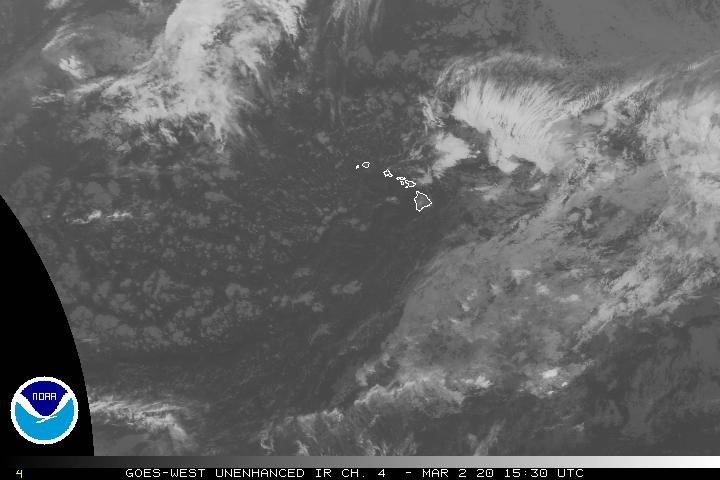
Tropical Cyclone activity in the eastern and central Pacific – Here’s the latest weather information coming out of the National Hurricane Center, covering the eastern north Pacific. You can find the latest tropical cyclone information for the central north Pacific (where Hawaii is located) by clicking on this link to the Central Pacific Hurricane Center. A satellite image, which shows the entire ocean area between Hawaii and the Mexican coast…can be found here.
Aloha Paragraphs

Artist Credit: Avi Kiriaty
Typical early autumn trade wind
weather pattern continues
As this weather map shows, we have moderately strong high pressure systems located to the northwest and northeast of the islands. At the same time, we find the tail-end of an early season cold front moving by to the north of the islands. Our local trade winds will be moderately strong through Thursday…then easing up Friday into the weekend.
The following numbers represent the most recent top wind gusts (mph), along with directions as of Tuesday evening:
29 Port Allen, Kauai – ENE
31 Kuaokala, Oahu – NE
30 Molokai – NE
30 Kahoolawe – NE
31 Kahului, Maui – NE
33 Lanai – NE
27 Kealakomo, Big Island – NE
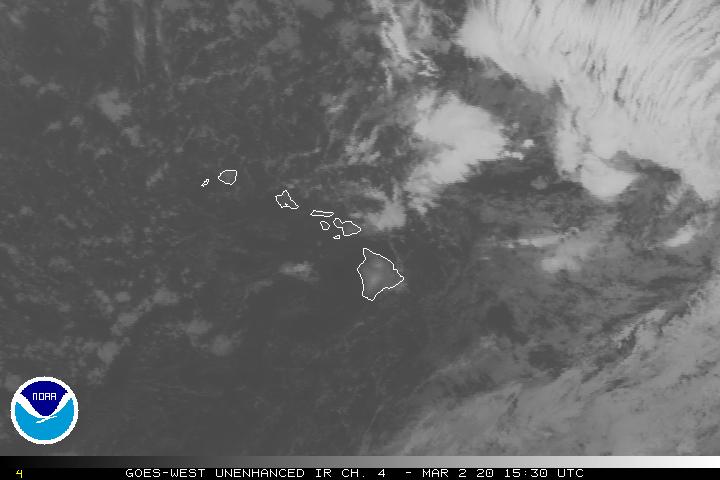
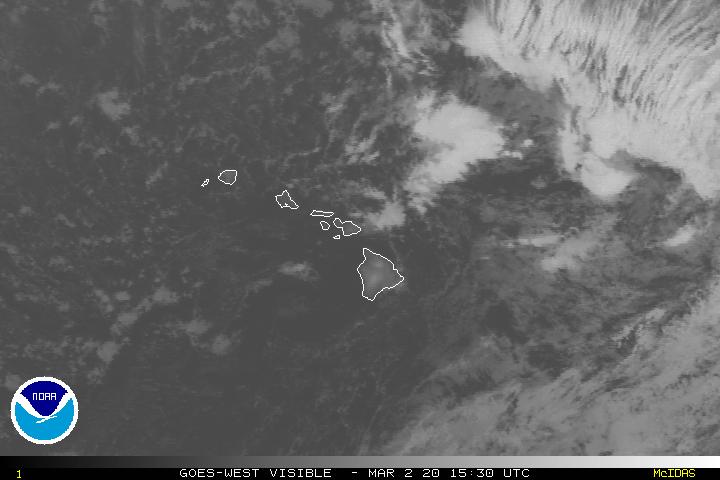
We can use the following links to see what’s going on in our area of the north central Pacific Ocean. Here's the latest NOAA satellite picture – the latest looping satellite image…and finally the latest looping radar image for the Hawaiian Islands.
Here are the latest 24-hour precipitation totals (inches) for each of the islands as of Tuesday evening:
0.06 Mount Waialeale, Kauai
0.15 Manoa Lyon Arboretum, Oahu
0.09 Molokai
0.00 Lanai
0.00 Kahoolawe
0.61 Puu Kukui, Maui
1.33 Kawainui Stream, Big Island
~~ Hawaii Sunset Commentary ~~
Our trade winds will remain active through Friday…then turn southeast and become lighter this weekend. We find several moderately strong high pressure systems (weather map), located to the northwest through northeast of the islands this evening. The NWS office in Honolulu is keeping small craft wind advisory flags up in those windiest areas around Maui County and the Big Island. There will be off and on showers falling along our windward sides, with just a few elsewhere…mostly during the night and early morning hours. A fairly typical trade wind weather pattern will continue through Friday. A low pressure to our northwest, and its associated cold front, will turn our winds southeast. This in turn will carry volcanic haze over parts of the island chain then…and aided by daytime heating of the islands…we'll likely see afternoon showers in the leeward upcountry areas Saturday and Sunday.
As we look at this satellite image, it shows scattered clouds upwind to the east, which will bring a few showers our way at times. These lower level clouds will bring showers to our windward sides generally at night…with mostly dry conditions prevailing over the leeward sides. There will be breaks in those clouds, and their off and on passing showers at times. Meanwhile, we also see a dense area of high and middle level clouds just to the southeast of the Big Island. This larger satellite image shows them well…while this looping satellite shows them streaming up from the deeper tropics.
Here in Kula, Maui at 515pm Tuesday evening, it was partly cloudy and calm…with an air temperature of 77F degrees. As mentioned above, we'll see windward showers falling at times, mostly during the night and early morning hours. A typical early autumn trade wind weather pattern will continue through the end of this work week. As we get into the upcoming weekend, our winds will veer southeast, ahead of a low pressure system, and its associated cold front to our northwest…which won't by the way reach our islands. The lighter winds, and daytime heating of the islands will trigger afternoon clouds and showers over the upcountry leeward slopes. There's a decent chance of volcanic haze spreading up from the Big Island to Maui County by Sunday into early next week. I'll be back again early Wednesday morning with your next new weather narrative, I hope you have a great Tuesday night wherever you're spending it! Aloha for now…Glenn.
Extra: Youtube music video, PSY…Gangnam Style
World-wide tropical cyclone activity:
Atlantic Ocean/Caribbean Sea: Tropical storm Nadine remains active, located about 545 miles south-southwest of the Azores. Sustained winds were 50 mph, moving south slowly at 5 mph. Here's the NHC graphical track map, along with the satellite image showing Nadine's position.
A new tropical disturbance has formed…located about 700 miles east-northeast of the Leeward islands. The NHC is giving this area a low 10% chance of developing into a tropical depression within the next 48 hours. Here's a satellite image showing both this area…and Nadine to the northeast.
Gulf of Mexico: There are no active tropical cyclones
Eastern Pacific Ocean: Tropical storm Miriam (13E) remains active in the eastern Pacific…located about 425 miles west-southwest of the southern tip of Baja California. Sustained winds are 65 mph, moving north-northwest at 6 mph. The NHC forecast this storm to be downgraded to a tropical depression within 48 hours. Here's the NHC graphical track map, and a satellite image of Miriam.
A new area of disturbed weather has formed several hundred miles southwest of Acapulco, Mexico. The NHC is giving this area a medium 30% chance of developing into a tropical depression within the next 48 hours. Here's a satellite image showing this area, in relation to Miriam to the northwest.
Central Pacific Ocean: There are no active tropical cyclones
Western Pacific Ocean: Super Typhoon Jelawat (19W) is active in the Philippine Sea, located about 495 NM south-southwest of Kadena AB, Okinawa, Japan. This tropical cyclone currently has sustained winds of 130 knots, with gusts to near 160 knots! The JTWC shows Jelawat having peaked, with a slow weakening from here on out. Here's a graphical track map, along with a satellite image.
Tropical storm Ewiniar (19W) is active in the western Pacific…located about 485 NM south-southeast of Yokosuka, Japan. Sustained winds are 50 knots. The current JTWC forecast keeps it over the open ocean, away from land, through the remainder of its life cycle. Here's the JTWC graphical track map, and a satellite image for Ewiniar.
South Pacific Ocean: There are no active tropical cyclones
North and South Indian Oceans: There are no active tropical cyclones
Interesting: Human activities like agriculture and urbanization can lead to the destruction of coral reefs and make their recovery and management difficult, according to research undertaken along the Kenyan coast. These activities increase the rate at which microbes — microscopic plants and animals such as bacteria, fungi, and algae, as well as some animals like sponges and worms — erode the reefs.
Overfishing and drainage from land — such as the one that occurs in Kenya's marine parks — were significant contributors to coral reef degradation, according to a study by the New York-based Wildlife Conservation Society and the University of Azores in Portugal, published in Marine Ecology Progress Series.
The study was motivated by the devastation wrought by the 1998 El Niño, when warm water killed around half of Indian Ocean corals, said Tim McClanahan, senior conservation zoologist at the Wildlife Conservation Society and a co-author of the study. "We wanted to know how fast the skeletons of these corals would break down and disappear, and if this rate was influenced by the pollution in the reefs," McClanahan said.
"So, we took coral skeletons that had died in 1998 and [studied] them over many years. We measured the level of pollution in the reef and found that the rate at which the corals broke down — or bio-eroded — was directly related to the amount of pollution: the more pollution there was, the faster corals broke down."
"Microbes, sponges and worms break down the reef structure or rock by dissolving the calcium carbonate that makes up the reefs," said McClanahan. "They occupy the small spaces in the rock and erode it. This renders the reefs more vulnerable to damage from waves and other disturbances."
In areas of intensive fishing, worms were also major causes of erosion, while in protected fishing areas, sponges were mainly responsible, according to McClanahan.
Interesting2: Life in extreme environments — hot acids and heavy metals exposure are particularly nasty — can apparently make very similar organisms deal with stress in very different ways, according to new research from North Carolina State University. One single-celled organism from a hot spring near Mount Vesuvius in Italy fights uranium toxicity directly — by eating the heavy metal and acquiring energy from it.
Another single-celled organism that lives on a smoldering heap near an abandoned uranium mine in Germany overcomes uranium toxicity indirectly — essentially shutting down its cellular processes to induce a type of cellular coma when toxic levels of uranium are too high in its environment. Interestingly, these very different responses to environmental stress come from two organisms that are 99.99 percent genetically identical.
In a paper published this week online in Proceedings of the National Academy of Sciences, NC State researchers show that these extreme organisms — basic life forms called Archaea that have no nucleus and that are so tiny they can only be seen under a microscope — can teach us a lot about how living things use different mechanisms to adapt to their surroundings. Archaea were first classified as a separate group of prokaryotes in 1977 based on the sequences of ribosomal RNA (rRNA) genes.
These two groups were originally named the Archaebacteria and Eubacteria and treated as kingdoms or sub-kingdoms. It was argued that this group of prokaryotes is a fundamentally different sort of life. To emphasize this difference, these two domains were later renamed Archaea and Bacteria The researchers, led by Dr. Robert Kelly, Alcoa Professor of Chemical and Biomolecular Engineering at NC State, exposed two very close relatives of thermoacidophilic Archaea — they live in highly acidic environments with temperatures of more than 160 degrees Fahrenheit — to pure uranium.
One, Metallosphaera sedula, metabolized the uranium as a way to support its energy needs. That in itself was surprising to Kelly and his fellow researchers, as it was the first report that an organism can directly use uranium as an energy source. Archaea exhibit a great variety of chemical reactions in their metabolism and use many sources of energy. These reactions are classified into nutritional groups, depending on energy and carbon sources.
Some archaea obtain energy from inorganic compounds such as sulfur or ammonia (they are lithotrophs). Now we have one using Uranium for energy. "This could be a new way to mine uranium using microorganisms to release the metal from ores — a process referred to as bio-leaching," Kelly says of M. sedula. Its genetic twin, Metallosphaera prunae, reacted very differently. When faced with pure uranium, it went into a dormant state, shutting down critical cellular processes that enable it to grow.
When the toxic threat was removed, M. prunae rebooted its cellular processes and returned to its normal state. Kelly says the findings could also have implications for understanding how antibiotic resistance develops and operates in pathogens. "We have come across a new model for how organisms learn how to live in an environment that would otherwise be deadly for them," he says. Kelly adds that the study calls into question the ways that scientists classified living things before the rise of the genomic era.
"How do we classify microorganisms now that we can compare genomes so easily?" Kelly asks. "These are not different species by the classical definition because their genomes are virtually identical, but they have very different phenotypes, or lifestyles, when faced with stress."
 Email Glenn James: