Air Temperatures – The following maximum temperatures were recorded across the state of Hawaii Tuesday afternoon:
Lihue, Kauai – 84
Honolulu airport, Oahu – 86
Molokai airport – 86
Kahului airport, Maui – 86
Kona airport – 84
Hilo airport, Hawaii – 83
Air Temperatures ranged between these warmest and coolest spots near sea level – and on the highest mountain tops around the state…as of 810pm Tuesday evening:
Honolulu, Oahu – 78
Hilo, Hawaii – 73
Haleakala Summit – 39 (near 10,000 feet on Maui)
Mauna Kea Summit – 39 (near 13,800 feet on the Big Island)
Hawaii’s Mountains – Here’s a link to the live web cam on the summit of near 13,800 foot Mauna Kea on the Big Island of Hawaii. This web cam is available during the daylight hours here in the islands…and when there’s a big moon shining down during the night at times. Plus, during the nights you will be able to see stars, and the sunrise and sunset too…depending upon weather conditions. Here's the Haleakala Crater webcam on Maui…although this webcam is not always working correctly.
Tropical Cyclone activity in the eastern and central Pacific – Here’s the latest weather information coming out of the National Hurricane Center, covering the eastern north Pacific. You can find the latest tropical cyclone information for the central north Pacific (where Hawaii is located) by clicking on this link to the Central Pacific Hurricane Center. A satellite image, which shows the entire ocean area between Hawaii and the Mexican coast…can be found here.
Aloha Paragraphs

Lighter winds arriving Wednesday-Friday…
afternoon showers, some of which
will be heavy in the upcountry areas
Surf along our south and west leeward
shores rising Wednesday into Thursday
Rising northwest swell this weekend…possible
high surf advisory north and west shores
Look for some color at sunset this evening
As this weather map shows, we have a near 1026 millibar high pressure system located far to the northeast of the islands. At the same time, we find an early season cold front to the northwest of the islands, which will push a high pressure ridge closer to us over the next several days. Our local winds will become lighter through the rest of this work week…with rebounding trade winds by the weekend.
The following numbers represent the most recent top wind gusts (mph), along with directions as of Tuesday evening:
21 Port Allen, Kauai – ESE
29 Kuaokala, Oahu – NE
27 Molokai – ENE
35 Kahoolawe – NE
31 Kahului airport, Maui – NE
24 Lanai – NE
27 South Point, Big Island – NE
We can use the following links to see what’s going on in our area of the north central Pacific Ocean. Here's the latest NOAA satellite picture – the latest looping satellite image…and finally the latest looping radar image for the Hawaiian Islands.
Here are the latest 24-hour precipitation totals (inches) for each of the islands as of Tuesday evening:
0.33 Mount Waialeale, Kauai
0.43 Manoa Lyon Arboretum, Oahu
0.12 Molokai
0.00 Lanai
0.01 Kahoolawe
0.31 Puu Kukui, Maui
0.56 Kawainui Stream, Big Island
~~ Hawaii Sunset Commentary ~~
Our trade winds will become lighter through Friday…then increasing again this coming weekend into the first part of next week. We find a near 1026 millibar high pressure system (weather map), located far to the northeast of the islands Tuesday evening. Typical late summer trade wind weather pattern for the time being, although with somewhat more showers around now, as the atmosphere is becoming less stable.
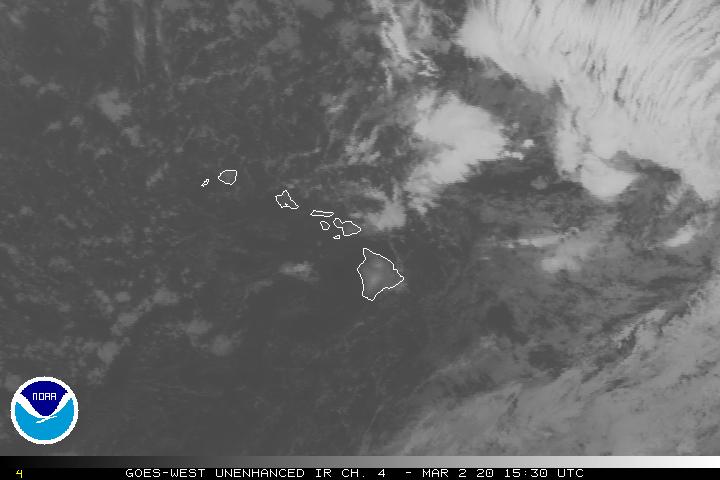
As we look at this satellite image, it shows clouds over over and around the state. We'll see these low cumulus and stratocumulus clouds being carried over the windward sides locally, leading to localized showers falling at times. At the same time, there's high cirrus clouds to the northeast of the state…with another much smaller area of cirrus approaching from the west.
Here in Kula, Maui at 520pm Tuesday evening, it was partly cloudy and near calm…with an air temperature of 70.7F degrees. The forecast calls for a change in our weather starting Wednesday through the end of this work week. This change will include an early season cold front pushing towards our islands from the northwest, although it will remain north of the state…as it slides eastward. This frontal boundary will get close enough however, to push a high pressure ridge down closer to Hawaii in the process. This will cause our winds to become lighter, with daytime onshore flowing sea breezes along our leeward beaches. Afternoon showers will likely break out in the upcountry areas around the state locally…during this upcoming period of lighter winds. The forecast calls for the chance of locally generous showers falling at times through Thursday or Friday…as an upper level low pressure system slides over the state. The trade winds will fill in over state by the weekend, and may become quite strong by Sunday into early next week. Speaking of the weekend, there's a good chance that we'll see our first high surf advisory level, northwest swell arriving then. All of the above are the first signs of our upcoming autumn season, as storms well north, begin to bring changes to our tropical Hawaiian Islands down here in the tropics. By the way, the autumnal equinox begins Saturday, September 22nd. Looking even further ahead, our trade winds will back off again around the middle of next week, when another cold front approaches the state then. I'll be back again early Wednesday morning with your next new weather narrative from paradise, I hope you have a great Tuesday night wherever you're spending it! Aloha for now…Glenn.
World-wide tropical cyclone activity:
Atlantic Ocean/Caribbean Sea: Tropical storm Nadine (14L) is active about 270 miles west of the Azores. Sustained winds are 50 mph, moving north-northeast at 05 mph, as she heads towards the Azores. Here's the NHC graphical track map for this tropical storm. Here's a satellite image showing Nadine. A tropical storm warning is in effect for the Azores Islands of Flores, Corvo, Faial, Pico,Sao Jorge, Graciosa, and Terceira, Sao Miguel and Santa Maria. (The Archipelago of the Azores is composed of nine volcanic islands situated in the North Atlantic Ocean, and is located about 1,500 km west of Lisbon and about 1,900 km southeast of Newfoundland). Gale conditions will be affecting portions of the Azores through Thursday.
At the same time, we find a new tropical disturbance having formed to the southwest of Nadine, located 8500 miles east of Bermuda. It has a low 10% chance of developing into a tropical cyclone within the next 48 hours. Here's a satellite image showing both Nadine and this new area of disturbed weather in the central Atlantic.
Gulf of Mexico: There are no active tropical cyclones
Eastern Pacific Ocean: Post-tropical cyclone Lane (12E) is dissipating about 1380 miles west of the southern tip of Baja California. Sustained winds are 35 mph, and it is moving west at 06 mph. Here's the NHC graphical track map. Here's a satellite image showing this dissipating system. There will be no threat to land areas throughout the remainder of this tropical cyclone's life cycle. Here's a satellite image showing where former Lane is in relation to the Hawaiian Islands. – Final Advisory
Central Pacific Ocean: There are no active tropical cyclones
Western Pacific Ocean: There are no active tropical cyclones
South Pacific Ocean: There are no active tropical cyclones
North and South Indian Oceans: There are no active tropical cyclones
Interesting: Many species are being forced to adapt to slowly rising temperatures around the world. However, some simply do not have the ability to change. They are stuck in a sort of "evolutionary straitjacket." This includes many species of fruit fly, a common bug found in many houses circling overripe or rotting fruit.
According to new research from Monash University, these species may face extinction in the near future, given current projects of a 3 degree C increase in mean annual temperature in the next century and even greater temperature extremes. Fruit flies are small, ranging in color from yellow to black.
They are found all around the world in all kinds of ecosystems, but more species are found in tropical regions. Fruit flies are found in the genus, Drosophila, a Latin adaptation of the Greek word meaning "dew-loving". According to the phylogeny (evolutionary tree) of drosophila, high heat resistance is a feature only found on some of the branches.
The other evolutionary branches have very limited ability to change their level of heat resistance. This is true even if a fly which is native to a cooler environment spends its entire life in a warmer environment. Even this fly's heat tolerance is not significantly altered.
"Given our findings, these expected increases pose a major threat to biodiversity in the near future. Particularly as Drosophila or fruit fly findings are often more broadly applicable," said Dr Kellermann of the Monash University School of Biological Sciences.
Kellermann and fellow researchers looked at nearly 100 fruit fly species and found that they had evolved to temperature and humidity extremes within their specific environment. At the same time, that evolution allowed for very little flexibility to change their levels of heat resistance, making them vulnerable to changes in climate.
"If a species can only withstand temperatures of 36ºC and the maximum temperature of the environment is already 36ºC, an increase of even 1ºC would already put this species over the edge towards extinction," Dr Kellermann said. Species found in the tropics and mid-latitudes are most likely to fall within the category of most at-risk.
Interesting2: Going faster than light is impossible as we understand the universe. It is the ultimate limit of our environment. A warp drive is defined as a way to manipulate space-time itself to move a starship, taking advantage of a loophole in the laws of physics that prevent anything from moving faster than light. Basically the starship would be enclosed in a bubble outside our normal space time where higher speeds can be achieved.
To arrive the bubble is removed allowing the starship to surface in our normal space time. A concept for a real-life warp drive was suggested in 1994 by Mexican physicist Miguel Alcubierre, however subsequent calculations found that such a device would require prohibitive amounts of energy.
New calculations suggest a much lower energy requirement. The Alcubierre drive is a speculative idea based on a valid solution of the Einstein field equations as proposed by Miguel Alcubierre by which a spacecraft might achieve faster-than-light travel, making travel to other stars a possibility.
It should be understood that this is different from a ship actually exceeding the speed of light within its local frame of reference. Rather, the ship would traverse distances due to the expansion and contraction of space behind and before the ship, respectively. "Perhaps a Star Trek experience within our lifetime is not such a remote possibility."
These are the words of Dr. Harold "Sonny" White, the Advanced Propulsion Theme Lead for the NASA Engineering Directorate. Dr. White and his colleagues don't just believe a real life warp drive is theoretically possible; they've already started the work to create one.
"There is hope," Harold "Sonny" White of NASA's Johnson Space Center said on September 14th) at the 100 Year Starship Symposium, a meeting to discuss the challenges of interstellar spaceflight. Working at NASA Eagleworks, Dr. White's team is trying to find proof of those loopholes.
They have "initiated an interferometer test bed that will try to generate and detect a microscopic instance of a little warp bubble" using an instrument called the White-Juday Warp Field Interferometer. By creating one of these warp bubbles, the spaceship's engine will compress the space ahead and expand the space behind, moving it to another place without actually moving, and carrying none of the adverse effects of other travel methods.
According to Dr. White, "by harnessing the physics of cosmic inflation, future spaceships crafted to satisfy the laws of these mathematical equations may actually be able to get somewhere unthinkably fast—and without adverse effects." Whatever it may be called, the frontier of interstellar travel is close by us.
 Email Glenn James: