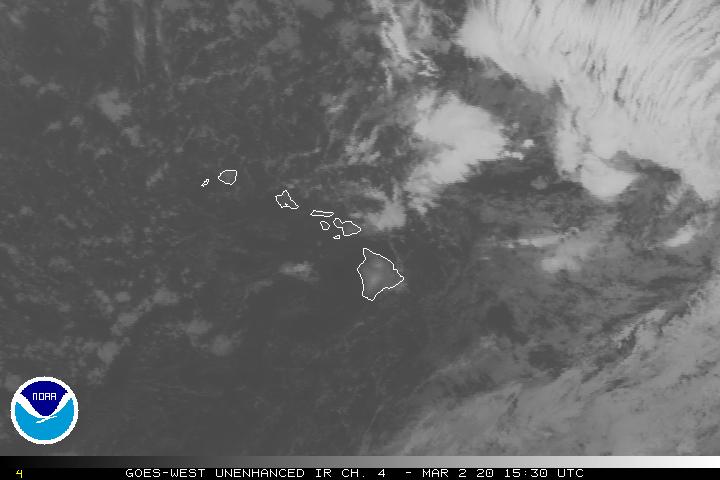
Air Temperatures – The following maximum temperatures were recorded across the state of Hawaii Monday afternoon:
Lihue, Kauai – 84
Honolulu airport, Oahu – 86
Molokai airport – 84
Kahului airport, Maui – 87
Kona airport – 84
Hilo airport, Hawaii – 81
Air Temperatures ranged between these warmest and coolest spots near sea level – and on the highest mountain tops around the state…as of 710pm Monday evening:
Barking Sands, Kauai – 80
Hilo, Hawaii – 73
Haleakala Summit – 46 (near 10,000 feet on Maui)
Mauna Kea Summit – 45 (near 13,800 feet on the Big Island)
Hawaii’s Mountains – Here’s a link to the live web cam on the summit of near 13,800 foot Mauna Kea on the Big Island of Hawaii. This web cam is available during the daylight hours here in the islands…and when there’s a big moon shining down during the night at times. Plus, during the nights you will be able to see stars, and the sunrise and sunset too…depending upon weather conditions. Here's the Haleakala Crater webcam on Maui…although this webcam is not always working correctly.
Tropical Cyclone activity in the eastern and central Pacific – Here’s the latest weather information coming out of the National Hurricane Center, covering the eastern north Pacific. You can find the latest tropical cyclone information for the central north Pacific (where Hawaii is located) by clicking on this link to the Central Pacific Hurricane Center. A satellite image, which shows the entire ocean area between Hawaii and the Mexican coast…can be found here.
Aloha Paragraphs

Trade winds continuing, occasional passing showers,
mostly along the windward sections at night
Small surf along our south and west
shores…rising on Wednesday
Medium large northwest swell this weekend
As this weather map shows, we have a near 1026 millibar high pressure system located far to the northeast of the islands. At the same time, we find an early season cold front to the northwest of the islands, which will push a high pressure ridge closer to us over the next several days. Our local winds will remain locally gusty, although becoming lighter into Tuesday…then even lighter towards the middle of the week for several days.
The following numbers represent the most recent top wind gusts (mph), along with directions as of Monday evening:
20 Port Allen, Kauai – ENE
33 Kuaokala, Oahu – NE
30 Molokai – NE
33 Kahoolawe – NE
37 Kahului, Maui – NE
36 Lanai – NE
33 PTA West, Big Island – NE
We can use the following links to see what’s going on in our area of the north central Pacific Ocean. Here's the latest NOAA satellite picture – the latest looping satellite image…and finally the latest looping radar image for the Hawaiian Islands.
Here are the latest 24-hour precipitation totals (inches) for each of the islands as of Monday evening:
0.47 Mount Waialeale, Kauai
0.34 Palisades, Oahu
0.17 Molokai
0.00 Lanai
0.00 Kahoolawe
0.71 Puu Kukui, Maui
0.34 Kealakekua, Big Island
~~ Hawaii Sunset Commentary ~~
Our trade winds will remain active Tuesday, then becoming lighter Wednesday, and turning southeast…through Friday. We find a near 1026 millibar high pressure system (weather map), located far to the northeast of the islands Monday evening. There will be moisture arriving on the trade winds, bringing showers to the windward sides of the state at times, mostly during the night and early morning hours. Typical late summer trade wind weather pattern for the time being.
As we look at this satellite image, it shows clouds over the Big Island, and upwind of the windward sides too. We'll see these low cumulus and stratocumulus clouds being carried over the windward sides locally, leading to localized showers falling at times tonight. At the same time, there's high cirrus clouds to the southwest, west, and northeast, which will do a fairly minor amount of sun dimming during the days…although provide a nice sunset this evening.
Here in Kula, Maui at 535pm Monday evening, it was mostly clear to partly cloudy and lightly breezy…with an air temperature of 75.6F degrees. As noted above, our locally gusty trade winds will continue to blow through Tuesday, with generally fine late summer conditions. The ongoing forecast calls for a change in our weather beginning Wednesday. This change will include an early season cold front pushing towards our islands from the northwest, although it will remain north of the islands…as it passes by moving eastward. This frontal boundary will get close enough however, to push a high pressure ridge down closer to Hawaii in the process. This will cause our local winds to become lighter from the southeast. Afternoon showers will likely break out in the upcountry areas around the state locally…during this upcoming period of lighter winds Wednesday through the end of the work week. The forecast calls for the chance of locally generous showers falling at times through this period…with a few windward showers perhaps too. There's also a chance of seeing some volcanic haze (vog) around on the smaller islands, that is…if the southeast winds make it all the way down to the Big Island end of the chain. The trade winds will fill back into the entire state by the weekend, and may become quite strong by Sunday into early next week. Speaking of the weekend, there's a good chance that we'll see our first high surf advisory level northwest swell arriving then. I'll be back again early Tuesday morning with your next new narrative, I hope you have a great Monday night wherever you're spending it! Aloha for now…Glenn.
World-wide tropical cyclone activity:
Atlantic Ocean/Caribbean Sea: Tropical storm Nadine (14L) is active about 410 miles southwest of the Azores. Sustained winds are 60 mph, moving northeast at 08 mph. Here's the NHC graphical track map for this tropical storm. Here's a satellite image showing Nadine.
Gulf of Mexico: There are no active tropical cyclones
Eastern Pacific Ocean: Hurricane Lane (12E) is active about 1170 miles west of the southern tip of Baja California. Sustained winds are 70 mph, and it is moving north at 09 mph. Here's the NHC graphical track map. Here's a satellite image showing this hurricane. There will be no threat to land areas throughout the remainder of this tropical cyclone's life cycle. Here's a satellite image showing where hurricane Lane is in relation to the Hawaiian Islands.
Central Pacific Ocean: There are no active tropical cyclones
Western Pacific Ocean: There are no active tropical cyclones
South Pacific Ocean: There are no active tropical cyclones
North and South Indian Oceans: There are no active tropical cyclones
Interesting: A new US fuel efficiency standard finalized by the Obama administration last month will jolt America's nascent electric car industry to life, but could leave European auto manufacturers racing to catch up, analysts and industry sources say. From 2025, American cars and light trucks will have to achieve a standard of at least 54.5 miles per gallon (mpg) under the new regulation, higher than can be achieved by any existing fuel-powered cars, according to the US Department of Energy.
The only cars on the US market which exceed the 54.5 mpg target (measured as mpg equivalent) are at least partly powered by plug-in electricity, the US Environmental Protection Agency says. This could spell trouble for Europe's electric car industry as a 'thought experiment' by the International Council on Clean Transportation (ICCT) has found that the US target surpasses its EU equivalent by some distance.
A 54.5mpg standard would be roughly equal to a 70 grams of CO2 per km (g/km) measurement, the ICCT believes, with air conditioning credits exemptions potentially taking the figure up to a maximum of 83 g/km. The EU has only set a fuel savings target of 95 g/km for 2020, with the promise of a communication about consultations on a future 2025 targets later this year. Matthias Abend, a clean energy executive for the German car maker BMW, told EurActiv it was "absolutely true" that European auto exports would not be able to compete with the US, if the fuel economy gap remained so wide.
Interesting2: Between 1969 and 1972, Apollo astronauts brought just under 842 pounds of rocks and regolith back from the Moon. In 1985, engineers at the University of Wisconsin discovered significant amounts of Helium-3 in the lunar soil. Helium-3 is a stable isotope of helium — the gas we use to fill party balloons with — and is notable because it's missing a neutron, an important property that means we can used it in nuclear fusion reactions to produce clean energy.
Unfortunately, our most plentiful stores of the isotope are a quarter of a million miles away. Current nuclear power plants use fission reactors, splitting uranium nuclei to release energy. This heat turns water into steam that drives a turbine to produce electricity. Unfortunately, radioactivity, spent nuclear fuel reprocessed into uranium, plutonium, and radioactive waste are by-products of this reaction.
To get away from fission power, scientists have been working on nuclear fusion energy. Nuclear fusion is the same reaction that fuels the sun; high temperatures and dense concentrations of gas allow positively-charged nuclei to get close enough to each other that the attractive nuclear force overcomes the repulsive electrical force. T
hey fuse, producing new elements and energy. Helium as the fuel in this type of reaction can provide energy without radioactivity and nuclear by-products. Fusion reactors fueled by tritium and deuterium — both isotopes of helium — lose more energy than they produce, making them poor fuel sources.
But fusion reactions between Helium-3 and deuterium, which creates normal helium and a proton without a neutron, wastes less energy. It's the proton that's important; manipulating it in an electric field produces energy. The Helium-3 fusion process is about 70 percent efficient compared to coal and natural gas, which are only about 20 percent efficient.
So we know how to harness the energy potential in Helium-3 (even though the technology to do so efficiently is a few years off), we just don't have enough of it on Earth to make it a viable energy source. That's because Helium-3 is carried by the solar wind and has a hard time getting through our planet's magnetic field.
We can make it — tritium, hydrogen with two neutrons, and deuterium, hydrogen with an extra neutron, both decay into Helium-3. It's also a byproduct of nuclear weapons testing. But this still isn't enough. The United States' entire Helium-3 reserve is a little under 65 pounds; a country this size would need about 50,000 pounds — 25 tons — for a year's worth of power.
The moon's lack of magnetic field means Helium-3 can build up on its surface. As Apollo 17's lunar module pilot Harrison "Jack" Schmitt sees it, there are very few disadvantages to mining Helium-3 from the moon. Aside from it being a hard thing to do. Hard, but not impossible.
Interesting3: The latest update from the National Oceanic and Atmospheric Association's National Climatic Data Center states that August 2012 was one of the warmest months on record. According to the NCDC's report, this August had a global land and ocean surface temperature of 61.22°F, 1.12°F warmer than average.
This report made this year's eight month, the fourth warmest August since they began keeping records in 1880. This August's global land surface temperature was also the second warmest August on record; the new record, 61.72°F, is 1.62°F above the average.
In addition, the worldwide ocean surface temperature for August 2012 was 61.04°F, 0.94°F above average. This year's August temperature makes last month the fifth warmest August on record. This warm end to meteorological summer also made some noise for other periods of time during 2012.
The average combined global land and ocean surface temperature for June-August 2012 was 1.15°F above the average temperature of 60.1°F. This data notes that this period is the third warmest June-August on record since 1880.
A record was broken, however, for the warmest June-August on record. This meteorological summer's globally-averaged land surface temperature of 61.95°F was 1.85°F above average. The National Climatic Data Center also said that the first eight months of 2012 was quite warm compared to other recorded periods of time.
According to the NCDC's report, the combined global land and ocean average surface temperature for January—August of this year was the ninth warmest period of this data set on record, at 1.01°F above the 20th century average.
 Email Glenn James: