Air Temperatures – The following maximum temperatures were recorded across the state of Hawaii Friday afternoon:
Lihue, Kauai – 85
Honolulu airport, Oahu – 86
Molokai airport – 83
Kahului airport, Maui – 86
Kona airport – 83
Hilo airport, Hawaii – 83
Air Temperatures ranged between these warmest and coolest spots near sea level – and on the highest mountain tops around the state…as of 910pm Friday evening:
Kailua-kona – 78
Hilo, Hawaii – 71
Haleakala Summit – 50 (near 10,000 feet on Maui)
Mauna Kea Summit – 43 (near 13,800 feet on the Big Island)
Hawaii’s Mountains – Here’s a link to the live web cam on the summit of near 13,800 foot Mauna Kea on the Big Island of Hawaii. This web cam is available during the daylight hours here in the islands…and when there’s a big moon shining down during the night at times. Plus, during the nights you will be able to see stars, and the sunrise and sunset too…depending upon weather conditions. Here's the Haleakala Crater webcam on Maui…although this webcam is not always working correctly.
Tropical Cyclone activity in the eastern and central Pacific – Here’s the latest weather information coming out of the National Hurricane Center, covering the eastern north Pacific. You can find the latest tropical cyclone information for the central north Pacific (where Hawaii is located) by clicking on this link to the Central Pacific Hurricane Center. A satellite image, which shows the entire ocean area between Hawaii and the Mexican coast…can be found here.
Aloha Paragraphs

Normal late summer trade wind
weather pattern…winds becoming
somewhat lighter this weekend
As this weather map shows, we have a near 1027 millibar high pressure system located to the northeast of the islands. Our local winds will remain locally gusty, then becoming slightly lighter into this weekend…much lighter towards the middle of the new week ahead.
The following numbers represent the most recent top wind gusts (mph), along with directions as of Friday evening:
14 Port Allen, Kauai – NE
30 Kuaokala, Oahu – NE
30 Molokai – NE
27 Kahoolawe – NE
32 Kahului, Maui – NE
27 Lanai – NE
23 Upolu airport, Big Island – NE
We can use the following links to see what’s going on in our area of the north central Pacific Ocean. Here's the latest NOAA satellite picture – the latest looping satellite image…and finally the latest looping radar image for the Hawaiian Islands.
Here are the latest 24-hour precipitation totals (inches) for each of the islands as of Friday afternoon:
0.69 Mount Waialeale, Kauai
0.42 Manoa Lyon Arboretum, Oahu
0.31 Molokai
0.06 Lanai
0.00 Kahoolawe
0.90 Puu Kukui, Maui
0.34 Kawainui Stream, Big Island
~~ Hawaii Sunset Commentary ~~
Our trade winds will remain active through the weekend into early next week, then lighten up later next Tuesday or Wednesday…for several days. We find a near 1027 millibar high pressure system (weather map), located to the northeast of the islands Friday evening. This high pressure cells remains in a good location to spin out moderately strong trade winds, with those stronger gusts locally. There will be moisture arriving on the trade winds, bringing showers to the windward sides of the state at times…with a few along leeward slopes locally.
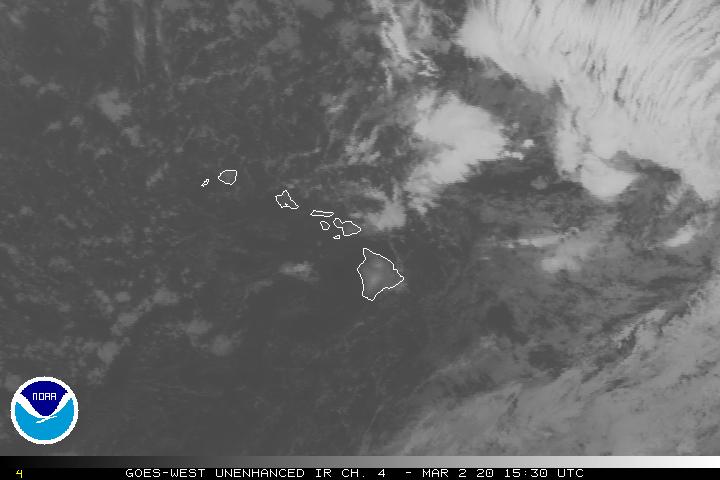
As we look at this satellite image, it shows scattered low clouds upstream to the east and northeast…heading towards the windward sides. These clouds will bring showers here and there, as they arrive on the trade wind flow. These incoming clouds will keep our windward sides showery at times. The forecast calls for more limited shower activity this weekend, falling almost exclusively along the windward coasts and slopes.
Friday evening film: I'm going to see a film that will probably be alright, although I'm not terribly excited about it. It's called The Expendables 2, starring Sylvester Stallone, Jason Statham, Jet Li, Bruce Willis, Arnold Schwarzenegger, Liam Hemsworth, Chuck Norris, and Jean-Claude van Damme…among many others. The synopsis: The Expendables are back and this time it's personal… Barney Ross, Lee Christmas, Yin Yang, Gunnar Jensen, Toll Road and Hale Caesar — with newest members Billy the Kid and Maggie aboard — are reunited when Mr. Church enlists the Expendables to take on a seemingly simple job. The task looks like an easy paycheck for Barney and his band of old-school mercenaries. But when things go wrong and one of their own is viciously killed, the Expendables are compelled to seek revenge in hostile territory where the odds are stacked against them. Hell-bent on payback, the crew cuts a swath of destruction through opposing forces, wreaking havoc and shutting down an unexpected threat in the nick of time — six pounds of weapons-grade plutonium; enough to change the balance of power in the world. But that's nothing compared to the justice they serve against the villainous adversary who savagely murdered their brother. That is done the Expendables way. ~~~ As you can see, this film includes all the heavy hitters from way back when. I'll check it out, while I wait for the crowds to thin out on a few other films that attract me more. I'll let you know what I thought in the morning, until then…here's the trailer.
Here in Kula, Maui at 530pm Friday evening, it was partly cloudy and near calm…with an air temperature of 70.3F degrees. The computer models are pointing out a possible change in our weather during the new week ahead, right around the time that our autumn season begins. The forecast points out that our winds may turn southeast, or even stop altogether, between about the middle of the week into Friday or so, after a long period with almost constant trades. This in turn suggests that we could see vog (volcanic haze) arriving then, with some afternoon showers popping-up in the upcountry areas around the state then too. I'll be back Saturday morning with your next new weather narrative, I hope you have a great Friday night wherever you're spending it! Aloha for now…Glenn.
World-wide tropical cyclone activity:
Atlantic Ocean/Caribbean Sea: Hurricane Nadine (14L) is the 8th hurricane of the Atlantic season, and is active about 880 miles east of Bermuda. Sustained winds are 80 mph, moving east-northeast at 15 mph. Here's the NHC graphical track map for this hurricane, which isn't expected to impact any land areas. Here's what the hurricane models are doing with hurricane Nadine. Here's a satellite image showing Nadine.
An area of disturbed weather remains active in the central tropical Atlantic, located about 700 miles east of the windward Islands. Environmental conditions don't appear likely for significant development…while this area moves west to west-northwest at 15 mph. The NHC is giving this area a low 10% chance of developing into a tropical depression during the next 48 hours. Here's a satellite image showing this area, and hurricane Nadine above.
Eastern Pacific Ocean: Tropical storm Kristy (11E) remains active about 325 miles west of the southern tip of Baja California. Sustained winds are 40 mph, and it is moving northwest at 9 mph. Here's the NHC graphical track map. Here's a satellite image showing this tropical storm. Here's what the hurricane models are showing for this system. There will be no threat to land areas throughout the remainder of Kristy's life cycle.
Tropical depression 12E is now active about 1080 miles west-southwest of the southern tip of Baja California. Sustained winds are 35 mph, and it is moving west at 6 mph. Here's the NHC graphical track map. Here's a satellite image showing this tropical storm, and weakening tropical storm Kristy to the northeast of 12E…closer to the coast of Baja California. Here's what the hurricane models are showing for this system. There will be no threat to land areas throughout the remainder of this tropical cyclone's life cycle.
Central Pacific Ocean: There are no active tropical cyclones
Western Pacific Ocean: Typhoon Sanba (17W) remains active to the east of Taiwan…located about 115 miles south-southeast of Kadena AB, Okinawa, Japan. Sustained winds are 110 knots, with gusts to near 135 knots. This typhoon will move more or less north over Okinawa. Here's the JTWC graphical track map for Sanba…along with a satellite image of Sanba. The JTWC forecast calls for Sanba to slowly weaken…as it moves nearly right over Okinawa today, then on towards the South Korea coast a day or so later. Here's the looping satellite image from Okinawa, which is showing Sanba approaching from the south.
South Pacific Ocean: There are no active tropical cyclones
North and South Indian Oceans: There are no active tropical cyclones
Interesting: How hot can it get on Earth? It is a sort of dubious honor to be tht place but some place has to be the record holder. A World Meteorological Organization panel has concluded that the all-time heat record held for exactly 90 years by El Azizia in Libya is invalid because of an error in recording the temperature. The announcement follows a danger-fraught investigation during the 2011 Libyan revolution.
Death Valley National Park in California, USA, now officially holds the title of the world's hottest place – as symbolic for meteorologists as Mt. Everest is for geographers. El Azizia, is a city and the capital of the Jafara district in northwestern Libya, 25 miles southwest of Tripoli.
It is a major trade center of the Sahel Jeffare plateau, being on a trade route from the coast to the Nafusa Mountains and the Fezzan region to the south. It is on the edge of the Sahara desert. Death Valley is a desert valley located in Eastern California. Situated within the Mojave Desert, it has the lowest, driest, and hottest locations in North America.
Death Valley now officially holds the record for the highest reliably reported temperature in the world, 134 °F at Furnace Creek on July 10, 1913. During 2010-2011, a WMO Commission of Climatology special international panel of experts conducted an in-depth investigation of the long-held world-record temperature extreme of 136.4 ºF.
That temperature (often cited by numerous sources as the highest surface temperature for the planet) was recorded at El Azizia. The investigation was conducted with the support of the Libyan National Meteorological Centre for the WMO Commission of Climatology World Archive of Weather and Climate Extremes, the official WMO world meteorology-verified record of weather and climate extremes.
The WMO evaluation committee concluded the most compelling scenario for the 1922 event was that a new and inexperienced observer, not trained in the use of an unsuitable replacement instrument that could be easily misread, improperly recorded the observation and was consequently in error by about seven degrees Celsius.
Based on these findings, the WMO Commission of Climatology World Archive of Weather and Climate Extremes has invalidated the 58ºC temperature extreme measured at El Azizia in 1922. Consequently, the WMO assessment is that the official highest recorded surface temperature of 134°F was measured on 10 July 1913 at Greenland Ranch (Death Valley), California, USA.
Interesting2: Oil spills can have catastrophic impacts on marine ecosystems so it is important for responsible parties to make every effort to help mitigate these damages when they occur. Cleanup efforts have ranged from bio-remediation, to controlled burning, to using chemical dispersants, and skimming. However, these clean up methods can take weeks to complete and are often very costly.
Researchers at MIT have developed a new technique for magnetically separating oil and water that could be used to clean up oil spills. The new technique will improve efficiency, as the method will allow oil to be collected and sent to a refinery to be reprocessed.
Markus Zahn, a professor at MIT said "After the BP oil disaster about two years ago in the gulf of Mexico, I got the idea that if the oil were magnetic we would be able to remove it with strong magnets and separate it from the water." Researchers experimented with water-repellent ferrous nanoparticles that when mixed with oil, could separate the oil from the water using magnets.
Afterwards, the nanoparticles could be magnetically removed from the oil. When oil spills occur, most of the oil sinks and the rest of the water that is on top spreads due to moving water. Choppy waters that make oil recovery more difficult since oil is further broken up, exacerbating this spread.
However, by putting magnetic nanoparticles that like the oil into the mix, the particles will attach to the oil and allow for separation of clean water. Lead author, Shahriar Khushrushahi stated, "Because of magnetic forces we can separate the two very quickly because the forces are so much stronger than density and that’s the advantage.
We can actually process this much faster and continuously without any real power being expended." The design and process is made to be simple. This is beneficial because oil spill clean ups occur on a large scale and most likely at sea where electrical power is scare and maintenance facilities are limited.
 Email Glenn James: