Air Temperatures – The following maximum temperatures were recorded across the state of Hawaii Monday afternoon:
Lihue, Kauai – 85
Honolulu airport, Oahu – 86
Molokai airport – 83
Kahului airport, Maui – 86
Kona airport – 86
Hilo airport, Hawaii – 82
Air Temperatures ranged between these warmest and coolest spots near sea level – and on the highest mountain tops around the state…as of 730pm Monday evening:
Barking Sands, Kauai – 81
Hilo, Hawaii – 74
Haleakala Summit – 48 (near 10,000 feet on Maui)
Mauna Kea Summit – 37 (near 13,800 feet on the Big Island)
Hawaii’s Mountains – Here’s a link to the live web cam on the summit of near 13,800 foot Mauna Kea on the Big Island of Hawaii. This web cam is available during the daylight hours here in the islands…and when there’s a big moon shining down during the night at times. Plus, during the nights you will be able to see stars, and the sunrise and sunset too…depending upon weather conditions. Here's the Haleakala Crater webcam on Maui…although this webcam is not always working correctly.
Tropical Cyclone activity in the eastern and central Pacific – Here’s the latest weather information coming out of the National Hurricane Center, covering the eastern north Pacific. You can find the latest tropical cyclone information for the central north Pacific (where Hawaii is located) by clicking on this link to the Central Pacific Hurricane Center. A satellite image, which shows the entire ocean area between Hawaii and the Mexican coast…can be found here.
Aloha Paragraphs

Trade wind speeds increasing…off
and on passing windward showers,
a few elsewhere at times too
Good sunrise this morning!
As this weather map shows, we have several near 1030 millibar high pressure systems located to the north and northeast of the islands. Our local winds will rebound in strength during the first half of this week.
The following numbers represent the most recent top wind gusts (mph), along with directions as of Monday evening:
30 Port Allen, Kauai – NE
35 Kuaokala, Oahu – ESE
32 Molokai – NE
39 Kahoolawe – NE
37 Kahului, Maui – NE
35 Lanai – NE
35 Waikoloa, Big Island – E
We can use the following links to see what’s going on in our area of the north central Pacific Ocean. Here's the latest NOAA satellite picture – the latest looping satellite image…and finally the latest looping radar image for the Hawaiian Islands.
Here are the latest 24-hour precipitation totals (inches) for each of the islands as of Monday evening:
1.12 Mount Waialeale, Kauai
0.20 Waiawa C.F., Oahu
0.13 Molokai
0.17 Lanai
0.00 Kahoolawe
0.70 Kula 1, Maui
0.58 Kealakekua, Big Island
~~ Hawaii Sunset Commentary ~~
Our trade winds will remain moderately strong, to locally strong and gusty through mid-week…and then gradually ease up into the weekend. We find near 1030 millibar high pressure systems (weather map), located to the north and northeast of the islands Monday evening. The NWS forecast office in Honolulu is keeping the small craft wind advisory active around those windiest coasts and channels around Maui and the Big Island. There will be moisture arriving on the trade winds, bringing showers to the windward sides of the state at times into Tuesday…with some along leeward slopes locally. The overlying atmosphere is getting more stable now, although showers will be locally quite generous here and there for the next 24 hours. Conditions will gradually become drier by mid-week onwards.
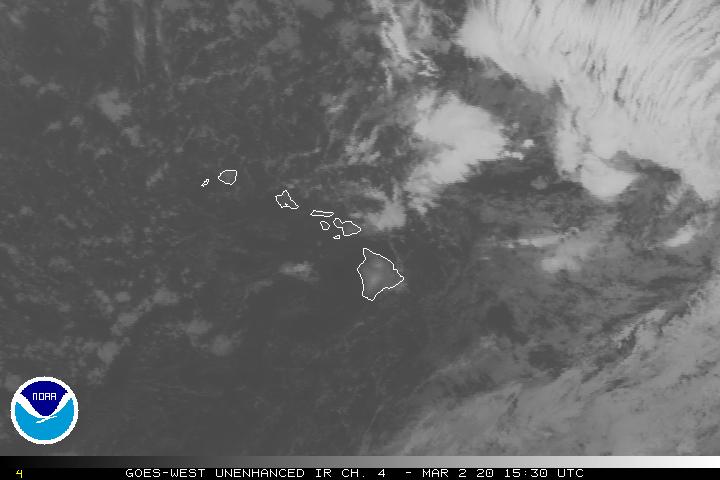
As we look at this satellite image, it shows low clouds over the islands, and to the east and northeast of the state. These lower level clouds will bring showers as they arrive on the trade wind flow…keeping our windward sides off and on wet. We're in between showery cloud areas around sunset, although the next new showery area will arrive after dark. This in turn will bring increasing showers to our windward sides into Tuesday morning. The models are showing drier weather gradually arriving later Tuesday into Wednesday onwards.
Here in Kula, Maui at 515pm Monday evening, it was partly cloudy…with an air temperature of 72.5F degrees. Our local winds will remain quite strong and gusty for the next 24-36 hours…and then mellow out some Wednesday through the rest of the week. Trade showers will remain active, as clouds impact the windward sides of the islands. It will take until Wednesday or so, before we grade back into a normal late summer trade wind weather pattern. I'll be back again early Tuesday morning with your next new weather narrative from paradise. I hope you have a great Monday night wherever you're spending it! Aloha for now…Glenn.
World-wide tropical cyclone activity:
Atlantic Ocean/Caribbean Sea: Post-tropical cyclone Leslie (12L) is active in the Atlantic…located 130 miles west-northwest of St. Johns, Newfoundland. Sustained winds were 70 mph, moving north-northeast at a very fast 45 mph. Here's the NHC graphical track map for Leslie, and a satellite image. – Final Advisory
Tropical storm Michael (13L) remains active in the central Atlantic, although is quickly dissipating. It's located about 1090 miles west of the Azores, moving north-northeast at 23 mph…with sustained winds of 45 mph. Here's the NHC graphical, track map.
Finally, newly formed tropical depression 14L is now active about 1210 miles east of the Lesser Antilles. Sustained winds are 35 mph, moving westerly at 10 mph. It will soon strengthen into tropical storm Nadine. Here's the NHC graphical track map for this depression, which isn't expected to impact any land areas…as it eventually becomes a hurricane on Friday.
Here's a satellite image showing post-tropical cyclone Leslie, tropical storm Michael, and tropical depression 14L.
Gulf of Mexico: There are no active tropical cyclones
Eastern Pacific Ocean: There are no active tropical cyclones
An area of disturbed weather, also called a tropical disturbance, is active offshore from southern Mexico. It has a medium 50% chance of developing into a tropical cyclone during the next 48 hours. Here's a satellite image showing this area called 90E.
Central Pacific Ocean: There are no active tropical cyclones
Western Pacific Ocean: Tropical storm Sanba (17W) remains active in the Philippine Sea to the east of the Philippine islands…located about 725 miles east of Manila. Sustained winds are 40 knots, with gusts to near 50 knots. This storm will move more or less north-northwest to the east of the Philippines. Here's the JTWC graphical track map for Sanba. The JTWC forecast calls for Sanba to become a typhoon early Thursday morning.
South Pacific Ocean: There are no active tropical cyclones
North and South Indian Oceans: There are no active tropical cyclones
Interesting: Already facing an onslaught of threats from logging and conversion for agriculture, forests worldwide are increasingly impacted by the effects of climate change, including drought, heightened fire risk, and disease, putting the ecological services they afford in jeopardy, warns a new paper published in the journal Nature Climate Change. The study, authored by William Anderegg of Carnegie Institution for Science at Stanford University and Jeffrey Kane and Leander Anderegg of Northern Arizona University, reviews dozens of scientific papers dealing with the ecological impacts of climate change.
They find widespread cases of forest die-off from drought and elevated temperatures, which can increase the incidence of fire and pest infestations like pine beetles. These effects have the potential to trigger transitions to other ecosystems, including scrub land and savanna.
But the impacts vary from forest to forest and the authors say more research is needed to fully understand the effects of climate change on forest ecosystems. However it is not only forests that are affected by climate change — they themselves impact climate.
Forests store 45 percent of the carbon found in terrestrial ecosystems and sequester as much as 25 percent of annual carbon emissions from human activities, helping mitigate a key driver of climate change. Yet they also raise local temperate by absorbing sunlight.
Clearing forests in polar regions has the paradoxical effect of increasing the reflectivity of Earth's surface, reducing local temperatures. Yet clear-cutting of forests in the tropics accounts for 8-15 percent of anthropogenic greenhouse gas emissions.
The authors say that the research gaps make it difficult to forecast the economic and ecological impacts of climate change on forests, which cover cover some 42 million square kilometers or 30 percent of Earth's land surface and underpin hundreds of billions to trillions of dollars a year in economic activity.
 Email Glenn James: