Air Temperatures – The following maximum temperatures were recorded across the state of Hawaii Monday afternoon:
Lihue, Kauai – 85
Honolulu airport, Oahu – 86
Molokai airport – 84
Kahului airport, Maui – 86
Kona airport – 86
Hilo airport, Hawaii – 85
Air Temperatures ranged between these warmest and coolest spots near sea level – and on the highest mountain tops around the state…as of 730pm Monday evening:
Barking Sands, Kauai – 80
Hilo, Hawaii – 77
Haleakala Summit – 50 (near 10,000 feet on Maui)
Mauna Kea Summit – 36 (near 13,800 feet on the Big Island)
Hawaii’s Mountains – Here’s a link to the live web cam on the summit of near 13,800 foot Mauna Kea on the Big Island of Hawaii. This web cam is available during the daylight hours here in the islands…and when there’s a big moon shining down during the night at times. Plus, during the nights you will be able to see stars, and the sunrise and sunset too…depending upon weather conditions. Here's the Haleakala Crater webcam on Maui…although this webcam is not always working correctly.
Tropical Cyclone activity in the eastern and central Pacific – Here’s the latest weather information coming out of the National Hurricane Center, covering the eastern north Pacific. You can find the latest tropical cyclone information for the central north Pacific (where Hawaii is located) by clicking on this link to the Central Pacific Hurricane Center. A satellite image, which shows the entire ocean area between Hawaii and the Mexican coast…can be found here.
Aloha Paragraphs

We're moving into a typical early autumn trade
wind weather pattern…through Friday
As this weather map shows, we have two moderately strong high pressure systems located to the northeast of the islands. At the same time, we find an early season cold front moving by to the north and northeast of the islands. Our local trade winds will be moderately strong Tuesday through Thursday…then easing up Friday into the weekend.
The following numbers represent the most recent top wind gusts (mph), along with directions as of Monday evening:
24 Port Allen, Kauai – E
29 Kuaokala, Oahu – N
30 Molokai – NE
30 Kahoolawe – NE
32 Kahului, Maui – NE
37 Lanai – NE
35 Kealakomo, Big Island – NE
We can use the following links to see what’s going on in our area of the north central Pacific Ocean. Here's the latest NOAA satellite picture – the latest looping satellite image…and finally the latest looping radar image for the Hawaiian Islands.
Here are the latest 24-hour precipitation totals (inches) for each of the islands as of Monday evening:
0.82 Mount Waialeale, Kauai
1.32 Manoa Lyon Arboretum, Oahu
0.67 Molokai
0.12 Lanai
0.02 Kahoolawe
2.98 Puu Kukui, Maui
1.07 Kawainui Stream, Big Island
~~ Hawaii Sunset Commentary ~~
Our trade winds will remain active through Friday…then turn southeast and become lighter during the weekend. We find a couple of moderately strong high pressure systems (weather map), located to the northeast of the islands this evening. The NWS office in Honolulu is keeping small craft wind advisory flags up in those windiest areas around Maui County and the Big Island. There will be off and on showers falling along our windward sides, with just a few elsewhere. A fairly typical trade wind weather pattern will become established Tuesday through Friday. An approaching cold front by the weekend will turn our winds southeast, bringing volcanic haze over parts of the island chain then…with afternoon showers in the leeward upcountry areas Saturday and Sunday.
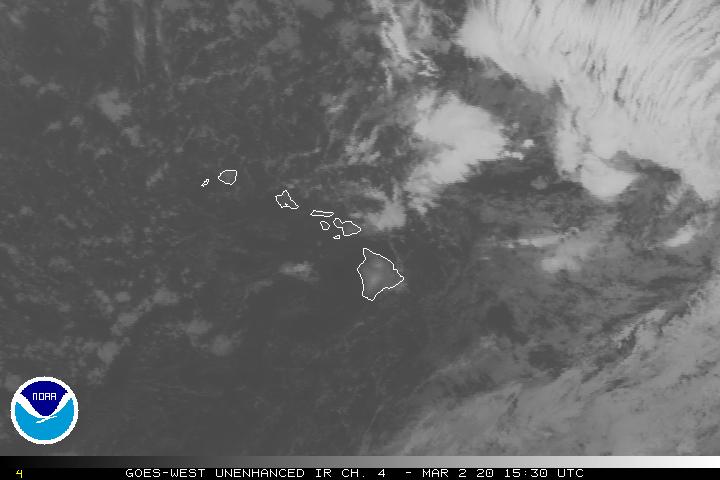
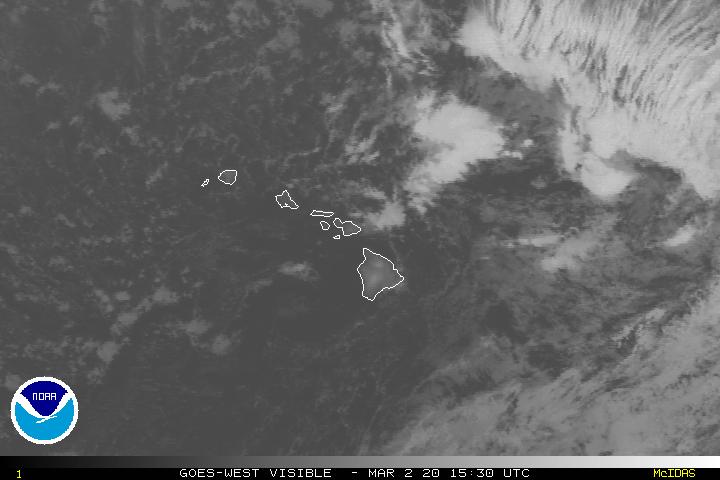
As we look at this satellite image, it shows an area of clouds approaching from the east, which will bring a few showers our way at times. This area will bring showers to our windward sides…with a few stretching over into the leeward sides on the gusty trade winds tonight. The wettest windward locations will be in Maui County and the Big Island…up through Oahu at times too. There will be breaks in those clouds, and their off and on passing showers at times. Drier weather will arrive by Tuesday, lasting through this new work week. The windward sides will still find a few showers falling, generally during the night and early morning hours.
Here in Kula, Maui at 530pm Monday evening, it was mostly clear to partly cloudy…with an air temperature of 76.8F degrees. As mentioned above, we'll see a few windward showers continue at times. As the winds will be at least moderately strong and gusty, the leeward sides may see a couple of these showers falling on the smaller islands at times. Conditions will return to normal as we push through the rest of this work week, with a typical early autumn trade wind weather pattern prevailing. As we get into the upcoming weekend, our winds will veer southeast, ahead of an approaching cold front…which won't reach the islands. The lighter winds, and daytime heating of the islands will trigger afternoon clouds and showers over the upcountry leeward slopes likely. There's a decent chance of volcanic haze spreading up from the Big Island to Maui County by Sunday into early next week. I'll be back early Tuesday morning with your next new weather narrative, I hope you have a great Monday night wherever you're spending it! Aloha for now…Glenn.
Extra: Youtube video of the Space Shuttle Endeavour arriving in Los Angeles County
World-wide tropical cyclone activity:
Atlantic Ocean/Caribbean Sea: Tropical storm Nadine remains active, located about 455 miles south-southwest of the Azores. Sustained winds were 45 mph, with the center moving west-southwest slowly at 6 mph. Here's the NHC graphical track map, along with the satellite image showing Nadine's position.
Gulf of Mexico: There are no active tropical cyclones
Eastern Pacific Ocean: Hurricane Miriam (13E) remains active in the eastern Pacific…located about 415 miles southwest of the southern tip of Baja California. Sustained winds are 100 mph, moving west-northwest slowly at 5 mph…making this a category 2 hurricane. The NHC forecast this hurricane to weaken back into a tropical storm within 48 hours. Here's the NHC graphical track map, and a satellite image of Miriam.
Central Pacific Ocean: There are no active tropical cyclones
Western Pacific Ocean: Super Typhoon Jelawat (19W) is active in the Philippine Sea, located about 385 NM east-northeast of Manila. This tropical cyclone currently has sustained winds of 140 knots, with gusts to near 170 knots! The JTWC shows Jelawat strengthening another 5 knots, peaking during the next 12 hours or so. Here's a graphical track map, along with a satellite image.
Tropical storm Ewiniar (19W) is active in the western Pacific…located about 130 NM west-southwest of Iwo-To, Japan. Sustained winds are 45 knots. The current JTWC forecast keeps it over the open ocean, although moving by just to the west of Iwo-To island today. Here's the JTWC graphical track map, and a satellite image for Ewiniar.
South Pacific Ocean: There are no active tropical cyclones
North and South Indian Oceans: There are no active tropical cyclones
Interesting: In March 2011, a devastating earthquake and tsunami set off a partial meltdown at the Fukushima nuclear plant on Japan's coast. A recent study led by European researchers found Fukushima is not alone, as 22 other plants around the world may be similarly susceptible to destructive tsunami waves, with most of them in east and southeast regions of Asia.
The 23 facilities on the list (including Fukushima) house a total of 74 nuclear reactors. Thirteen of the plants are active, while the others are either nearing completion or being expanded to house more reactors. The researchers say East and Southeast Asia are at the greatest risk of a nuclear crisis triggered by a tsunami because of the rise of atomic power stations in the region, especially in China, which houses 27 of the world's 64 nuclear reactors currently under construction.
"The most important fact is that 19 (two of which are in Taiwan) out of the 27 reactors are being built in areas identified as dangerous," state the authors of the study. Meanwhile, in Japan, seven plants — one of which is currently under construction — are located in zones at risk of a tsunami, and South Korea is now expanding two plants in risk zones, the researchers said.
The study, which appears in a recent issue of the journal Natural Hazards, urges energy officials in these countries to consider how they would deal with the potentially far-reaching consequences of a catastrophe. "The location of nuclear installations does not only have implications for their host countries but also for the areas which could be affected by radioactive leaks," study researcher Joaquín Rodríguez-Vidal, of the University of Huelva, told SINC, a Spanish news agency.
Interesting2: There are many ways to harm your respiratory system such as smoking or breathing in asbestos. For urbanites living in cities across Europe, merely living and breathing in the city can be bad. A new study released by the European Environment Agency (EEA) found that most residents of European cities breathe toxic pollutants exceeding international health standards.
The most deadly air within the EU is found in the eastern countries of Bulgaria and Romania, but there are few urban areas that escape unhealthy pollutants like ozone, nitrogen oxides, and particulate matter. The published study is already being seized upon by environmental groups who demand much tougher EU standards.
The primary sources of urban air pollution in Europe is transport, energy, and agriculture. The executive director of the EEA, Jacqueline McGlade, blamed economic inefficiencies as well as the failure of many EU countries to meet their binding commitment of pollution reduction.
The report shows that almost one third of city dwellers were exposed to excessive levels of airborne particulate matter. Approximately 17 percent were also exposed to high levels of ozone, the pollutant responsible for producing smog. The report also shows seven percent of urbanites exposed to nitrogen dioxide above the EU recommended level. The poor air quality in European cities can cause widespread effects on human and ecological health.
There are some studies which claim that nearly 500,000 premature deaths are caused by breathing unhealthy air. The air pollution also damages plants and contributes to corrosion of buildings. The EEA estimates the price tag for poor air quality at $815 billion for health care costs and an additional $218 billion in lost productivity.
The report shows that there is still work to do with some pollutants. However, it highlights the success of air quality regulations with certain pollutants such as sulfur oxides (SO2) and carbon monoxide (CO). Levels of SO2, one of the more pernicious pollutants for human and environmental health, has been cut by 82 percent since 1990 thanks to the adoption of more efficient control technologies such as scrubbers.
Levels of CO fell by 62 percent, non-methane volatile organic compounds (NMVOCs) fell by 56 percent, nitrogen oxides down by 47 percent, and ammonia by 28 percent. While all pollutants have been cut in some way, poor ambient air quality still remains in the EU urban centers. This has led for environmental and health advocacy groups to call for stricter guidelines for air pollution to make the EU standards sync with World Health Organization standards.
 Email Glenn James: