Air Temperatures – The following maximum temperatures were recorded across the state of Hawaii Thursday afternoon:
Lihue, Kauai – 84
Honolulu airport, Oahu – 88
Kaneohe, Oahu – 89
Molokai airport – 83
Kahului airport, Maui – 86
Kona airport – 85
Hilo airport, Hawaii – 83
Air Temperatures ranged between these warmest and coolest spots near sea level – and on the highest mountain tops around the state…as of 8pm Thursday evening:
Barking Sands, Kauai – 82
Hilo, Hawaii – 76
Haleakala Summit – M (near 10,000 feet on Maui)
Mauna Kea Summit – 41 (near 13,800 feet on the Big Island)
Hawaii’s Mountains – Here’s a link to the live web cam on the summit of near 13,800 foot Mauna Kea on the Big Island of Hawaii. This web cam is available during the daylight hours here in the islands…and when there’s a big moon shining down during the night at times. Plus, during the nights you will be able to see stars, and the sunrise and sunset too…depending upon weather conditions. Here's the Haleakala Crater webcam on Maui…although this webcam is not always working correctly.
Tropical Cyclone activity in the eastern and central Pacific – Here’s the latest weather information coming out of the National Hurricane Center, covering the eastern north Pacific. You can find the latest tropical cyclone information for the central north Pacific (where Hawaii is located) by clicking on this link to the Central Pacific Hurricane Center. A satellite image, which shows the entire ocean area between Hawaii and the Mexican coast…can be found here.
Aloha Paragraphs

Gusty trade winds, windward showers
at times…nice summer weather
As this weather map shows, we have moderately strong high pressure systems located to the north through northeast of the islands, with a low pressure system far to our west…along the International Dateline. Our local trade winds will remain moderately through the rest of this week into next week…with locally stronger gusts.
The following numbers represent the most recent top wind gusts (mph), along with directions as of Thursday evening:
27 Waimea Heights, Kauai – NE
39 Kuaokala, Oahu – ENE
30 Molokai – NE
36 Kahoolawe – ENE
36 Kahului, Maui – NE
42 Lanai – NE
32 Kealakomo, Big Island – NE
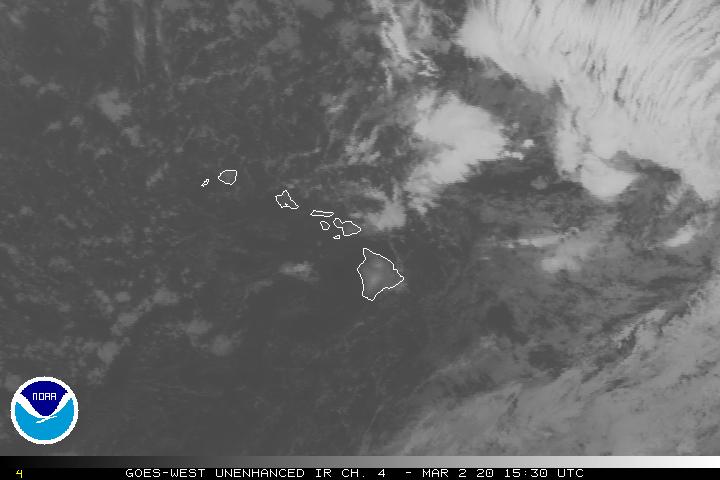
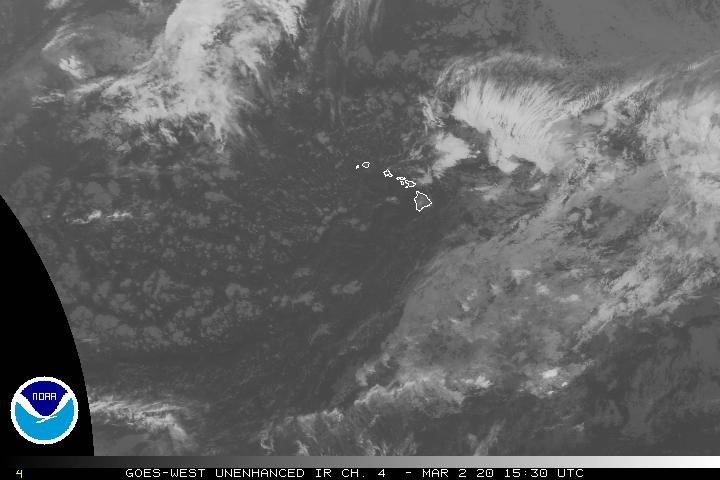
We can use the following links to see what’s going on in our area of the north central Pacific Ocean. Here's the latest NOAA satellite picture – the latest looping satellite image…and finally the latest looping radar image for the Hawaiian Islands.
Here are the latest 24-hour precipitation totals (inches) for each of the islands as of Thursday evening:
0.07 Mount Waialeale, Kauai
0.13 Wilson Tunnel, Oahu
0.23 Molokai
0.00 Lanai
0.00 Kahoolawe
0.32 Haiku, Maui
0.88 Kawainui Stream, Big Island
Sunset Commentary:
Moderately strong trade winds will continue to blow across our Hawaiian Islands…with those locally stronger gusts in the windier locations. We find high pressure systems (weather map) located to the north through northeast of the islands Thursday evening…supporting this wind flow. These winds remain strong enough that the NWS forecast office in Honolulu is continuing the small craft wind advisory over parts of Maui County and the Big Island. These trades will carry a few windward showers towards us for the time being, with generally dry conditions expected along our leeward sides. The leeward Kona slopes on the Big Island on the other hand, may see a few afternoon or early evening showers locally. The computer models continue to also suggest we may see an increase in windward biased showers, on all the islands this weekend into early next week. We can use this satellite image to see low level clouds to our east and northeast, which will bring localized windward shower activity…especially during the night and early morning hours.
Here in Kula, Maui at 515pm Thursday evening, it was partly cloudy and lightly breezy…with an air temperature of 80.6F degrees. As mentioned above, the trade winds will continue to blow across our islands through the next week at least. If we look at this satellite image, providing a larger view than the one above, we see brighter white clouds far to our west and northwest, and southeast of the islands too. These are upper level clouds associated with thunderstorm activity for the most part. Despite this, our normal summertime trade wind weather conditions will prevail here in the islands. As we move into the Saturday through early next week, the models are showing an upper level low pressure system, with its cold air aloft, moving over the state. This will likely destabilize our air mass to some degree, with a chance that our windward biased showers could become more active. Conditions should stabilize and dry out again, as we move into around next Tuesday or so. I'll be back early Friday morning with your next new weather narrative from paradise, I hope you have a great Thursday night until then! Aloha for now…Glenn.
World-wide tropical cyclone activity:
Central Pacific Ocean: There are no active tropical cyclones
Eastern Pacific Ocean: Tropical storm Gilma (7E)…is located about 670 miles west-southwest of the southern tip of Baja California. Sustained winds have decreased to 65 mph. Gilma is expected to maintain tropical storm force winds through Saturday morning, and then drop down into the tropical depression level thereafter…before completely dissipating by Monday morning. There is no danger to the Mexican coast from this tropical cyclone. Here's the hurricane model output for Gilma.
Meanwhile, an area of low pressure along the west coast of Mexico is associated with the circulation of tropical depression Ernesto. There is a high 60% chance of this disturbance developing into a tropical cyclone within 48 hours.
Here's the NHC satellite image showing this area along with tropical storm Gilma.
Atlantic Ocean/Gulf of Mexico/Caribbean: Tropical depression Ernesto (5L) is quickly weakening as it continues to move inland over southern Mexico, located about 215 miles west-southwest of Vera Cruz, Mexico. Maximum sustained winds are 25 mph. Here's the official NHC graphical track map / Here's a satellite image of this depression / Here's the hurricane model output for tropical depression Ernesto. This dissipating tropical system continues causing heavy rainfall over portions of Mexico.
Meanwhile, Tropical depression (7L) remains active in the central Atlantic, located about 775 miles east of the Windward Islands. Maximum sustained winds are 35 mph. Here's the official NHC graphical track map / Here's a satellite image of this depression / Here's the hurricane model output for tropical depression 7L.
An area of disturbed weather is active in the Atlantic, the remnants of former tropical cyclone Florence, located several hundred miles north of the Northern Leeward Islands, has a low 0% chance of developing into a tropical cyclone.
Finally, a third area of disturbed weather is active is active off the west coast of Africa, moving westward away from the coast into the Atlantic Ocean now. This system has a medium 50% chance of developing into a tropical cyclone within the next 48 hours.
Here's a satellite image showing tropical depression Ernesto, tropical depression 7L…and these two other areas of disturbed weather in the Atlantic.
Western Pacific Ocean: Tropical depression Kirogi (13W) is dissipating in the western Pacific, located approximately 470 NM east of Misawa, Japan. Sustained winds were 40 knots, with gusts to near 50 knots. 13W will quickly weaken, as it gains latitude, taking it over cooler sea water temperatures. Here's the JTWC graphical track map, along with a NOAA satellite image. – Final Warning
South Pacific Ocean: There are no active tropical cyclones
South and North Indian Oceans: There are no active tropical cyclones
Interesting: Leaky pipes are a common problem. Where is it leaking so that it can be found and fixed. With longer pipes especially those which are buried, this is a a major problem. Developing more accurate ways of finding leaks would enable water companies and consumers to save revenue and reduce their environmental impact.
The system invented at the University of Sheffield tests pipes by transmitting a pressure wave along them that sends back a signal if it passes any unexpected features, such as a leak or a crack in the pipe’s surface. The pressure wave is generated by a valve fitted to an ordinary water hydrant, which is opened and closed rapidly.
The wave sends back a reflection, or a signal, if it encounters any anomalous features in the pipe. The strength of that signal can then be analyzed to determine the location and the size of the leak. The concept was originally developed by a team led by Professor Stephen Beck in the University’s Department of Mechanical Engineering, the invention was developed into a prototype device in partnership with colleagues in the Department of Civil and Structural Engineering, and Yorkshire Water.
Between 20 and 40 per cent of our total water supply can be lost through damaged pipes. What makes the new test particularly useful is that it can be done in the field. The device has now been trialled at Yorkshire Water’s field operators training site in Bradford and results show that it offers a reliable and accurate method of leak testing. Leaks in cast iron pipes were located accurately to within one meter, while leaks in plastic pipes were located even more precisely, to within 20 centimeters.
The results of the trial are published in a paper entitled, "On site leak location in a pipe network by cepstrum analysis of pressure transients", in the Journal – American Water Works Association. Existing leak detection techniques rely on acoustic sensing with microphones commonly used to identify noise generated by pressurized water escaping from the pipe.
This method, however, is time consuming and prone to errors: the use of plastic pipes, for example, means that the sound can fall away quickly, making detection very difficult. In contrast the device invented by the Sheffield team uses a series of calculations based on the size of the pipe, the speed of the pressure wave, and the distance it has to travel.
The device can be calibrated to get the most accurate results and all the data is analyzed on site, delivering immediate results that can be prioritized for action. Dr James Shucksmith, in the Department of Civil and Structural Engineering at the University of Sheffield, who led the trial, said: "The system has delivered some very promising results at Yorkshire Water.
We hope now to find an industrial partner to develop the device to the point where it can be manufactured commercially." Dr Allyson Seth, Networks Analytics Manager at Yorkshire Water commented: “Driving down leakage on our 31,000 km network of water pipes is a high priority for us. "Over the last 12 months alone, we’ve targeted leakage reduction and as a result we’re currently recording our lowest ever levels of leakage."
Interesting2: A new technique for building low-cost houses in earthquake-prone areas has been successfully tested in Peru, and could be rolled out in any developing country with a seismic risk, according to researchers. The system consists of prefabricated steel bars in the form of trusses, triangular support structures, which are welded to each other to form grids that, in turn, form the walls and ceiling of a house — essentially forming a lightweight steel structural skeleton.
These skeletons are then filled in with hollow brick or adobe, a building material made from clay, sand, water and natural fibres, which is used widely in house construction across the developing world, despite being highly vulnerable to earthquakes. The system "is not complicated at all, and any qualified construction worker could do it", Francisco Ginocchio, a professor of civil engineering at the Pontifical Catholic University of Peru (PUCP), told SciDev.Net.
It was tested at PUCP's Anti-seismic Structure Laboratory, in collaboration with the Technical University of Madrid (UPM), between 2008 and 2011. Tests were carried out on two-story buildings, some of them built at full scale, constructed using cheap local materials such as adobe and hollow brick. The results were published in the online journal Materiales de Construcción earlier this year.
The truss system, known as the 'integral masonry system', had previously been patented in Spain for use in brick masonry. However, Josep Adell, a professor of architecture at UPM and one of the study's authors, and his colleagues, thought the system could also be applied to adobe. Adobe is widely used in house construction in the developing world.
For example, in Peru, a country with one of the highest seismic risks in the world, 40 per cent of the population — more than ten million people — live in houses made with adobe. "If a big earthquake occurs, [the houses] would be a death trap," Marcial Blondet, a professor of civil engineering at PUPC, told SciDev.Net.
But according to laboratory tests, houses reinforced with trusses could endure even severe earthquakes. "The prototypes did not collapse nor were they significantly damaged [in tests]," Blondet added. "All material could be made or adapted locally," Ginocchio said.
However, the costs have not yet been quantified and would mainly depend on the type of trusses used. Belen Orta, an architect from Spain and co-author of the study, told SciDev.Net that the costs would also depend on the scale of roll-out and the number of houses built. But in the long run, it is always cheaper to build reinforced houses than cheap houses that will collapse during earthquakes, Blondet said.
 Email Glenn James: