Air Temperatures – The following maximum temperatures were recorded across the state of Hawaii Wednesday afternoon:
Lihue, Kauai – 84
Honolulu airport, Oahu – 86
Kaneohe, Oahu – 88
Molokai airport – 86
Kahului airport, Maui – 86
Kona airport – 85
Hilo airport, Hawaii – 82
Air Temperatures ranged between these warmest and coolest spots near sea level – and on the highest mountain top around the state…as of 8pm Wednesday evening:
Barking Sands, Kauai – 81
Hilo, Hawaii – 74
Haleakala Summit – M (near 10,000 feet on Maui)
Mauna Kea Summit – 37 (near 13,800 feet on the Big Island)
Hawaii’s Mountains – Here’s a link to the live web cam on the summit of near 13,800 foot Mauna Kea on the Big Island of Hawaii. This web cam is available during the daylight hours here in the islands…and when there’s a big moon shining down during the night at times. Plus, during the nights you will be able to see stars, and the sunrise and sunset too…depending upon weather conditions. Here's the Haleakala Crater webcam on Maui…although this webcam is not always working correctly.
Tropical Cyclone activity in the eastern and central Pacific – Here’s the latest weather information coming out of the National Hurricane Center, covering the eastern north Pacific. You can find the latest tropical cyclone information for the central north Pacific (where Hawaii is located) by clicking on this link to the Central Pacific Hurricane Center. A satellite image, which shows the entire ocean area between Hawaii and the Mexican coast…can be found here.
Aloha Paragraphs

Gusty trade winds, windward showers
at times…generally fine weather
As this weather map shows, we have moderately strong high pressure systems located to the northwest through northeast of the islands, with a low pressure system far to our west…along the International Dateline. Our local trade winds will remain moderately through Friday…with locally stronger gusts.
The following numbers represent the most recent top wind gusts (mph), along with directions as of Wednesday evening:
31 Port Allen, Kauai – NE
36 Kuaokala, Oahu – NE
36 Molokai – ESE
42 Kahoolawe – ENE
38 Kahului, Maui – NE
32 Lanai – NE
31 Upolu airport, Big Island – NE
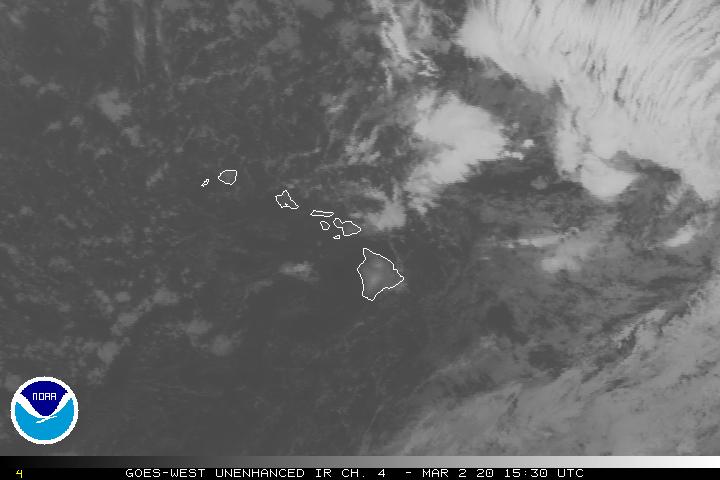
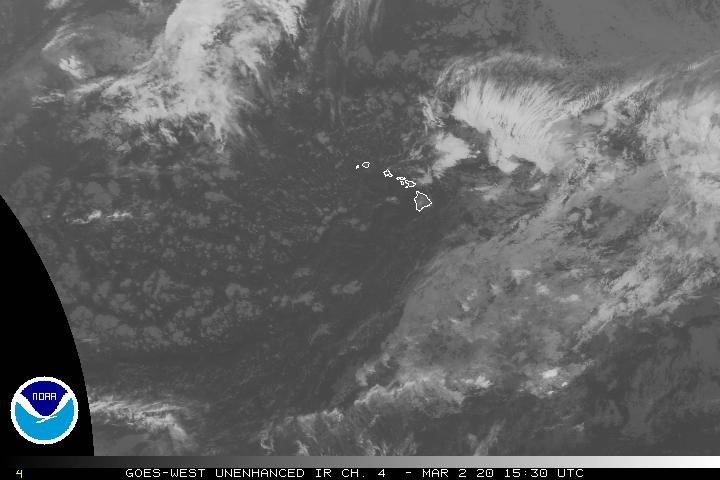
We can use the following links to see what’s going on in our area of the north central Pacific Ocean. Here's the latest NOAA satellite picture – the latest looping satellite image…and finally the latest looping radar image for the Hawaiian Islands.
Here are the latest 24-hour precipitation totals (inches) for each of the islands as of Wednesday evening:
0.50 Mount Waialeale, Kauai
0.41 Manoa Lyon Arboretum, Oahu
0.21 Molokai
0.00 Lanai
0.00 Kahoolawe
0.57 Puu Kukui, Maui
1.25 Kawainui Stream, Big Island
Sunset Commentary:
Moderately strong trade winds will continue to blow across our Hawaiian Islands…with those locally stronger gusts in the windier locations. We find high pressure systems (weather map) located to the northwest through northeast of the islands…supporting this wind flow. These winds remain strong enough that the NWS forecast office in Honolulu is continuing the small craft wind advisory over parts of Maui County and the Big Island. These trades will carry a few windward showers towards us for the time being, with generally dry conditions expected along our leeward sides. The Kona slopes on the Big Island, on the other hand, may see a few afternoon or early evening showers locally. Speaking of the Big Island and showers, there may be an area of showers that may impact the southern part of that southernmost island tonight into Thursday. The computer models continue to also suggest we may see a modest increase in windward biased showers on all the islands Friday into Saturday. We can use this satellite image to see patchy low level clouds to our east and northeast, which will prompt localized shower activity…especially during the night and early morning hours.
Here in Kula, Maui at 555pm Wednesday evening, it was partly cloudy and near calm…with an air temperature of 73.6F degrees. As mentioned above, the trade winds will continue to blow across our tropical latitudes here in the north central Pacific. Winds will remain a bit stronger than usual, at least in gusts during the days…ranging between 30-40+ mph for the most part…in those windiest places around the state. If we look at this satellite image, providing a larger view than the one above, we see brighter white clouds to our northwest, west, and south of the islands. These are upper level clouds associated with thunderstorm activity for the most part. Despite this, our normal summertime trade wind weather conditions will prevail here in the islands. There will continue to be fairly minor day to day changes in our weather, with generally fine weather through the next week at least…other than those expected modest increases in windward shower activity at times. I'll be back again early Thursday morning with your next new weather narrative. I hope you have a great Wednesday night wherever you happen to be spending it! Aloha for now…Glenn.
World-wide tropical cyclone activity:
Central Pacific Ocean: There are no active tropical cyclones
Eastern Pacific Ocean: Hurricane Gilma (7E) has weakened some…located about 715 miles southwest of the southern tip of Baja California. Sustained winds have increased to 75 mph, moving northwest. Gilma is expected to maintain hurricane force winds for about 12 hours, and then drop back down into the tropical storm realms shortly thereafter. There is no danger to Mexico or Hawaii at this time. Here's the hurricane model output for Gilma.
Meanwhile, the tropical disturbance further to the east-southeast (Invest 93E) of Gilma, is located several hundred miles south-southwest of Acapulco, Mexico. This disturbance has a low 20% chance of developing into a tropical depression within the next 48 hours. Here's the NHC satellite image showing this area along with hurricane Gilma.
Atlantic Ocean/Gulf of Mexico/Caribbean: Tropical storm Ernesto (5L) is moving inland over Mexico, located about 5 miles east of Coatzacoalcos, Mexico. Maximum sustained winds are 60 mph. Here's the official NHC graphical track map / Here's a satellite image of this storm / Here's the hurricane model output for tropical storm Ernesto. This tropical storm is causing very heavy flooding rainfall over portions of Mexico and Central America.
Meanwhile, a second area of disturbed weather remains active in the far eastern Atlantic, located about 1050 miles west of the Cape Verde Islands. This tropical disturbance has a high 70% chance of developing into a tropical cyclone during the next 48 hours. This disturbance, if it were to develop into a tropical depression, would take on the title of 6L, and then be given the name Gorden if it attained tropical storm status.
Finally, a third area of disturbed weather is active in the Atlantic, the remnants of former tropical cyclone Florence, is located a few hundred miles northeast of the Northern Leeward Islands, has a low 0% chance of developing into a tropical cyclone.
Here's a satellite image showing tropical storm Ernesto…and the two areas of disturbed weather in the Atlantic.
Western Pacific Ocean: Tropical storm Kirogi (13W) remains active in the western Pacific, located approximately 550 NM east-southeast of Misawa, Japan. Sustained winds were 35 knots, with gusts to near 45 knots. 13W will weaken, as it gains latitude, taking it over cooler sea water temperatures. Here's the JTWC graphical track map, along with a NOAA satellite image.
South Pacific Ocean: There are no active tropical cyclones
South and North Indian Oceans: There are no active tropical cyclones
Interesting: California's hydropower is vulnerable to climate change, a University of California, Riverside scientist has advised policymakers in "Our Changing Climate," a report released July 31 by the California Natural Resources Agency and the California Energy Commission (CEC). "Climate change is expected to affect the quantity and timing of water flow in the state," explained Kaveh Madani, a former postdoctoral research scholar in UC Riverside's Water Science and Policy Center (WSPC), who led a research project on climate change effects on hydropower production, demand, and pricing in California.
"Under dry climate warming, the state will receive less precipitation, with most of it as rain instead of snow, impacting hydropower supply and operations." On average, 15 percent of California's electricity comes from hydropower, a cheap and relatively clean energy source. About 75 percent of this hydropower comes from high-elevation units, located above 1,000 ft.
The state has more than 150 high-elevation units, with most of them located in Northern California and the Sierra Mountains. The majority of the high-elevation reservoirs are small in terms of their storage capacity, being built only for hydroelectricity production and no other benefits, such as water supply and flood control.
"If California loses snowpack under climate warming, these high-elevation reservoirs might not be able to store enough water for hydropower generation in summer months when the demand is much higher and hydropower is priced higher," said Madani, currently an assistant professor of civil, environmental, and construction engineering at the University of Central Florida. "California might, therefore, lose hydropower in warmer months and hydropower operators may lose considerable revenues."
Interesting2: There are always claims over fruit or fruit drinks and their health benefits. A daily glass of grapefruit juice lets patients derive the same benefits from an anti-cancer drug as they would get from more than three times as much of the drug by itself, according to a new clinical trial. The combination could help patients avoid side effects associated with high doses of the drug and reduce the cost of the medication.
Researchers at the University of Chicago Medicine study the effects that foods can have on the uptake and elimination of drugs used for cancer treatment. In a study published in August in Clinical Cancer Research, they show that eight ounces a day of grapefruit juice can slow the body’s metabolism of a drug called sirolimus, which has been approved for transplant patients but may also help many people with cancer.
Grapefruit is an excellent source of many nutrients and phytochemicals that contribute to a healthy diet. Grapefruit is a good source of vitamin C, contains the fiber pectin, and the pink and red hues contain the beneficial antioxidant lycopene. Studies have shown grapefruit helps lower cholesterol, and there is evidence that the seeds have antioxidant properties. Patients who drank eight ounces a day of grapefruit juice increased their sirolimus levels by 350 percent.
A drug called ketoconazole that also slows drug metabolism increased sirolimus levels by 500 percent. Grapefruit juice’s pharmaceutical prowess stems from its ability to inhibit enzymes in the intestine that break down sirolimus and several other drugs. The effect begins within a few hours of what the researchers refer to as grapefruit juice administration. It wears off gradually over a few days.
Cohen and colleagues organized three simultaneous phase-1 trials of sirolimus. Patients received only sirolimus, sirolimus plus ketoconazole, or sirolimus plus grapefruit juice. They enrolled 138 patients with incurable cancer and no known effective therapy. The first patients started with very low sirolimus doses, but the amounts increased as the study went on, to see how much of the drug was required in each setting to reach targeted levels, so that patients got the greatest anti-cancer effect with the least side effects.
The optimal cancer-fighting dose for those taking sirolimus was about 90 mg per week. At doses above 45 mg, however, the drug caused serious gastrointestinal problems, such as nausea and diarrhea, so patients taking sirolimus alone switched to 45 mg twice a week. The optimal doses for the other two groups were much lower. Patients taking sirolimus plus ketoconazole needed only 16 mg per week to maintain the same levels of drug in the blood. Those taking sirolimus plus grapefruit juice needed between 25 and 35 mg of sirolimus per week.
Grapefruit can have a number of interactions with drugs, often increasing the effective potency of other compounds. Grapefruit contains a number of polyphenolic compounds, including the flavanone naringin, alongside the two furanocoumarins bergamottin and dihydroxybergamottin. These inhibit the drug-metabolizing enzyme isoform CYP3A4 predominately in the small intestine, but at higher doses also inhibit hepatic CYP3A4. It is via inhibition of this enzyme that grapefruit increases the effects of a variety of drugs by increasing their bioavailability.
Interesting3: As shrimp aquaculture has boomed globally to keep pace with surging demand, the environmental toll on mangroves and other coastal ecosystems has been severe. Now, conservation groups and some shrimp farmers are creating a certification scheme designed to clean up the industry and reward sustainable producers. Carlos Perez, a well-to-do businessman, has been farming shrimp in Ecuador since 1979. He has seen the industry boom: Ecuador exported about $1.2 billion worth of shrimp last year, and its shrimp farmers employ about 102,000 people.
He has also watched as shrimp farms have played a major role in the destruction of two-thirds of the country's mangrove swamps — rich ecosystems that serve as buffers against storms, store carbon, and support fish, birds, and small mammals.
There's got to be a better way, Perez says, and so he is working closely with a global alliance called the Aquaculture Stewardship Council to develop, test, and deploy new standards for shrimp aquaculture. The Aquaculture Stewardship Council, or ASC, hopes to do for fish farming what its sister organization, the Marine Stewardship Council, or MSC, has done for ocean fishing: Reward the most responsible producers.
"It is the most demanding standard that has ever been produced for shrimp and fish," Perez says. Perez, who is 59 and grew up in the Galapagos Islands, has environmental credibility. A Georgia Tech-educated engineer, he was one of the inventors of a patented system to filter the water that flows out of fish farms.
But the ASC standard for shrimp, which will be rolled out later this year, has run into resistance in the U.S. Big buyers of fish like Walmart and Darden, the restaurant chain, are instead working with an industry-led organization called the Global Aquaculture Alliance that has its own, less stringent certification standards. "With shrimp," Perez says, "there's going to be a huge battle."
 Email Glenn James: