Air Temperatures – The following maximum temperatures were recorded across the state of Hawaii Wednesday afternoon:
Lihue, Kauai – 84
Honolulu airport, Oahu – 85
Molokai airport – 85
Kahului airport, Maui – 84
Kona airport – 86
Hilo airport, Hawaii – 78
Air Temperatures ranged between these warmest and coolest spots near sea level – and on the highest mountain tops around the state…as of 1110pm Wednesday night:
Kailua-kona – 79
Hilo, Hawaii – 70
Haleakala Summit – 41 (near 10,000 feet on Maui)
Mauna Kea Summit – M (near 13,800 feet on the Big Island)
Hawaii’s Mountains – Here’s a link to the live web cam on the summit of near 13,800 foot Mauna Kea on the Big Island of Hawaii. This web cam is available during the daylight hours here in the islands…and when there’s a big moon shining down during the night at times. Plus, during the nights you will be able to see stars, and the sunrise and sunset too…depending upon weather conditions. Here's the Haleakala Crater webcam on Maui…although this webcam is not always working correctly.
Tropical Cyclone activity in the eastern and central Pacific – Here’s the latest weather information coming out of the National Hurricane Center, covering the eastern north Pacific. You can find the latest tropical cyclone information for the central north Pacific (where Hawaii is located) by clicking on this link to the Central Pacific Hurricane Center. A satellite image, which shows the entire ocean area between Hawaii and the Mexican coast…can be found here.
Aloha Paragraphs

President Obama body surfing on the windward side of Oahu
Trade winds, clear to partly cloudy with cloudy periods
and windward showers at times…locally elsewhere
Full Blue Moon coming up Friday night!
As this weather map shows, we have a moderately strong high pressure system located far to the north of the islands. Our local trade winds will be moderately strong and gusty through this week into next week…with stronger gusts at times.
The following numbers represent the most recent top wind gusts (mph), along with directions as of Wednesday evening:
27 Port Allen, Kauai – ESE
32 Kahuku Trng, Oahu – SE
32 Molokai – E
33 Kahoolawe – E
31 Kahului, Maui -NE
30 Lanai – NE
29 Upolu airport, Big Island – NE
We can use the following links to see what’s going on in our area of the north central Pacific Ocean. Here's the latest NOAA satellite picture – the latest looping satellite image…and finally the latest looping radar image for the Hawaiian Islands.
Here are the latest 24-hour precipitation totals (inches) for each of the islands as of Wednesday evening:
2.96 Kilohana, Kauai
1.88 Poamoho RG 1, Oahu
0.40 Molokai
0.59 Lanai
0.00 Kahoolawe
1.32 Puu Kukui, Maui
1.82 Glenwood, Big Island
~~ Hawaii Sunset Commentary ~~
Our trade winds will continue to be moderately strong, and last through the next week…at least. We still find a moderately strong high pressure system (weather map) located far to the north of the islands Wednesday night. Windward showers will fall at times, enhanced by a low pressure trough aloft. At the same time, the leeward coasts and slopes, and the interior sections locally too…will see showers here and there.
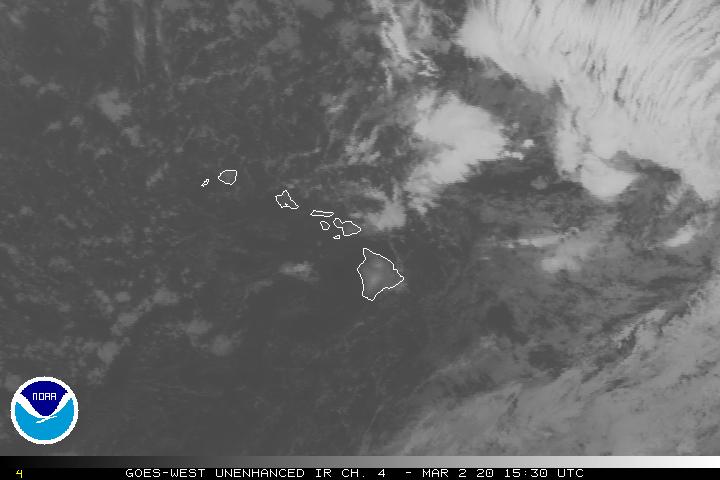
Here in Kula, Maui at 515pm Wednesday evening, it was cloudy with occasional light showers and near calm…with a relatively cool air temperature of 68F degrees. The trades are forecast to continue across our islands, with little change in their general direction or strength through the next week. These trade winds will blow generally in the moderately strong realms. If we look at this satellite image, it shows low clouds surrounding the islands, although its difficult to see them through the streaks of high clouds. These lower level clouds are bringing passing showers to our windward sides at times. There will be showers falling along our leeward coasts and slopes in places too.
The rest of this week will continue to have the trade winds blowing, along with showers falling at times locally through Friday. The forecast goes on to suggest that we'll see drier weather gradually arriving as we move into the weekend. Our hearts go out to the folks who have experienced heavy weather on the Gulf coast, and soon further inland, by gradually weakening tropical storm Isaac. Finally, in looking back at Wednesday, what with the numerous showers we had here in upcountry Maui, and with the cloudy skies and cooler than normal temperatures, it felt more like a winter day…than a day in late August! I'll be back early Thursday morning with your next new weather narrative, I hope you have a great Wednesday night wherever you happen to be spending it. Aloha for now…Glenn.
World-wide tropical cyclone activity:
Gulf of Mexico: Tropical storm Isaac (9L) is slowly weakening inland over central Louisiana. It was located about 50 miles south of Monroe, Louisiana…moving north-northwest at 9 mph. The latest sustained wind speeds were 40 mph. Here's the NHC graphical track map. Here's a satellite image of Isaac, as this storm slowly leaves the Gulf of Mexico behind. Heavy flooding rainfall continues to lash the area, as Isaac moves further inland. Here's the NWS looping radar from New Orleans/Baton Rouge.
Atlantic Ocean/Caribbean Sea: Hurricane Kirk (11L) remains active in the central Atlantic Ocean…located 1500 miles west-southwest of the Azores. Sustained winds were 75 mph, moving towards the northwest at 12 mph. Here's the NHC graphical track map, along with a satellite image of hurricane Kirk. Here's the hurricane model output for Kirk.
Tropical depression 12L has formed in the tropical Atlantic…located 1185 miles to the east of the Windward Islands. Here's the NHC graphical track map for 12L, and a satellite image. Here's the hurricane models information for this depression. Look for tropical depression 12L to become tropical storm Leslie.
Here's a satellite image showing tropical storm Isaac (9L), tropical storm Kirk…and newly formed tropical depression 12L.
Eastern Pacific Ocean: Hurricane Ileana (9E) remains active offshore from the Mexico east coast…located about 305 miles southwest of the southern tip of Baja California. Sustained winds were 80 mph, remaining a hurricane for another day or two. Here's the NHC graphical track map, along with a satellite image. Here's what the hurricane models are doing with Ileana. There is no threat to land from this hurricane.
Central Pacific Ocean: There are no active tropical cyclones
Western Pacific Ocean: There are no active tropical cyclones
South Pacific Ocean: There are no active tropical cyclones
North and South Indian Oceans: There are no active tropical cyclones
Interesting: The drought parching the United States is one of the worst in the nation's history, but it hasn't been as destructive as the drought that may have withered ancient Egypt's Old Kingdom. Pollen and charcoal buried in the Nile Delta 4,200 years ago tell the tale of a drought of literally Biblical proportions associated with the fall of the pyramid builders.
"Even the mighty builders of the ancient pyramids more than 4,000 years ago fell victim when they were unable to respond to a changing climate," said U.S. Geological Survey Director Marcia McNutt in a press release. "This study illustrates that water availability was the climate-change Achilles Heel then for Egypt, as it may well be now, for a planet topping seven billion thirsty people."
Evidence of other empire toppling droughts lay buried in the sediments of the Nile River until it was dug up by a University of Pennsylvania doctoral student who now works for the USGS. The results were published in Geology. Approximately 5,000 years ago, another drought may have hastened the demise of the kingdom of Uruk in what is now Iraq.
In an echo of modern times, Syria suffered during a drought 3,000 years ago. The Babylonians too felt the effects of famine from that drought. On the coast of the eastern Mediterranean, the Ugarit kingdom fell at that time.
Interesting2: Our world orbits a single star. There are many more multiple stars systems than those that are single star systems. How hard would it be to have planets orbit a double star? Well that answer is not clear yet but astronomers have found planet orbiting a double star.
Astronomers at the International Astronomical Union meeting announced the discovery of the first transiting circumbinary multi-planet system: two planets orbiting around a pair of stars. This discovery shows that planetary systems can form and survive even in the chaotic environment around a binary star. And such planets can exist in the habitable zone of their stars.
If one hears the Star Wars them when reading this story, remember Tatooine, orbits not one, but two stars. "Each planet transits over the primary star, giving unambiguous evidence that the planets are real," said Jerome Orosz, San Diego State University Associate Professor of Astronomy and lead author of the study which is published today in the journal Science.
This system, known as Kepler-47, contains a pair of stars that whir around each other every 7.5 days. One star is similar to the Sun while the other is a diminutive star only one third the size and 175 times fainter. The inner planet is only 3x larger in diameter than the Earth, making it the smallest known transiting circumbinary planet. It orbits the stellar pair every 49 days.
To add the oddness, the outer planet is slightly larger than Uranus and orbits every 303 days, making it the longest-period transiting planet currently known. More importantly, its orbit puts it in the habitable zone, the region around a star where a terrestrial planet could have liquid water on its surface.
While the planet is probably a gas-giant planet and thus not suitable for life, its discovery establishes that circumbinary planets can, and do, exist in habitable zones. If it has moons of the right size and composition its moons may well bear life as know it.
Although much more difficult to detect than planets around single stars, the rich dynamics and wild climate changes make these circumbinary planets worth the effort to find. These two planets join the elite group of 4 previously known transiting circumbinary planets, Kepler-16, 34, 35 and 38.
The new planetary system is located roughly 5000 light-years away, in the constellation Cygnus. The planets are much too far away to see, so they were discovered by the drop in brightness they cause when they transit (eclipse) their host stars. The loss of light caused by the silhouette is tiny, only 0.08% for planet b and 0.2% for planet c. By comparison, Venus blocked about 0.1% of the Sun's surface during its recent transit.
Precise photometric data from NASA’s Kepler space telescope allowed the transits and eclipses to be measured, which in turn provided the relative sizes of the objects. Spectroscopic data from telescopes at McDonald Observatory in Texas enabled the absolute sizes to be determined.
"Kepler-47 shows us that typical planetary architectures, with multiple planets in co-planar orbits, can form around two stars," said co-author Joshua Carter, a Hubble Fellow at the Harvard-Smithsonian Center for Astrophysics. "We’ve learned that circumbinary planets can be like the planets in our own Solar System, but with two suns."
The work was presented at the International Astronomical Union meeting by Dr. William Welsh, Professor of Astronomy at San Diego State University, on behalf of the Kepler Science Team. "The thing I find most exciting," said Welsh, "is the potential for habitability in a circumbinary system. Kepler-47c is not likely to harbor life, but if it had large moons, those would be very interesting worlds."
 Email Glenn James: