Air Temperatures – The following maximum temperatures were recorded across the state of Hawaii Tuesday afternoon:
Lihue, Kauai – 84
Honolulu airport, Oahu – 87
Molokai airport – 84
Kahului airport, Maui – 84
Kona airport – 85
Hilo airport, Hawaii – 83
Air Temperatures ranged between these warmest and coolest spots near sea level – and on the highest mountain tops around the state…as of 1110pm Tuesday night:
Kailua-kona – 77
Hilo, Hawaii – 71
Haleakala Summit – 43 (near 10,000 feet on Maui)
Mauna Kea Summit – M (near 13,800 feet on the Big Island)
Hawaii’s Mountains – Here’s a link to the live web cam on the summit of near 13,800 foot Mauna Kea on the Big Island of Hawaii. This web cam is available during the daylight hours here in the islands…and when there’s a big moon shining down during the night at times. Plus, during the nights you will be able to see stars, and the sunrise and sunset too…depending upon weather conditions. Here's the Haleakala Crater webcam on Maui…although this webcam is not always working correctly.
Tropical Cyclone activity in the eastern and central Pacific – Here’s the latest weather information coming out of the National Hurricane Center, covering the eastern north Pacific. You can find the latest tropical cyclone information for the central north Pacific (where Hawaii is located) by clicking on this link to the Central Pacific Hurricane Center. A satellite image, which shows the entire ocean area between Hawaii and the Mexican coast…can be found here.
Aloha Paragraphs

Gusty trade winds, quite cloudy with windward showers
at times…a few elsewhere in leeward areas too
High cirrus clouds through the next few days
As this weather map shows, we have a moderately strong high pressure system located far to the north of the islands. Our local trade winds will be moderately strong and gusty through this week into next week…with stronger gusts occurring at times.
The following numbers represent the most recent top wind gusts (mph), along with directions as of Tuesday evening:
30 Lihue, Kauai – NE
39 Kuaokala, Oahu – NE
35 Molokai – NE
33 Kahoolawe – NE
30 Kahului, Maui -NE
37 Lanai – NE
29 Puu Mali, Big Island – ENE
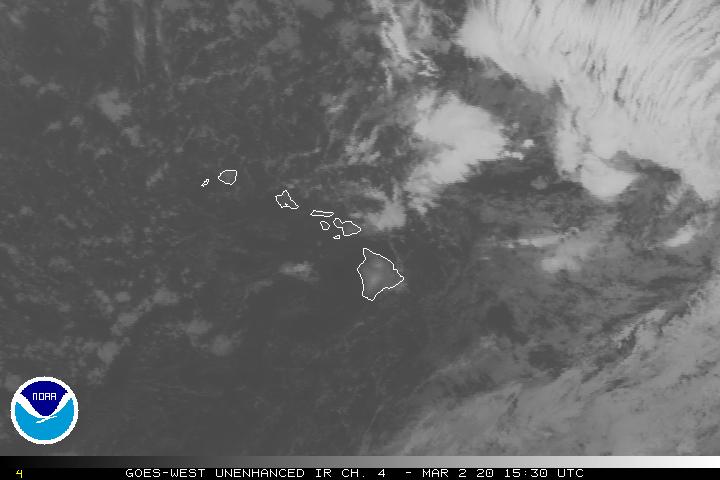
We can use the following links to see what’s going on in our area of the north central Pacific Ocean. Here's the latest NOAA satellite picture – the latest looping satellite image…and finally the latest looping radar image for the Hawaiian Islands.
Here are the latest 24-hour precipitation totals (inches) for each of the islands as of Tuesday evening:
2.00 Kilohana, Kauai
0.96 Oahu Forest NWR, Oahu
0.29 Molokai
0.00 Lanai
0.01 Kahoolawe
1.30 Puu Kukui, Maui
0.47 Mountain View, Big Island
~~ Hawaii Sunset Commentary ~~
Our trade winds will remain active through the next week and more…here in our Hawaiian Islands. These trade winds remain strong enough to keep small craft wind advisories active over those windiest parts of Maui County and the Big Island. We still find our primary, moderately strong high pressure system (weather map) located far to the north of the islands Tuesday evening. Windward showers will fall at times, enhanced at times by a low pressure trough aloft. At the same time, the leeward coasts and slopes, and the interior sections locally too…will see a few showers here and there.
Here in Kula, Maui at 530pm Tuesday evening, it was mostly cloudy and calm…with an air temperature of 71.1F degrees. The trades are forecast to continue across our islands, with little change in their general direction or strength well into the future. These trade winds will blow generally in the moderately strong realms…with stronger gusts at times. If we look at this satellite image, it shows low clouds surrounding the islands, some of which are bringing passing showers to our windward sides. There will be some showers falling along our leeward coasts and slopes in a few places too. At the same time, we see a large swath of high cirrus clouds over the state, which embracing the entire island chain at the time of this writing. These in turn should provide a nice colorful sunset this evening, and then again in the morning for sunrise.
The rest of this week will continue to have the trade winds blowing, along with somewhat more than the normal amount of showers at times through Friday. This is due to the destabilizing influence of an upper level trough of low pressure. The forecast goes on to suggest that we'll see drier weather slated for the upcoming weekend, probably. I'll be back again early Wednesday morning with your next new weather narrative, I hope you have a great Tuesday night wherever you happen to be spending it. By the way, we here in the islands send our best wishes for all those folks along the Gulf coast, who are riding out the onslaught of heavy weather, storm surge, and strong gusty winds, which are being delivered by hurricane Isaac! Aloha for now…Glenn.
Extra: youtube video, wild ride for experts only…don't do this yourself!
World-wide tropical cyclone activity:
Gulf of Mexico: Hurricane Isaac (9L) is active along the coast of Louisiana. It was located about 45 miles southwest of New Orleans…moving northwest at 6 mph. The latest sustained wind speeds were 75 mph. Here's the NHC graphical track map. Here's a satellite image of Isaac. Heavy flooding rainfall, hurricane force winds, and significant storm surge threat are occurring in a relative large area of the Gulf coast, as this large tropical cyclone continues to lash the area. Top sustained forecast winds are 75 mph. Here's the NWS looping radar from New Orleans/Baton Rouge.
Atlantic Ocean/Caribbean Sea: Tropical storm Kirk (11L) remains active in the central Atlantic Ocean…located 1485 miles west-southwest of the Azores. Sustained winds were 45 mph, moving towards the west-northwest at 12 mph. Here's the NHC graphical track map, along with a satellite image of tropical storm Kirk.
Finally, a tropical disturbance remains active in the eastern Atlantic…located 700 miles to the west-southwest the Cape Verde Islands. It has a medium 50% chance of forming into a tropical depression within the next 48 hours.
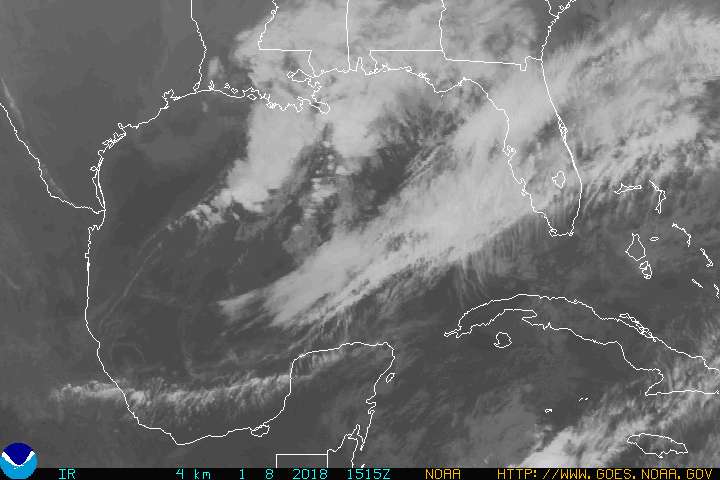
Here's a satellite image showing hurricane Isaac (9L) over the southeastern Louisiana coast, tropical storm Kirk…and that area of disturbed weather in the Atlantic.
Eastern Pacific Ocean: Tropical storm Ileana (9E) remains active offshore from the Mexico east coast…located about 370 miles south-southwest of the southern tip of Baja California. Sustained winds were 70 mph, with strengthening expected into a hurricane today. Here's the NHC graphical track map, along with a satellite image. Here's what the hurricane models are doing with Ileana. There is no threat to land from this tropical storm…despite its strengthening nature.
Central Pacific Ocean: There are no active tropical cyclones
Western Pacific Ocean: Tropical storm Tembin (15W) remains active about 450 NM south-southwest of Seoul, South Korea. Sustained winds are 50 knots, with gusts to near 65 knots. The JTWC shows Tembin offshore to the east of mainland China, moving north-northeast. The forecast has this weakening tropical cyclone impacting the west coast of South Korea within 24 hours. Here's the JTWC graphical track map.
South Pacific Ocean: There are no active tropical cyclones
North and South Indian Oceans: There are no active tropical cyclones
Interesting: Animal identification has become much more sophisticated over the years. For horse owners, it has always been necessary to be able to tell their animals apart for various reasons. For example, a horse needs to be identified if it is to be sold or entered into a competition. The traditional method for this has been branding the animal with a hot iron.
However, animal identification for the average dog or cat owner consists of much more humane methods such as microchip transponders implanted under the skin. If these microchips are available, why are horses still being put through the stress of having their skin fried?
A new study looks at the issue of animal identification from a scientific angle to determine if this old tradition still holds merit. In Europe, horse branding has been essentially ended, with just a few countries still continuing the practice. Advocates claim that branding is perfectly satisfactory and saves horse owners the need to purchase costly equipment.
Typical brands have multiple elements for identification. There is usually a symbol indicating the particular breed along with a number to identify each individual. The question is how well can these brandings be read over time. The study was conducted by Jörg and Christine Aurich from the University of Veterinary Medicine in Vienna, Austria.
They brought in three well experienced people to record the brands on 250 horses competing in a German equestrian event. They were able to identify 90 percent of the breed symbols on the horses, and 84 percent were identified correctly by all three people.
However, with the branded numbers, only half could be recorded correctly, and only 40 percent were correctly recorded by all three. The researchers decided to confirm their findings by trying to identify the brands under more ideal conditions.
They looked at markings on 28 horses that had been euthanized and shaved in the area around the brand (usually the left thigh and the left side of neck for two of them. The markings could only be identified on nine of them, and for six, neither the symbol nor the number could be read! Furthermore, the researchers examined the body tissue around the branding site and found changes in the tissue consistent with experiencing third degree burns.
The study had reached the conclusion that branding clearly is not effective for identification and can be considered an unnecessary cruel practice. Jörg Aurich sums up the results concisely. "Branding is clearly associated with local tissue damage and the markings are often insufficiently clear to be decoded, even by experienced observers or after the horse has died. There really isn't any reason to continue to mark horses in this outdated way."
 Email Glenn James: