Air Temperatures – The following maximum temperatures were recorded across the state of Hawaii Thursday afternoon:
Lihue, Kauai – 84
Honolulu airport, Oahu – 86
Kaneohe, Oahu – M
Molokai airport – 86
Kahului airport, Maui – 88
Kona airport – 86
Hilo airport, Hawaii – 84
Air Temperatures ranged between these warmest and coolest spots near sea level – and on the highest mountain tops around the state…as of 8pm Thursday evening:
Barking Sands, Kauai – 80
Hilo, Hawaii – 74
Haleakala Summit – 41 (near 10,000 feet on Maui)
Mauna Kea Summit – M (near 13,800 feet on the Big Island)
Hawaii’s Mountains – Here’s a link to the live web cam on the summit of near 13,800 foot Mauna Kea on the Big Island of Hawaii. This web cam is available during the daylight hours here in the islands…and when there’s a big moon shining down during the night at times. Plus, during the nights you will be able to see stars, and the sunrise and sunset too…depending upon weather conditions. Here's the Haleakala Crater webcam on Maui…although this webcam is not always working correctly.
Tropical Cyclone activity in the eastern and central Pacific – Here’s the latest weather information coming out of the National Hurricane Center, covering the eastern north Pacific. You can find the latest tropical cyclone information for the central north Pacific (where Hawaii is located) by clicking on this link to the Central Pacific Hurricane Center. A satellite image, which shows the entire ocean area between Hawaii and the Mexican coast…can be found here.
Aloha Paragraphs

Trade winds continuing well into the
future, showers at times…some heavy
for a bit longer – locally
As this weather map shows, we have a moderately strong high pressure systems located to the northwest and northeast of the islands. At the same time we have a trough of low pressure over the central part of the island chain…slowly moving westward. Our local trade winds will remain soft to moderately strong through Friday…then pick up a bit Saturday and Sunday into early next week.
The following numbers represent the most recent top wind gusts (mph), along with directions as of Thursday evening:
18 Poipu, Kauai – NE
28 Kahuku Trng, Oahu – ENE
28 Molokai – NE
36 Kahoolawe – NE
30 Kahului, Maui – NE
27 Lanai – NE
32 South Point, Big Island – NE
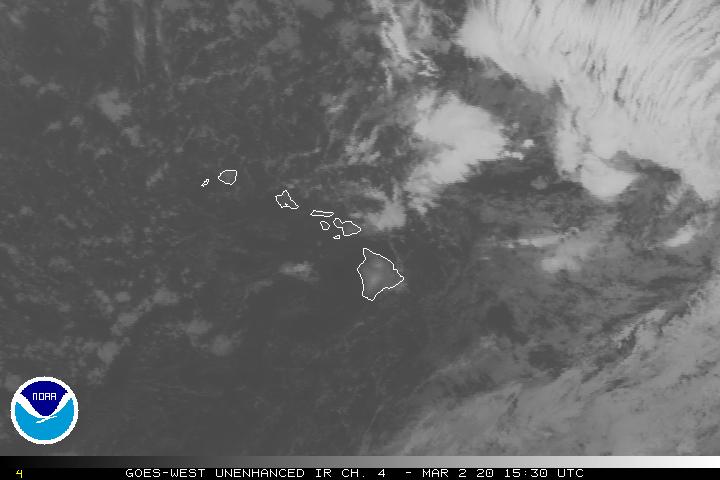
We can use the following links to see what’s going on in our area of the north central Pacific Ocean. Here's the latest NOAA satellite picture – the latest looping satellite image…and finally the latest looping radar image for the Hawaiian Islands.
Here are the latest 24-hour precipitation totals (inches) for each of the islands as of Thursday evening:
0.12 Moloaa Dairy, Kauai
1.03 Nuuanu Upper, Oahu
0.47 Molokai
0.21 Lanai
0.00 Kahoolawe
5.96 Puu Kukui, Maui
0.86 Ahumoa, Big Island
~~ Sunset Commentary ~~
Gentle to moderately strong trade winds prevail…which will pick up a notch this weekend. These trade winds aren't strong enough to require small craft wind advisories at the moment, although later this weekend we may need them over parts of the eastern Islands of Maui County and the Big Island. We find a couple of moderately strong high pressure systems (weather map) located to the northwest through northeast of the islands Thursday evening. At the same time, we find a trough of low pressure, aligned more or less north to south…over Oahu. Our summertime trades will carry windward showers our way at times. The leeward coasts and slopes will see a few showers here and there, during the afternoon and evening hours…although this threat will be fading away by Friday. This area of low pressure, the trough, will prompt some of our showers to be locally quite generous here and there until then.
Here in Kula, Maui at 540pm Thursday evening, it was partly cloudy…with an air temperature of 73.9F degrees. The trades are forecast to continue across our island chain through the next 10 days or more. These trade winds will blow generally in the soft to moderately strong realms through Friday…then pick up a bit this weekend into next week. If we look at this satellite image, it shows generally clear to partly cloudy skies upstream of the windward sides of the islands. In addition, there's a rather insignificant streak of cirrus clouds now moving over the Big Island and Maui County. These cirrus clouds look like they may gradually move up over Oahu and Kauai Friday.
We find cooler air aloft associated the aforementioned trough of low pressure, which will cause an enhancement to any showers that occur…as these clouds move through our area. There was a temporary flood advisory over the island of Oahu at the time of this writing…although it should expire not long after sunset. The largest rainfall total during the last 24 hours was, by a long shot…the very generous 5.96" atop the West Maui Mountains! At sunset, looking over at those West Maui's from here in Kula, there are tall cumulus clouds stacked-up, where there's likely still some rain falling. As we move into Friday and the weekend, our atmosphere will dry out and stabilize, with good weather prevailing. Looking even further ahead, next week looks like it will have generally good weather too, with the trade winds blowing steadily. I'll be back again early Friday morning with your next weather narrative for these beautiful islands of ours. I hope you have a great Thursday night wherever you happen to be spending it! Aloha for now…Glenn.
World-wide tropical cyclone activity:
Central Pacific Ocean: There are no active tropical cyclones
Eastern Pacific Ocean: There are no active tropical cyclones
An area of disturbed weather remains evident a few hundred miles south of the Gulf of Tehuantepec…with a low 20% chance of generating into a tropical cyclone. Development of this area into a tropical depression could occur during the next few days. Here's a satellite image showing this area offshore from southern Mexico.
Atlantic Ocean/Gulf of Mexico/Caribbean: Tropical storm Isaac (9L) is in the Caribbean Sea…located about 185 miles south-southeast of Port Au Prince, Haiti…moving west-northwest at 14 mph. This tropical cyclone will be moving over the far southwest part of Dominican Republic and Haiti. It then moves over Cuba, then across the Florida Straits into the Gulf of Mexico towards the Florida panhandle as a hurricane. The latest sustained wind speeds were 60 mph. Here's what the computer hurricane models are doing with Isaac.
Post-tropical cyclone Joyce (10L) is dissipating quickly in the Atlantic…located about 12030 miles east of the Leeward Islands…moving west-northwest at 16 mph. Sustained winds were35 mph. This tropical cyclone is degenerating into a remnant low pressure system. Final Advisory
Finally, there's that tropical disturbance off the African west coast, moving across the eastern Atlantic. It is a medium 30% chance of developing into a tropical depression over the next 48 hours.
Here's a satellite image showing tropical storm Isaac (9L) and post-tropical cyclone Joyce (10L)…and this area of disturbed weather in the eastern Atlantic.
Western Pacific Ocean: Typhoon Tembin (15W) remains active about 180 NM southwest of Taipei, Taiwan. Sustained winds are 75 knots, with gusts to near 90 knots. The JTWC shows Tembin offshore from the southwest part of Taiwan now, having moved into the southern Taiwan Strait. The forecast has Tembin doing a loop to the southwest and south of Taiwan, then moving northeast up along the east coast of the island into open ocean again. Here's the JTWC graphical track map…showing this loop that this Tembin is going to take.
Newly formed Typhoon Bolaven (16W) is active in the western Pacific…located about 380 NM southeast of Kadena AB, Okinawa, Japan. Sustained winds are 120 knots, with gusts to near 145! knots! The JTWC keeps Bolaven over the ocean, although moving right over Kadena AB in about 2 days, and then offshore from South Korea…and making a landfall along the west coast of North Korea into the Chinese mainland. Here's the JTWC graphical track map…which shows it continuing to strengthen into a super typhoon.
South Pacific Ocean: There are no active tropical cyclones
North and South Indian Oceans: There are no active tropical cyclones
Interesting: There is a general desire to be healthy and happy in life. Succeeding at these tasks is quite daunting. Middle-aged adults help their hearts with regular leisure-time physical activities according to one new study. The midlife well being of both men and women seems to depend on having a wide circle of friends whom they see regularly according to another study.
Both are simple concepts and readily apparent but now supported by these studies. Middle-aged adults who regularly engage in leisure-time physical activity for more than a decade may enhance their heart health, according to new research in the American Heart Association’s journal Circulation.
"It’s not just vigorous exercise and sports that are important," said Mark Hamer, Ph.D., study lead author and associate professor of epidemiology and public health at University College in London, U.K. "These leisure-time activities represent moderate intensity exercise that is important to health.
It is especially important for older people to be physically active because it contributes to successful aging." At the baseline assessment in 1991-1993, researchers analyzed two key inflammatory markers, C-reactive protein (CRP) External link and interleukin-6 (IL-6). Researchers again assessed physical activity and inflammatory markers in 1997-99 and about 11 years later.
Physically active participants at baseline had lower CRP and IL6 levels. The difference remained stable over time compared to participants that rarely adhered to physical activity guidelines during a 10-year follow-up. A network of relatives is also important—but only for men—shows the study of more than 6500 Britons born in 1958.
The authors base their findings on information collected from the participants, all of whom were part of the National Child Development Study (NCDS), when they were aged 42, 45 and 50. At the age of 42, participants completed a validated questionnaire (Malaise Inventory) to gauge their psychological well being and provided details of their partnership and job status, as well as the age at which they left full time education.
One in seven said they had no contacts with relatives outside their immediate household and around one in 10 said they had no friends. Four out of 10 men and around one in three women said they had more than six friends whom they saw regularly. Employment had no bearing on the size of social networks, but education did.
Men who left full time education between the ages of 17 and 19 were 45% less likely to have a larger kinship network, while those staying on until 20 or beyond were 60% less likely to do so. The comparable figures for women were 17% and 60%, respectively.
Staying on in full time education after 16 also reduced the size of men's friendship network, but it increased women's—by 38% if they left between 17 and 19, and by 74% if they left after the age of 20. Having a partner was associated with a larger kinship network. Being single reduced that probability by 31% for men and by 26% for women. But it had no impact on friendship networks.
When participants' psychological well being was assessed at the age of 50, the results showed a significant association between the number of friends and psychological well being, the impact of which was greater for women.
Psychological well being was especially poor among those with no relatives or friends: among men this was 2.3 points lower if they had no relatives and 2.6 points lower if they had no friends compared with those with 10 or more regular social contacts. The moral of this is to exercise moderately, get married and cultivate a circle of friends in order to age healthy and happy.
 Email Glenn James: