











Air Temperatures – The following maximum temperatures were recorded across the state of Hawaii Thursday afternoon:
Lihue, Kauai – 84
Honolulu airport, Oahu – 86
Kaneohe, Oahu – 88
Molokai airport – 83
Kahului airport, Maui – 87
Kona airport – 85
Hilo airport, Hawaii – 83
Air Temperatures ranged between these warmest and coolest spots near sea level – and on the highest mountain top around the state…as of 8pm Thursday evening:
Barking Sands, Kauai – 81
Hilo, Hawaii – 73
Haleakala Summit – M (near 10,000 feet on Maui)
Mauna Kea Summit – 37 (near 13,800 feet on the Big Island)
Hawaii’s Mountains – Here’s a link to the live web cam on the summit of near 13,800 foot Mauna Kea on the Big Island of Hawaii. This web cam is available during the daylight hours here in the islands…and when there’s a big moon shining down during the night at times. Plus, during the nights you will be able to see stars, and the sunrise and sunset too…depending upon weather conditions. Here's the Haleakala Crater webcam on Maui…although this webcam is not always working correctly.
Tropical Cyclone activity in the eastern and central Pacific – Here’s the latest weather information coming out of the National Hurricane Center, covering the eastern north Pacific. You can find the latest tropical cyclone information for the central north Pacific (where Hawaii is located) by clicking on this link to the Central Pacific Hurricane Center. A satellite image, which shows the entire ocean area between Hawaii and the Mexican coast…can be found here.
Aloha Paragraphs

Trade winds prevail…increasing
high cirrus clouds
As this weather map shows, we have moderately strong high pressure systems located far to the northwest and northeast of the islands…with a weak low pressure system to our north. Our local trade winds will remain moderately strong, with higher gusts locally into the weekend…and beyond.
The following numbers represent the most recent top wind gusts (mph), along with directions as of Thursday evening:
25 Port Allen, Kauai – NE
31 Kuaokala, Oahu – N
30 Molokai – NE
35 Kahoolawe – NE
32 Kahului, Maui – NE
29 Lanai – NE
28 Kealakomo, Big Island – NE
We can use the following links to see what’s going on in our area of the north central Pacific Ocean. Here's the latest NOAA satellite picture – the latest looping satellite image…and finally the latest looping radar image for the Hawaiian Islands.
Here are the latest 24-hour precipitation totals (inches) for each of the islands as of Thursday evening:
1.40 Mount Waialeale, Kauai
0.05 Ahuimanu Loop, Oahu
0.02 Molokai
0.00 Lanai
0.00 Kahoolawe
0.04 Puu Kukui, Maui
0.11 Kealakekua, Big Island
Sunset Commentary:
There's little change expected in our moderately strong trade wind flow across the Hawaiian Islands…through the rest of this week into next week. We find near 1030 millibar high pressure systems (weather map) located far to the northeast and northwest of Hawaii…delivering this wind flow across our islands. The trade winds will carry just a few windward showers towards us, with generally dry conditions expected along our leeward sides. We can use this satellite image to see just the usual array of scattered …..low level clouds to our east and northeast…along with a few higher level cirrus to our west through south. The low clouds to our east and northeast will bring just a few windward biased showers periodically through the rest of this week…generally during the night and early morning hours.
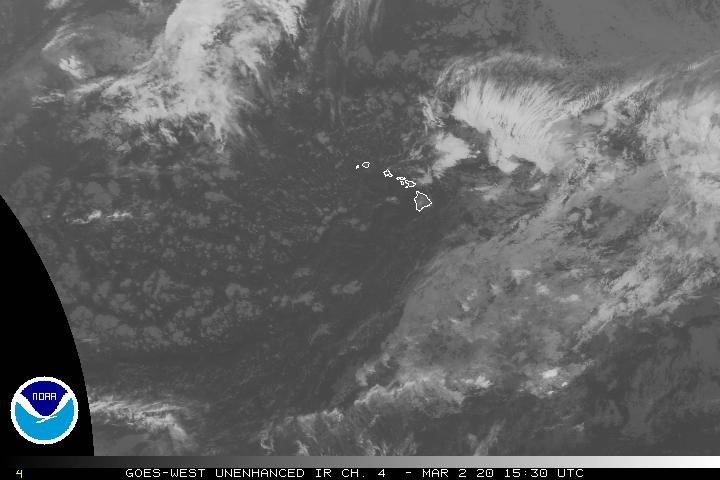
Here in Kula, Maui at 515pm Thursday evening, it was cloudy and calm…with an air temperature of 71.2F degrees. As mentioned above, the trade winds will continue to blow well into the future. Winds will remain quite breezy, at least in gusts, ranging between 30-40 mph during the afternoon hours. If we look at this satellite image, which shows a larger view than the one in the paragraph above…we see lots of thunderstorms and high cirrus clouds offshore to the northwest, west, southwest, south, and southeast. These high clouds will be approaching the state, making for good sunset and sunrise colors, as well as dimming our sunshine at times locally. All things considered however, our normal summertime trade wind weather conditions will prevail, with little day to day change expected. I'll be back early Friday morning with your next new weather narrative from paradise. I hope you have a great Thursday night wherever you happen to be spending it! Aloha for now…Glenn.
World-wide tropical cyclone activity:
Central Pacific Ocean: There are no active tropical cyclones
Eastern Pacific Ocean: There are no active tropical cyclones
Atlantic Ocean/Gulf of Mexico/Caribbean: Tropical storm Ernesto (5L) remains active in the Caribbean Sea, located about 90 miles west of St. Lucia. Maximum sustained winds are 50 mph, which is expected to increase to a hurricane late Sunday or early this coming Monday…to the south or southwest of Jamaica. Here's the official NHC graphical track map / Here's a satellite image of this storm / Here's the hurricane model output for TS Ernesto
Western Pacific Ocean: Tropical storm Saola (10W) brought stormy weather, and rough surf to the east coast of China as it moved inland recently. Sustained winds are now 35 knots, with gusts to 45 knots. It will quickly dissipate as it interacts with the physical terrain features of China, bringing gusty winds and rainfall inland with it. Here's the JTWC graphical track map, along with a NOAA satellite image. – Final Warning
Tropical depression Haikui (12W) remains active in the western Pacific, located approximately 580 NM east of Kadena AB, Okinawa, Japan. Sustained winds were 30 knots, with gusts to near 40 knots. It is expected to strengthen into a tropical storm soon, and go on to become a typhoon within 48 or so hours. Here's the JTWC graphical track map, along with a NOAA satellite image.
South Pacific Ocean: There are no active tropical cyclones
South and North Indian Oceans: There are no active tropical cyclones
Interesting: Earthquakes come and go. Everybody knows of some that are more likely such as the San Andreas fault in California. What about the quieter places in the world? An earthquake of similar magnitude is in store for Oregon at some point, and scientists at Oregon State University have raised the warning flag again — they predict it could be soon — in a new report.
In fact, the probability of a major quake in the next 50 years could range as high as 40 percent. The group also studied the historic intervals between quakes over the last 10,000 years. Given that the last known major quake was in the year 1700, a quake in the next 50 years fits the pattern.
The last Cascadian earthquake set off a tsunami that not only struck Cascadia's Pacific coast, but also crossed the Pacific Ocean to Japan, where it damaged coastal villages. Written records of the damage in Japan pinpoint the earthquake to the evening of January 26, 1700.
That earthquake collapsed houses of the Cowichan people on Vancouver Island and caused numerous landslides. The shaking was so violent that people could not stand and so prolonged that it made them sick. On the west coast of Vancouver Island, the tsunami completely destroyed the winter village of the Pachena Bay people with no survivors.
These events are recorded in the oral traditions of the First Nations people on Vancouver Island. There are a lot more people in the Cascade area nowadays; the potential for harm is much more than then. "Right now, we have already exceeded 75 percent of the known recurrence intervals over the last 10,000 years. By the year 2060, we will have exceeded 85 percent of them, if we don't have an earthquake by then," said Goldfinger, an author.
"If the Cascadia fault had a warranty against failure, it would have expired many years ago." The Southern Oregon coast faces the greatest risk. Between Florence and Cape Mendocino, Calif., the report predicts an earthquake between 8.1 and 8.3 magnitude in the next 50 years at about 40 percent.
A larger earthquake like the 9.0 magnitude one in Japan has only a 10 percent chance, but could affect the entire Oregon coast. The threat isn't just the quake's power, however. The Cascadia Subduction Zone will probably cause shaking for 3-5 minutes, said Scott Ashford of OSU, not involved in the study.
A lot of the seismic design standards have been based on quakes of 30 seconds, common in California, and don't account for the extended shaking. "Oregon is not ready. We have a bunch of legacy infrastructure," said Ashford, "but it's never been tested and was never designed for Cascadia Subduction Zone earthquakes."
Wang says that the greatest risk to the Northwest is liquefaction, where wet, loose soil behaves like a liquid. Buried tanks and pipes can float out of the ground, and buildings can sink. She said that all of the port terminals along Oregon riverbanks are on easily-liquefied soil and that critical infrastructure like electricity and fuel could easily be disrupted.
An Oregon Department of Transportation report from 2009 states that many major roads, including Interstate 5, will be completely impassable following a mega-quake because of damage like falling overpasses. As of 2009, 178 of Oregon's 2,567 bridges had received a retrofit for seismic stability. In an extreme earthquake, Ashford said, "electricity will be down, roads will be down and you can't go to pharmacy to refill something.
Everybody needs to take responsibility to be prepared." "After every earthquake, people always wish they had done something," said Wang. On the coast, people could have less than 15 minutes to reach high ground if there's a tsunami. "I go to the coast, and I enjoy staying in a hotel with my family," said Ashford.
But, "I always look: where's my evacuation route?" The lack of previous seismic events in Oregon explains some of the state's unpreparedness. "It's enigmatic," says Goldfinger. "Of all the subduction zones in world, the Cascadia Subduction Zone is the quietest that we know of."
 Email Glenn James: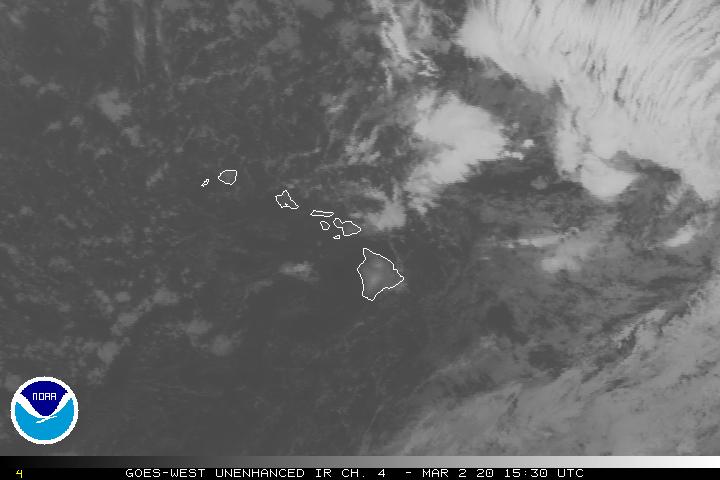



Sharon Says:
Aloha Glenn!
In those gorgeous satellite images, the ITCZ has moved much closer to our islands recently. Is there an explanation for what causes this? How will it affect our weather?
Mahalo from the weather wonderer!~~~Hello Sharon, the ITCZ is located approximately at 8 degrees north latitude…about where I would expect it to be during August, as shown here: http://www.prh.noaa.gov/hnl/graphics/npac.gif / There sure are lots of thunderstorms popping up in that elongated zone of low pressure, that’s for sure…as shown here: http://www.ssd.noaa.gov/goes/west/cpac/ir4.jpg / None of the models are showing anything spinning up down to our south, although several of the models are showing something forming well out over the ocean to our west in about 3-4 days. I don’t see the ITCZ (Intra-tropical convergence zone) having much bearing on our local weather…other than to keep our trade winds breezy. Looking over towards the eastern Pacific, which is quiet at the moment, we may see some action starting up over there in a few days as well…perhaps with a tropical storm by August 6th or 7th or so. Aloha, Glenn