Air Temperatures – The following maximum temperatures were recorded across the state of Hawaii Sunday afternoon:
Lihue, Kauai – 84
Honolulu airport, Oahu – 87
Kaneohe, Oahu – M
Molokai airport – 86
Kahului airport, Maui – 88
Kona airport – 84
Hilo airport, Hawaii – 84
Air Temperatures ranged between these warmest and coolest spots near sea level – and on the highest mountain tops around the state…as of 8pm Sunday evening:
Barking Sands, Kauai – 82
Hilo, Hawaii – 73
Haleakala Summit – 41 (near 10,000 feet on Maui)
Mauna Kea Summit – M (near 13,800 feet on the Big Island)
Hawaii’s Mountains – Here’s a link to the live web cam on the summit of near 13,800 foot Mauna Kea on the Big Island of Hawaii. This web cam is available during the daylight hours here in the islands…and when there’s a big moon shining down during the night at times. Plus, during the nights you will be able to see stars, and the sunrise and sunset too…depending upon weather conditions. Here's the Haleakala Crater webcam on Maui…although this webcam is not always working correctly.
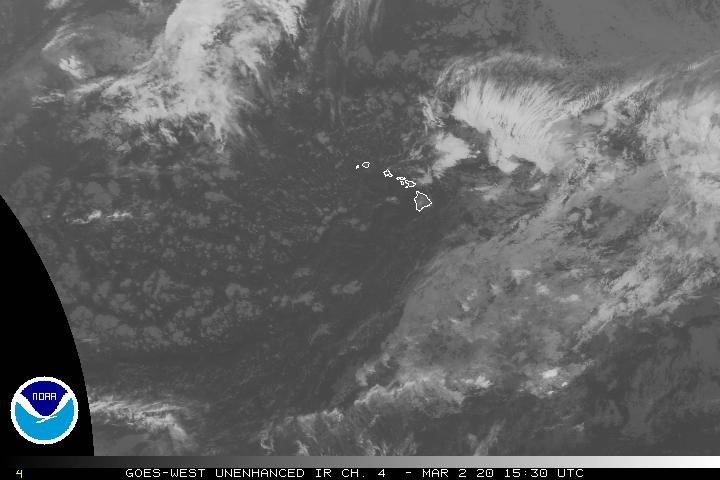
Tropical Cyclone activity in the eastern and central Pacific – Here’s the latest weather information coming out of the National Hurricane Center, covering the eastern north Pacific. You can find the latest tropical cyclone information for the central north Pacific (where Hawaii is located) by clicking on this link to the Central Pacific Hurricane Center. A satellite image, which shows the entire ocean area between Hawaii and the Mexican coast…can be found here.
Aloha Paragraphs

Trade winds continuing well into the
future, active windward showers
on the Big Island…and to a lesser
extent on Oahu, Kauai and Maui
As this weather map shows, we have a moderately strong high pressure systems aligned to the northwest and northeast of the islands. Our local trade winds will remain moderately strong in general through the next week.
The following numbers represent the most recent top wind gusts (mph), along with directions as of Sunday evening:
30 Lihue, Kauai – NE
39 Kuaokala, Oahu – NE
23 Molokai – E
35 Kahoolawe – NE
35 Kahului, Maui – NE
29 Lanai – NE
36 Puu Mali, Big Island – NE
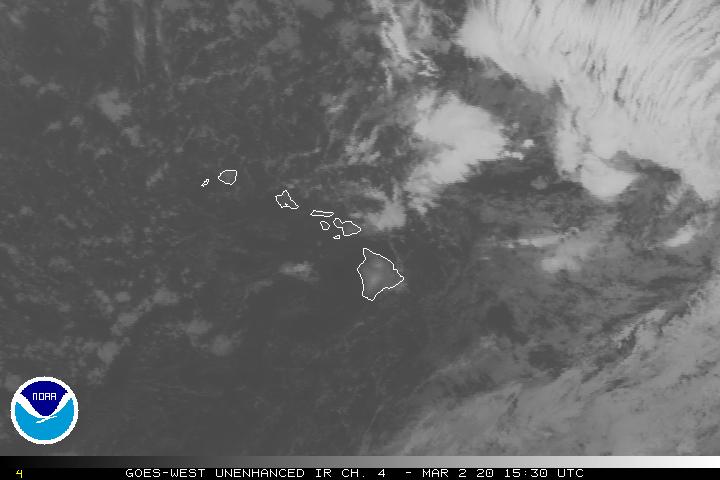
We can use the following links to see what’s going on in our area of the north central Pacific Ocean. Here's the latest NOAA satellite picture – the latest looping satellite image…and finally the latest looping radar image for the Hawaiian Islands.
Here are the latest 24-hour precipitation totals (inches) for each of the islands as of Sunday evening:
1.12 Mount Waialeale, Kauai
0.51 Oahu Forest NWR, Oahu
0.47 Molokai
0.00 Lanai
0.06 Kahoolawe
1.09 Puu Kukui, Maui
0.68 Kawainui Stream, Big Island
~~ Sunset Commentary ~~
Trade winds continuing into the new week ahead. We find a couple of moderately strong high pressure systems (weather map) located to the north-northwest through northeast of the islands Sunday evening. The trades that are being generated by this well established zone of high pressure to our north, will carry windward showers our way in an off and on manner…into the new week. The leeward sides will remain generally dry, although a few showers could fall here and there, especially along the Kona slopes on the Big Island during the afternoon into evening hours.
Friday evening film: This time around, some of my neighbors and I went to see a new film, called Hope Springs, starring Meryl Streep and Tommy Lee Jones, and Steve Carell. The synopsis: Kay and Arnold are a devoted couple, but decades of marriage have left Kay wanting to spice things up and reconnect with her husband. When she hears of a renowned couple's specialist in the small town of Great Hope Springs, Maine, she attempts to persuade her skeptical husband, a steadfast man of routine, to get on a plane for a week of marriage therapy. Just convincing the stubborn Arnold to go on the retreat is hard enough — the real challenge for both of them comes as they shed their bedroom hang-ups and try to re-ignite the spark that caused them to fall for each other in the first place. ~~~ The reviews of this film vary from great to lousy, although upon seeing it, I come down on the side of very entertaining. I wouldn't necessarily call it one of my favorite of the year, although it was a really sweet film. There were some good belly laughs, and also a few times when I'm sure a few folks in the theater may have shed a few tears, in other words…quite a wide range. The acting was superb, and we all agreed on that, with the average grade somewhere between B and B+. It was a film well worth seeing! Here's a trailer for this what's being called a comedy.
Here in Kula, Maui at 510pm Sunday evening, it was clear to partly cloudy…with an air temperature of 73.8F degrees. The trade winds will continue across our islands through the next week and more. These trade winds will blow generally in the moderately strong realms. If we look at this satellite image, we see low level patches and bands of clouds upstream of our islands, to the east and northeast. The forecast continues to show windward biased showers continuing at times, especially around the Big Island tonight…some of which could be locally heavy. I'll be back again early Monday morning with your next new weather narrative, I hope you have a great Sunday night wherever you happen to be spending it! Aloha for now…Glenn.
World-wide tropical cyclone activity:
Central Pacific Ocean: There are no active tropical cyclones
Eastern Pacific Ocean: There are no active tropical cyclones
Cloudiness and showers are located just offshore from southwest Mexico…to the south of the Gulf of California, with a low 0% chance of developing into a tropical depression over the next 48 hours or so. Here's a satellite image showing this tropical disturbance.
Atlantic Ocean/Gulf of Mexico/Caribbean: Tropical storm Gordon (8L) is weakening in the Atlantic, located about 255 miles east of the Azores. Sustained winds were 65 mph. Here's the NHC graphical track map for tropical storm Gordon.
Meanwhile, another area of disturbed weather is located in the central Atlantic, located about 1100 miles east of the Lesser Antilles…moving westward. The NHC is giving this area a high 80% chance of developing into a tropical depression during the next 48 hours.
Showers and thunderstorms are located over the southwestern Gulf of Mexico, with a medium 30% chance of developing into a tropical depression over the next day or two.
Finally, an area of disturbed weather is located south of the Cape Verde Islands is the eastern Atlantic, moving westward, with a low 20% chance of becoming a tropical depression within 48 hours.
Here's a satellite image showing tropical storm Gordon in the Atlantic, a tropical disturbance moving westward in the central Atlantic, and the area of disturbed weather in the southwest Gulf…and finally the area of disturbed weather in the eastern Atlantic offshore from the African west coast.
Western Pacific Ocean: Typhoon Tembin (15W) remains active…located about 420 NM south-southeast of Taipei, Taiwan. Sustained winds are 110 knots, with gusts to near 135 knots! The JTWC keeps Tembin over the ocean, although eventually brings it over the south central part of Taiwan, and then across the Taiwan Strait into the east coast of mainland China, not far to the north of Hong Kong. Here's the JTWC graphical track map…which shows it becoming a stronger typhoon over the next several days.
Newly formed Tropical storm Bolaven (16W) is active in the western Pacific…located about 400 NM south of Iwo To, Japan. The JTWC keeps Bolaven over the ocean, away from land through the next 5 days. Here's the JTWC graphical track map…which shows it becoming a typhoon around mid-week. Sustained winds are 35 knots, with gusts to near 45 knots.
South Pacific Ocean: There are no active tropical cyclones
North and South Indian Oceans: There are no active tropical cyclones
Interesting: The U.S. Department of Energy's "2011 Wind Technologies Market Report" finds that in 2011, the United States was still one of the fastest-growing markets for wind power. Around 6.8 gigwatts (GW) of new wind power capabilities were established in 2011, up from 5.2 GW in 2010. 2011 levels, however, were still beneath the 10 GW built in 2009.
With the concerns of uncertain federal policies on the way, 2012 is expected to have the wind power market reach its peak, according to the research. Put together by Lawrence Berkeley National Laboratory (Berkeley Lab), the "2011 Wind Technologies Market Report" listed some other important points: Today, wind power accounts for over 10% of the total electricity production in six states, two of which have over 20%.
Combined, these statistics comprise over 3% of the nation's entire supply of electricity. In 2011, wind power made up 32% of all the new additions to U.S. electricity capacity. In 2011, wind turbine manufacturers and suppliers still kept their productions domestic.
Therefore, a large number of wind power projects' equipment is from the U.S. In 2005-2006, approximately 35% of the equipment was domestic while in 2011 it rose to 67%. Yet, according to Ryan Wiser, a Staff Scientist at Berkeley Lab and co-author of the report, "behind these positive headline numbers, the domestic wind industry supply chain is currently facing severe pressure, due to uncertain prospects after 2012."
Profits have lowered, and there is a growing concern that manufacturing is producing over capacity, which could lead to major layoffs should turbine demand remain as is or further decline. Increased turbine scaling has created a larger average for capacity factors.
Since 1998-99, the average nameplate capacity of wind turbines installed in the U.S. has gone up by 174% (to 1.97 MW in 2011), the average turbine hub height has increased by 45%, and the average rotor diameter has grown by 86%. In some areas, however, the increase has been reduced by significant cuts in output of wind energy and wind developers building out lower wind speed sites.
 Email Glenn James: