Air Temperatures – The following maximum temperatures were recorded across the state of Hawaii Friday afternoon:
Lihue, Kauai – 85
Honolulu airport, Oahu – 87
Kaneohe, Oahu – M
Molokai airport – 85
Kahului airport, Maui – 86
Kona airport – 86
Hilo airport, Hawaii – 85
Air Temperatures ranged between these warmest and coolest spots near sea level – and on the highest mountain tops around the state…as of 10pm Friday evening:
Honolulu, Oahu – 77
Hilo, Hawaii – 71
Haleakala Summit – 43 (near 10,000 feet on Maui)
Mauna Kea Summit – M (near 13,800 feet on the Big Island)
Hawaii’s Mountains – Here’s a link to the live web cam on the summit of near 13,800 foot Mauna Kea on the Big Island of Hawaii. This web cam is available during the daylight hours here in the islands…and when there’s a big moon shining down during the night at times. Plus, during the nights you will be able to see stars, and the sunrise and sunset too…depending upon weather conditions. Here's the Haleakala Crater webcam on Maui…although this webcam is not always working correctly.
Tropical Cyclone activity in the eastern and central Pacific – Here’s the latest weather information coming out of the National Hurricane Center, covering the eastern north Pacific. You can find the latest tropical cyclone information for the central north Pacific (where Hawaii is located) by clicking on this link to the Central Pacific Hurricane Center. A satellite image, which shows the entire ocean area between Hawaii and the Mexican coast…can be found here.
Aloha Paragraphs

Trade winds continuing well into
the future, generally fine weather
prevailing…windward showers
increasing some this weekend
As this weather map shows, we have a moderately strong near 1025 millibar high pressure system located to the north of the islands. Our local trade winds becoming a little lighter into the weekend.
The following numbers represent the most recent top wind gusts (mph), along with directions as of Friday evening:
30 Port Allen, Kauai – NE
28 Kuaokala, Oahu – NNE
31 Molokai – NE
31 Kahoolawe – NE
30 Kahului, Maui – NE
32 Lanai – NE
28 Pali 2, Big Island – NE
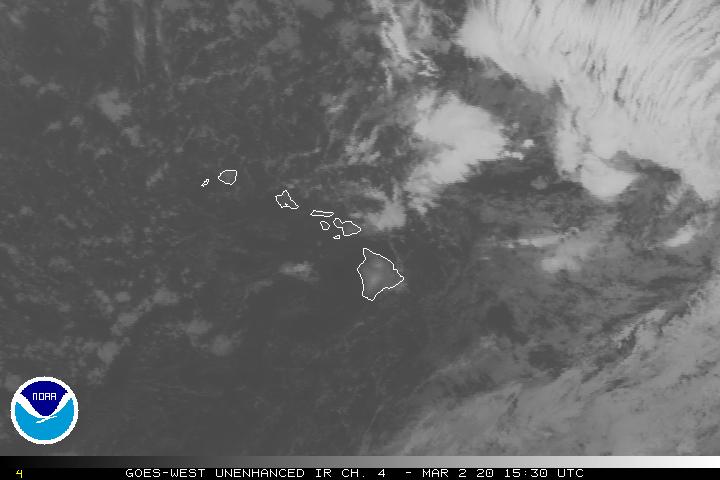
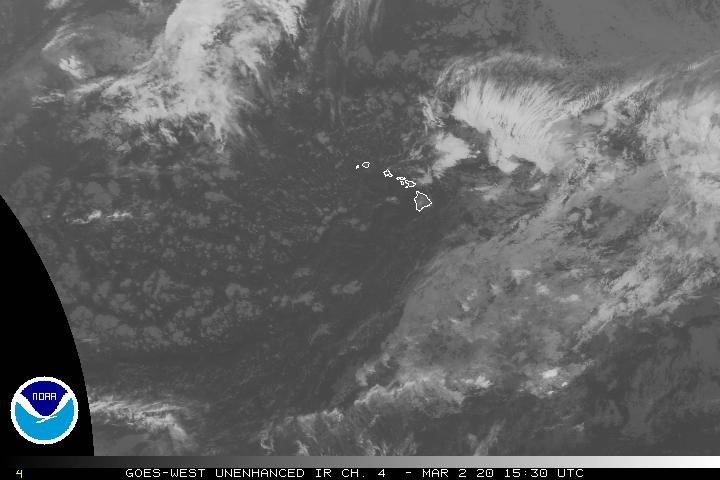
We can use the following links to see what’s going on in our area of the north central Pacific Ocean. Here's the latest NOAA satellite picture – the latest looping satellite image…and finally the latest looping radar image for the Hawaiian Islands.
Here are the latest 24-hour precipitation totals (inches) for each of the islands as of Friday afternoon:
0.24 Mount Waialeale, Kauai
0.21 Manoa Lyon Arboretum, Oahu
0.18 Molokai
0.00 Lanai
0.00 Kahoolawe
0.21 Puu Kukui, Maui
0.68 Pahoa, Big Island
~~ Sunset Commentary ~~
Trade winds continuing through the rest of this week…into the new week ahead. We find a near 1025 millibar high pressure system (weather map) located to the north of the islands Friday evening…with an elongated high pressure ridge running from its center southwest…to the northwest and west of Kauai. These trades will carry a few windward showers towards us at times, increasing some Saturday evening, into the new week. The leeward sides will remain generally dry, although the leeward Kona slopes on the Big Island may see a few afternoon or early evening showers at times.
Friday evening film: This time around, a few friends and I will go see a new film, called Hope Springs, starring Meryl Streep and Tommy Lee Jones, and Steve Carell. The synopsis: Kay and Arnold are a devoted couple, but decades of marriage have left Kay wanting to spice things up and reconnect with her husband. When she hears of a renowned couple's specialist in the small town of Great Hope Springs, she attempts to persuade her skeptical husband, a steadfast man of routine, to get on a plane for a week of marriage therapy. Just convincing the stubborn Arnold to go on the retreat is hard enough — the real challenge for both of them comes as they shed their bedroom hang-ups and try to re-ignite the spark that caused them to fall for each other in the first place. ~~~ The reviews of this film vary from great to lousy, although who knows until ones sees it for themselves? I'll give it a try, and get back to you tomorrow morning with my own thoughts, plus the other scientists that will be joining me. Here's a trailer for this, what's being called a comedy.
Here in Kula, Maui at 515pm Friday evening, it was mostly clear and a little breezy…with an air temperature of 79.9F degrees. The trade winds will continue to blow across our islands through the next week and more. These trade winds will blow generally in the moderately strong realms…although with those typically stronger gusts locally. If we look at this satellite image, we see low level cloud patches upstream of our islands, to the east and northeast. The computer forecast models continue to suggest a modest increase in windward biased showers starting this weekend, and lasting into the new week ahead. In sum: trade wind weather pattern is expected to continue, with occasional windward showers…increasing some Saturday evening into Sunday onwards. This isn't going to be a washout by any means, it will just bring our shower activity back up closer to normal for the most part through most of the new week. I'll be back Saturday morning with your next new weather narrative from paradise, I hope you have a great Friday night wherever you happen to be spending it! Aloha for now…Glenn.
World-wide tropical cyclone activity:
Central Pacific Ocean: There are no active tropical cyclones
Eastern Pacific Ocean: There are no active tropical cyclones
Atlantic Ocean/Gulf of Mexico/Caribbean: Hurricane Gordon (8L) is active in the Atlantic, located about 700 miles west-southwest of the Azores. Sustained winds were 00 mph. Here's the NHC graphical track map for hurricane Gordon…which will strength a touch more, before gradually weakening thereafter through the remainder of its life cycle.
Tropical depression Helene (9L) is active inland over southern Mexico, located about 15 miles south-southwest of Tampico, Mexico. Sustained winds were 35 mph…dissipating quickly into a remnant low tonight. Here's the NHC graphical track map for TD Helene.
Meanwhile, an area of disturbed weather is located far to the east in the Atlantic…moving westward. The NHC is giving this area a medium 40% chance of developing into a tropical depression during the next 48 hours.
Here's a satellite image showing hurriane Gordon in the Atlantic, tropical depression Helene over southern Mexico…and this tropical disturbance in the eastern Atlantic.
Western Pacific Ocean: There are no active tropical cyclones
South Pacific Ocean: There are no active tropical cyclones
North and South Indian Oceans: There are no active tropical cyclones
Interesting: In the face of a changing climate many species must adapt or perish. Ecologists studying evolutionary responses to climate change forecast that cold-blooded tropical species are not as vulnerable to extinction as previously thought.
The study, published in the British Ecological Society's Functional Ecology, considers how fast species can evolve and adapt to compensate for a rise in temperature. The research, carried out at the University of Zurich, was led by Dr Richard Walters, now at Reading University, alongside David Berger now at Uppsala University and Wolf Blanckenhorn, Professor of Evolutionary Ecology at Zurich.
"Forecasting the fate of any species is difficult, but it is essential for conserving biodiversity and managing natural resources," said lead author Dr Walters. "It is believed that climate change poses a greater risk to tropical cold-blooded organisms (ectotherms), than temperate or polar species.
However, as potential adaptation to climate change has not been considered in previous extinction models we tested this theory with a model forecasting evolutionary responses." Ectotherms, such as lizards and insects, have evolved a specialist physiology to flourish in a stable tropical environment.
Unlike species which live in varied habitats tropical species operate within a narrow range of temperatures, leading to increased dangers if those temperatures change.
 Email Glenn James: