Air Temperatures – The following maximum temperatures were recorded across the state of Hawaii Thursday afternoon:
Lihue, Kauai – 83
Honolulu airport, Oahu – 88
Kaneohe, Oahu – M
Molokai airport – 84
Kahului airport, Maui – 87
Kona airport – 84
Hilo airport, Hawaii – 82
Air Temperatures ranged between these warmest and coolest spots near sea level – and on the highest mountain tops around the state…as of 8pm Thursday evening:
Barking Sands, Kauai – 79
Hilo, Hawaii – 76
Haleakala Summit – 45 (near 10,000 feet on Maui)
Mauna Kea Summit – M (near 13,800 feet on the Big Island)
Hawaii’s Mountains – Here’s a link to the live web cam on the summit of near 13,800 foot Mauna Kea on the Big Island of Hawaii. This web cam is available during the daylight hours here in the islands…and when there’s a big moon shining down during the night at times. Plus, during the nights you will be able to see stars, and the sunrise and sunset too…depending upon weather conditions. Here's the Haleakala Crater webcam on Maui…although this webcam is not always working correctly.
Tropical Cyclone activity in the eastern and central Pacific – Here’s the latest weather information coming out of the National Hurricane Center, covering the eastern north Pacific. You can find the latest tropical cyclone information for the central north Pacific (where Hawaii is located) by clicking on this link to the Central Pacific Hurricane Center. A satellite image, which shows the entire ocean area between Hawaii and the Mexican coast…can be found here.
Aloha Paragraphs

Trade winds continuing well into
the future, generally fine weather
prevailing statewide…with those
usual windward showers at times
As this weather map shows, we have a moderately strong near 1026 millibar high pressure system located to the northeast of the islands…moving southwest. Our local trade winds becoming a little lighter into the weekend.
The following numbers represent the most recent top wind gusts (mph), along with directions as of Thursday evening:
28 Port Allen, Kauai – ENE
30 Kuaokala, Oahu – NE
30 Molokai – NE
37 Kahoolawe – NE
32 Kahului, Maui – NE
32 Lanai – NE
31 Puu Mali, Big Island – ESE
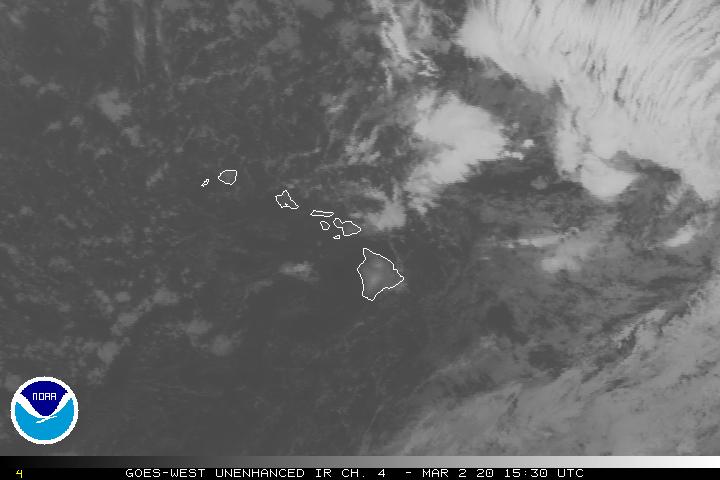
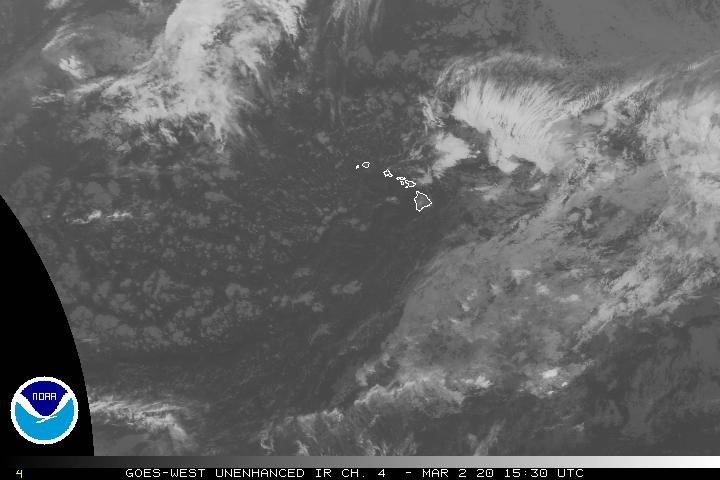
We can use the following links to see what’s going on in our area of the north central Pacific Ocean. Here's the latest NOAA satellite picture – the latest looping satellite image…and finally the latest looping radar image for the Hawaiian Islands.
Here are the latest 24-hour precipitation totals (inches) for each of the islands as of Thursday evening:
0.15 Kilohana, Kauai
0.11 Poamoho RG 1, Oahu
0.33 Molokai
0.00 Lanai
0.00 Kahoolawe
0.64 Puu Kukui, Maui
0.43 Kawainui Stream, Big Island
~~ Sunset Commentary: ~~
Trade winds continuing through the rest of this week…although with a slight weakening as we get into the weekend. We find a near 1026 millibar high pressure system (weather map) located to the northeast of the islands Thursday evening…with an elongated high pressure ridge running from its center southwest…to the north and northwest of Kauai. These trades will carry a few windward showers towards us at times, perhaps increasing some this weekend, into early next week. The leeward sides will remain generally dry, although the leeward Kona slopes on the Big Island may see a few afternoon or early evening showers at times.
Here in Kula, Maui at 510pm Thursday evening, it was clear to partly cloudy…with an air temperature of 80.6F degrees. The trade winds will continue to blow across our islands through the next week and more. These trade winds will ease up some Friday into the weekend. If we look at this satellite image, we see low level cloud patches upstream of our islands, to the east and northeast. At the same time, we see long line of thunderstorms far to our southwest through southeast of the state. The computer models continue to suggest a modest upturn in windward biased showers starting this weekend, and lasting through next Tuesday or Wednesday. In sum: trade wind weather pattern is expected to continue, with local wind speeds easing up a touch, with occasional windward showers…perhaps increasing some this weekend. I'll be back early Friday morning with your next new weather narrative, I hope you have a great Thursday night wherever you happen to be spending it! Aloha for now…Glenn.
World-wide tropical cyclone activity:
Central Pacific Ocean: There are no active tropical cyclones
Eastern Pacific Ocean: Post-tropical cyclone Hector (8E) is dissipating over the waters offshore from Mexico…located about 440 miles west-southwest of the southern tip of Baja California…with sustained winds of 30 mph. Former tropical depression Hector is now a remnant low pressure system. Here's a NHC graphical track map. Here's the NHC satellite image showing retired Hector. – Final Advisory
Atlantic Ocean/Gulf of Mexico/Caribbean: Tropical storm Gordon (8L) is active in the Atlantic, located about 1100 miles west of the Azores Islands. Sustained winds were 65 mph…with a small bit of further strengthening expected during the next 24-36 hours. Here's the NHC graphical track map for TS Gordon.
The remnants of retired tropical depression 7L is over the Bay of Campeche, Mexico. There's a high 80% chance that this area could regenerate into a tropical cyclone. Here's a satellite image of this area. Gusty winds and locally heavy rains will continue over this area.
Finally, a new area of disturbed weather is located far to the east in the Atlantic, just offshore from the western African coast. The NHC is giving this area a low 10% chance of developing into a tropical depression during the next 48 hours.
Here's a satellite image showing former 7L, tropical storm Gordon in the Atlantic…and this new tropical disturbance near the African coast.
Western Pacific Ocean: Typhoon Kai-tak (14W) is located approximately 120 NM east-northeast of Hanoi, Vietnam. Sustained winds were 60 knots with gusts to near 75 knots. The JTWC forecast track takes this storm across the Gulf of Tonkin…before making a landfall along the Cam Pha District of Vietnam. Heavy rains, strong winds, and rising surf will accompany 14W as it takes aim on this coast . Here's a JTWC graphical track map.
South Pacific Ocean: There are no active tropical cyclones
North and South Indian Oceans: There are no active tropical cyclones
Interesting: Global Warming Causes More Extreme Shifts of the Southern Hemisphere's Largest Rain Band, Study Suggests. The changes will result from the South Pacific rain band responding to greenhouse warming. The South Pacific rain band is largest and most persistent of the Southern Hemisphere spanning the Pacific from south of the Equator, south-eastward to French Polynesia.
Occasionally, the rain band moves northwards towards the Equator by 1000 kilometers, inducing extreme climate events. The international study, led by CSIRO oceanographer Dr Wenju Cai, focuses on how the frequency of such movement may change in the future. The study finds the frequency will almost double in the next 100 years, with a corresponding intensification of the rain band.
Dr Wenju and colleagues turned to the extensive archives of general circulation models submitted for the fourth and fifth IPCC Assessments and found that increases in greenhouse gases are projected to enhance equatorial Pacific warming.
In turn, and in spite of disagreement about the future of El Niño events, this warming leads to the increased frequency of extreme excursions of the rain band. During moderate El Niño events with warming in the equatorial eastern Pacific, the rain band moves north-eastward by 300 kilometers.
Countries located within the bands' normal position such as Vanuatu, Samoa, and the southern Cook Islands experience forest fires and droughts as well as increased frequency of tropical cyclones, whereas countries to which the rain band moves experience extreme floods. "During extreme El Niño events, such as 1982/83 and 1997/98, the band moved northward by up to 1000 kilometers.
The shift brings more severe extremes, including cyclones to regions such as French Polynesia that are not accustomed to such events," said Dr Cai, a scientist at the Wealth from Oceans Flagship. "Understanding changes in the frequency of these events as the climate changes proceed is therefore of broad scientific and socio-economic interest."
A central issue for community adaptation in Australia and across the Pacific is understanding how the warming atmosphere and oceans will influence the intensity and frequency of extreme events. The impact associated with the observed extreme excursions includes massive droughts, severe food shortage, and coral reef mortality through thermally-induced coral bleaching across the South Pacific.
"Understanding changes in the frequency of these events as the climate changes proceed is therefore of broad scientific and socio-economic interest."
 Email Glenn James: