Air Temperatures – The following maximum temperatures were recorded across the state of Hawaii Monday afternoon:
Lihue, Kauai – 84
Honolulu airport, Oahu – 88
Kaneohe, Oahu – M
Molokai airport – 85
Kahului airport, Maui – 88
Kona airport – 86
Hilo airport, Hawaii – 83
Air Temperatures ranged between these warmest and coolest spots near sea level – and on the highest mountain tops around the state…as of 5pm Monday evening:
Port Allen, Kauai – 84
Hilo, Hawaii – 76
Haleakala Summit – M (near 10,000 feet on Maui)
Mauna Kea Summit – 34 (near 13,800 feet on the Big Island)
Hawaii’s Mountains – Here’s a link to the live web cam on the summit of near 13,800 foot Mauna Kea on the Big Island of Hawaii. This web cam is available during the daylight hours here in the islands…and when there’s a big moon shining down during the night at times. Plus, during the nights you will be able to see stars, and the sunrise and sunset too…depending upon weather conditions. Here's the Haleakala Crater webcam on Maui…although this webcam is not always working correctly.
Tropical Cyclone activity in the eastern and central Pacific – Here’s the latest weather information coming out of the National Hurricane Center, covering the eastern north Pacific. You can find the latest tropical cyclone information for the central north Pacific (where Hawaii is located) by clicking on this link to the Central Pacific Hurricane Center. A satellite image, which shows the entire ocean area between Hawaii and the Mexican coast…can be found here.
Aloha Paragraphs

Trades…generally good weather
Wind Advisory…Maui and Big Island summits
As this weather map shows, we have a moderately strong high pressure system located far to the northeast of the islands, with a low pressure trough, and a cold front far to our north-northwest. Our local trade winds will remain moderately strong through this new week.
The following numbers represent the most recent top wind gusts (mph), along with directions as of Monday evening:
29 Port Allen, Kauai – ENE
36 Kuaokala, Oahu – NE
33 Molokai – NE
32 Kahoolawe – ENE
35 Kahului, Maui – NE
36 Lanai – NE
33 Puu Mali, Big Island – NE
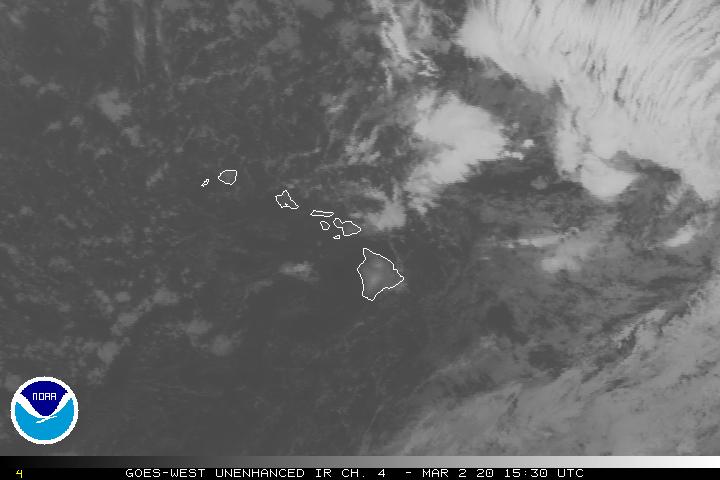
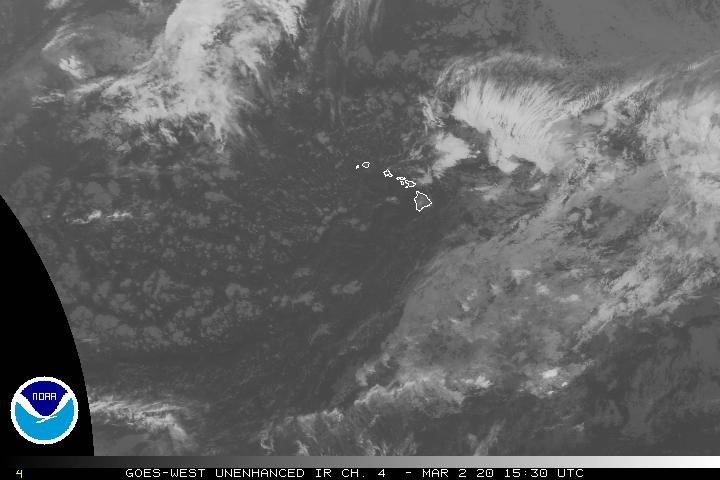
We can use the following links to see what’s going on in our area of the north central Pacific Ocean. Here's the latest NOAA satellite picture – the latest looping satellite image…and finally the latest looping radar image for the Hawaiian Islands.
Here are the latest 24-hour precipitation totals (inches) for each of the islands as of Monday evening:
0.44 Mount Waialeale, Kauai
0.10 Nuuanu Upper, Oahu
0.11 Molokai
0.00 Lanai
0.00 Kahoolawe
0.26 Puu Kukui, Maui
1.14 Kawainui Stream, Big Island
Sunset Commentary:
Moderately strong trade winds will continue to blow across our Hawaiian Islands…through the next week. We find a near 1028 millibar high pressure system (weather map) located to the northeast of the islands Monday evening…with an elongated high pressure ridge running from its center southwest to the north of Kauai. These trades will carry a few windward showers towards us, increasing somewhat during the overnight hours. The leeward sides will be generally dry, although the leeward Kona slopes on the Big Island may see a few afternoon or early evening showers locally. I don't see any interruptions to this fairly normal trade wind weather pattern through the end of the week…at least.
Here in Kula, Maui at 515pm Monday evening, it was clear to partly cloudy with a light breeze…and an air temperature of 80.2F degrees. The trade winds will continue to blow across our islands through the next week and more. If we look at this satellite image, we see scattered patches of low level clouds upstream of our islands, to the east and northeast. We'll find reasonably good weather prevailing in most areas over the next couple of days…especially along our leeward beaches. The trade winds remain strong enough, that the NWS forecast office in Honolulu is keeping a small craft wind advisory alive around those windiest channels and coast waters in Maui County and the Big Island. As usual, the cooler night time hours will prompt localized increases in showers, at least when cloud patches impact the windward sides of the islands. I don't see anything unusual weather conditions coming in our direction, so that our fine summertime weather conditions will prevail well into the future. I'll be back early Tuesday morning, I hope you have a great Monday night until then! Aloha for now…Glenn.
Extra: I couldn't resist showing you this cool…youtube video
World-wide tropical cyclone activity:
Central Pacific Ocean: There are no active tropical cyclones
Eastern Pacific Ocean: Tropical storm Hector (8E) remains active over the waters offshore from Mexico…located about 230 miles west-southwest of Socorro Island…with sustained winds of 45 mph. Tropical storm Hector isn't forecast to become a hurricane, and will be dropping back down to a tropical depression Thursday morning. Here's a NHC graphical track map. Here's the NHC satellite image showing tropical storm Hector.
Here's a satellite image showing both TS Hector
Atlantic Ocean/Gulf of Mexico/Caribbean: There are no active tropical cyclones
The remnants of retired tropical depression 7L is located over the west-central Caribbean Sea. There's a low 20% chance that this area could regenerate into a tropical cyclone. Here's a satellite image of this remnant low.
Meanwhile, another area of disturbed weather is located about 1050 miles southeast of Bermuda. This system has a medium 30% chance of developing into a tropical cyclone within the next 48 hours.
Here's a satellite image showing former 7L…and this other area of disturbed weather in the Atlantic.
Western Pacific Ocean: Tropical storm Kai-tak (14W) is located approximately 220 NM northeast of Manila, Philippines. Sustained winds were 50 knots with gusts to near 65 knots. It continues to be on a strengthening trend, and forecast by the JTWC to become a typhoon within 48 hours or so. The forecast track now takes this storm over northern Taiwan…and then northwest across the ocean towards mainland China…making landfall very near Hong Kong. Here's a JTWC graphical track map.
South Pacific Ocean: There are no active tropical cyclones
North and South Indian Oceans: There are no active tropical cyclones
Interesting: How many ancient cousins did early man have? Exciting new fossils discovered east of Lake Turkana confirm that there were two additional species of our genus — Homo — living alongside our direct human ancestral species, Homo erectus, almost two million years ago. The finds, announced in the prestigious scientific journal Nature on August 9th, include a face, a remarkably complete lower jaw, and part of a second lower jaw.
They were uncovered between 2007 and 2009 by the Koobi Fora Research Project (KFRP), led by Meave and Louise Leakey. KFRP’s fieldwork was facilitated by the Turkana Basin Institute (TBI), and the National Geographic Society. Four decades ago, the KFRP discovered the enigmatic fossil known as KNM-ER 1470 (or 1470 for short).
This skull, readily distinguished by its large brain size and long flat face, ignited a longstanding debate about just how many different species of early Homo lived alongside Homo erectus during the Pleistocene epoch. 1470’s unusual morphology was attributed by some scientists to sexual differences and natural degrees of variation within a single species, whereas others interpreted the fossil as evidence of a separate species.
Homo erectus is an extinct species of hominid that lived from the end of the Pliocene epoch to the later Pleistocene, about 1.3 to 1.8 million years ago. The species originated in Africa and spread as far as India, China and Java. The fossil KNM-ER 1470 is the center of much debate concerning its species. The skull was at first incorrectly dated at nearly three million years old, pre-dating the Homo habilis species.
Since then, the estimate has been corrected to 1.9 million years, but the differences in this skull, when compared to others of the Homo habilis species, are said to be too pronounced, leading to the presumption of a Homo rudolfensis species, contemporary with Homo habilis.
It is not certain whether H. rudolfensis was ancestral to the later species in Homo, or whether H. habilis was, or whether it was some third species, yet undiscovered. This decades-old dilemma has endured for two reasons. First, comparisons with other fossils have been limited due to the fact that 1470’s remains do not include its teeth or lower jaw.
Second, no other fossil skull has mirrored 1470’s flat and long face, leaving in doubt just how representative these characteristics are. The new fossils address both issues. "For the past 40 years we have looked long and hard in the vast expanse of sediments around Lake Turkana for fossils that confirm the unique features of 1470’s face and show us what its teeth and lower jaw would have looked like," says Meave Leakey, co-leader of the KFRP and a National Geographic Explorer-in-Residence.
"At last we have some answers." "Combined, the three new fossils give a much clearer picture of what 1470 looked like," says Fred Spoor, leader of the scientific analyses. "As a result, it is now clear that two species of early Homo lived alongside Homo erectus.
The new fossils will greatly help in unraveling how our branch of human evolution first emerged and flourished almost two million years ago." Found within a radius of just over 10 km from 1470’s location, the three new fossils are dated between 1.78 million and 1.95 million years old.
The face KNM-ER 62000, discovered by field crew member Elgite Lokorimudang in 2008, is very similar to that of 1470, showing that the latter is not a single odd one out individual. Moreover, the face’s well-preserved upper jaw has almost all of its cheek teeth still in place, which for the first time makes it possible to infer the type of lower jaw that would have fitted 1470.
A particularly good match can be found in the other two new fossils, the lower jaw KNM-ER 60000, found by Cyprian Nyete in 2009, and part of another lower jaw, KNM-ER 62003, found by Robert Moru in 2007. KNM-ER 60000 stands out as the most complete lower jaw of an early member of the genus Homo yet discovered.
 Email Glenn James: