











Air Temperatures – The following maximum temperatures were recorded across the state of Hawaii Friday afternoon:
Lihue, Kauai – 84
Honolulu airport, Oahu – 88
Kaneohe, Oahu – M
Molokai airport – 83
Kahului airport, Maui – 86
Kona airport – 85
Hilo airport, Hawaii – 83
Air Temperatures ranged between these warmest and coolest spots near sea level – and on the highest mountain tops around the state…as of 10pm Friday evening:
Barking Sands, Kauai – 80
Hilo, Hawaii – 73
Haleakala Summit – M (near 10,000 feet on Maui)
Mauna Kea Summit – 41 (near 13,800 feet on the Big Island)
Hawaii’s Mountains – Here’s a link to the live web cam on the summit of near 13,800 foot Mauna Kea on the Big Island of Hawaii. This web cam is available during the daylight hours here in the islands…and when there’s a big moon shining down during the night at times. Plus, during the nights you will be able to see stars, and the sunrise and sunset too…depending upon weather conditions. Here's the Haleakala Crater webcam on Maui…although this webcam is not always working correctly.
Tropical Cyclone activity in the eastern and central Pacific – Here’s the latest weather information coming out of the National Hurricane Center, covering the eastern north Pacific. You can find the latest tropical cyclone information for the central north Pacific (where Hawaii is located) by clicking on this link to the Central Pacific Hurricane Center. A satellite image, which shows the entire ocean area between Hawaii and the Mexican coast…can be found here.
Aloha Paragraphs

Gusty trades, windward showers
at times…summer weather!
As this weather map shows, we have moderately strong high pressure systems located to the north-northeast through far northeast of the islands, with a low pressure system far to our west…along the International Dateline. Our local trade winds will remain moderately through the weekend into the new week ahead…with locally stronger gusts.
The following numbers represent the most recent top wind gusts (mph), along with directions as of Friday evening:
23 Puu Opae, Kauai – SE
40 Kuaokala, Oahu – N
31 Molokai – NE
29 Kahoolawe – ENE
32 Kahului, Maui – NE
35 Lanai – NE
31 Kealakomo, Big Island – NE
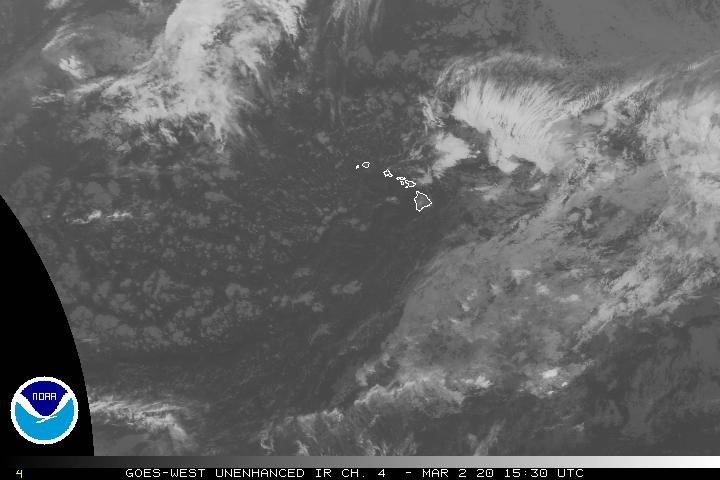
We can use the following links to see what’s going on in our area of the north central Pacific Ocean. Here's the latest NOAA satellite picture – the latest looping satellite image…and finally the latest looping radar image for the Hawaiian Islands.
Here are the latest 24-hour precipitation totals (inches) for each of the islands as of Friday afternoon:
0.07 Mount Waialeale, Kauai
0.06 Oahu Forest NWR, Oahu
0.10 Molokai
0.00 Lanai
0.00 Kahoolawe
0.03 Hana airport, Maui
1.09 Kawainui Stream, Big Island
Sunset Commentary:
Moderately strong trade winds will continue to blow across our Hawaiian Islands…with those locally stronger gusts in the windier locations. We find high pressure systems (weather map) located to the north-northeast through far northeast of the islands Friday afternoon…supporting this wind flow. These winds are easing up a little now, just enough that the NWS forecast office in Honolulu has cancelled the small craft wind advisory over parts of Maui County and the Big Island. These trades will carry a few windward showers towards us for the time being, with generally dry conditions expected along our leeward sides. The leeward Kona slopes on the Big Island on the other hand, may see a few afternoon or early evening showers locally. The computer models continue to also suggest we may see an increase in windward biased showers, on all the islands this weekend into early next week.
Friday night film: Several friends and I are heading down to Kahului this evening to see a new film, this one called Total Recall. It stars Colin Farrell, Bryan Cranston, Jessica Biel, Kate Beckinsale, Bill Nighy, and John Cho…among many others. The synopsis: welcome to Rekall, the company that can turn your dreams into real memories. For a factory worker named Douglas Quaid, even though he's got a beautiful wife who he loves, the mind-trip sounds like the perfect vacation from his frustrating life – real memories of life as a super-spy might be just what he needs. But when the procedure goes horribly wrong, Quaid becomes a hunted man. Finding himself on the run from the police ? controlled by Chancellor Cohaagen, the leader of the free world ? Quaid teams up with a rebel fighter to find the head of the underground resistance and stop Cohaagen. The line between fantasy and reality gets blurred and the fate of his world hangs in the balance as Quaid discovers his true identity, his true love, and his true fate. ~~~ This long film (2 hours 15 minutes) seems to have all the required things I like in an action flick, including intense sequences of sci-fi violence, some sexual content, brief nudity and severe language being thrown around! I'll of course let you know what I think in the morning, until then, here's the trailer.
Here in Kula, Maui at 515pm Friday evening, it was mostly clear and lightly breezy…with an air temperature of 80F degrees. The trade winds will continue to blow across our islands through the next week at least. If we look at this satellite image, we see scattered low level clouds upstream of our islands. Our normal trade wind weather conditions will prevail here in the islands well into the future. As we move into the Saturday through early next week, the models are showing an upper level low pressure system, with its cold air aloft, moving over the state. This will likely destabilize our air mass to some degree, with a chance that our windward biased showers could become somewhat more active. Conditions should stabilize and dry out again, as we move into the middle of next week or so. Otherwise, we're looking at pretty much status quo, as far as our summertime weather conditions go. I'll be back Saturday morning with your next new weather narrative. I hope you have a great Friday night from wherever you happen to be reading from! Aloha for now…Glenn.
Extra: The Perseid meteor shower — set to hit its peak this weekend — is expected to be "the best meteor shower of the year," NASA says. That's because, in addition to the blizzard of shooting stars, some of the most stunning orbs visible to mere mortals will be on sparkling display at the same time. The Perseid meteor shower is the glittery result of Earth's passage through a steam of debris left behind by a period comet called the Swift-Tuttle, according to NASA.
Reports of Perseid meteors are already rolling in and are expected to increase in intensity as the weekend gets underway. "We expect to see meteor rates as high as 100 per hour," said astronomer Bill Cooke, the head of NASA's Meteoroid Environment Office.
Cooke and his team will host an "Up All Night" live chat from Saturday at 11 p.m. to Sunday at 3 a.m. Participants will also get to see live video and audio feeds of the Perseid meteor shower from a camera mounted at the Marshall Space Flight Center. But the Perseid meteor shower is only part of the treat in store for stargazers, NASA says. "The brightest planets in the solar system are lining up right in the middle of the [Perseid] display," NASA says.
Specifically, "Jupiter, Venus and the crescent moon are gathering together just as the Perseid meteor shower reaches its peak." The red giant star Aldebaran will also be visible, "adding a splash of color to the gathering," NASA says. The three celestial orbs will make for a brilliant, three-point line in the sky, all surrounded by shooting stars.
The display is expected to be best seen in the eastern skies and in the early morning hours before sunrise. The show will get better as the weekend winds down. Early Monday, the increasingly narrowing moon will pass even closer to Venus, as Jupiter "hovers" overhead, according to NASA.
This is one of those moments for which astronomy buffs live, according to NASA, which adds: "Star-watchers say there's nothing prettier than a close encounter between the slender crescent moon and Venus. Nothing that is, except for the crescent moon, Venus and a flurry of Perseids."
World-wide tropical cyclone activity:
Central Pacific Ocean: There are no active tropical cyclones
Eastern Pacific Ocean: Tropical storm Gilma (7E)…is located about 665 miles west-southwest of the southern tip of Baja California. Sustained winds are running 60 mph. Gilma is expected to maintain tropical storm force winds through Saturday morning, and then drop down into the tropical depression level thereafter…before completely dissipating by Monday morning. There is no danger to the Mexican coast from this tropical cyclone. Here's the hurricane model output for Gilma.
Meanwhile, an area of low pressure offshore from the west coast of Mexico is associated with the circulation of former tropical depression Ernesto. There is a high 90% chance of this disturbance developing into a tropical cyclone within 48 hours.
Here's the NHC satellite image showing this area along with tropical storm Gilma.
Atlantic Ocean/Gulf of Mexico/Caribbean: Tropical depression (7L) remains active in the central Atlantic, located about 295 miles east of Barbados. Maximum sustained winds are 35 mph. Here's the official NHC graphical track map / Here's a satellite image of this depression / Here's the hurricane model output for tropical depression 7L.
Meanwhile, an area of disturbed weather is just to the north of the Cape Verde Islands, moving westward over the Atlantic Ocean. This system has a low 20% chance of developing into a tropical cyclone within the next 48 hours.
Here's a satellite image showing tropical depression 7L…and this other area of disturbed weather in the Atlantic.
Western Pacific Ocean: There are no active tropical cyclones
South Pacific Ocean: There are no active tropical cyclones
South and North Indian Oceans: There are no active tropical cyclones
Interesting: Stan Cox is a senior researcher at the Land Institute. His book, Losing Our Cool: Uncomfortable Truths About Our Air Conditioned World, describes the threat that our ever-increasing need for air conditioning poses to efforts to maintain our planetary climate within its natural limits, the limits that all living things on the planet have evolved to thrive in.
Consider these facts.
– With temperatures rising, those with air conditioning will be using them more frequently.
– As people in developing countries move into the middle class, they will buy air conditioners as a high priority item, especially in hot countries like India.
– Much of the electricity for these units is provided by fossil fuels, which contribute to global warming
– New refrigerants called HFC's , which were developed to avoid the impact the ozone layer associated with CFC's, are, unfortunately, potent greenhouse gases (GHG) and these will eventually leak out
Furthermore, air conditioning has encouraged people to move into and develop previously uninhabitable areas like Phoenix, that are inherently unsustainable without massive inflows of energy and fresh water. These people are now totally dependent on air conditioning for their survival.
Cox was recently a guest on Diane Rehm's radio talk show on NPR as part of her Environmental Outlook series. In that program Cox claimed that the overall impact of air-conditioning systems in both vehicles and buildings today is almost half a billion metric tons, which is about 7% of the US total.
Cox went on to say that if we remain on our current course, we can expect electricity used to power air-conditioners to increase tenfold by 2050. This is despite significant increases in a/c efficiency which has gone up 30% just in the past few years.
He goes on to say that in many instances, air-conditioning is "non-essential." Cox has done a valuable service in calling attention to this important issue, though I would have to say that his concerns going forward are somewhat exaggerated. There are a number of forces already at play in a variety of areas that will drive these numbers lower.
As we move forward and the need becomes even more apparent, these forces will most certainly be joined by others. A number of the following ideas were pointed out by Diane’s other guests on the show, including Steve Yurek of the Air Conditioning, Heating and Refrigeration Institute, Durwood Zaelke of the Institute for Governance and Sustainable Development, and NY Times environmental reporter Elisabeth Rosenthal, as well as various callers.
Among these are, on the equipment side: non-refrigerated cooling (such as evaporative cooling), geothermal heat pumps (which can pump heat into or out of a building), thermal energy storage systems (in which ice is made at night, when it can be done more efficiently, and used the following day to cool buildings), energy recovery ventilators (that extract heat and moisture from fresh air coming in), and absorption cooling in which a heat source is substituted for the mechanical action of the compressor.
This latter opens the door for solar cooling, which is a tremendously appealing concept, since the energy source is always present when it is needed most. On the building side, there are advanced control systems, which should help eliminate the problem of freezing indoors when it’s hot outside, advanced window glazing with optically reflective coatings, improved insulation and air sealing technology and passive solar design which takes building orientation, window location, and material selection into account before a structure is erected.
Then, of course, on the behavioral side, there is awareness raising and the possibility that people can be convinced that it doesn’t have to be winter cold inside during the summer (and summer hot during the winter.) There will be new, energy efficient, low carbon, and renewable energy sources. And finally, there will be government action.
For starters, an international agreement along the lines of the Montreal Protocol, to further regulate the use of refrigerants to eliminate those with high heat-trapping GHG characteristics is urgently needed. The Montreal Protocol, widely recognized as the most successful environmental agreement ever passed, has not only dramatically reduced the hole in the ozone layer, it also, according to Zaelke, avoided the release of a volume of GHG emissions so high it would have exacerbated our current climate worries by an additional fifty percent!
This agreement will eventually be followed by a truly meaningful international agreement on greenhouse emissions directly with mechanisms that will incorporate the true societal cost of various alternatives into the economics of energy.
There can be no doubt that such an agreement will eventually be passed. But sadly, thanks largely to intransigence on the part of the U.S. delegation; it is already too late to avoid significant harm.
 Email Glenn James: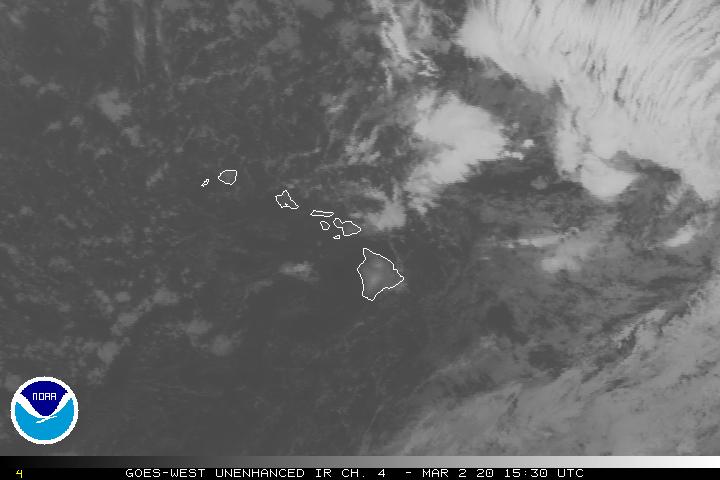






Jim Says:
Aloha Glenn, just wondering how the Perseid meteor shower viewing will be on the islands this weekend? Mahalo~~~Hi Jim, that’s a good question. I just put a story on this page, which you may have seen scrolling down to the bottom here. It talks about the meteor shower as if it will be one of the best of the year! As for weather conditions, they should provide good sky visibilities along with the leeward coasts and slopes, although the windward sides may become somewhat more cloudy and perhaps showery than they have been the last couple of days. I wish everyone luck in being to spot those great shooting stars this weekend! Aloha, Glenn