Air Temperatures – The following maximum temperatures were recorded across the state of Hawaii Wednesday:
Lihue, Kauai – 83
Honolulu airport, Oahu – 86 (Record high temperature for Wednesday – 91F / 1991)
Kaneohe, Oahu – 75
Molokai airport – 83
Kahului airport, Maui – 86 (Record high temperature for Wednesday – 94 / 1953)
Kona airport – 84
Hilo airport, Hawaii – 83
Air Temperatures ranged between these warmest and coolest spots near sea level – and on the highest mountain top around the state…as of 5pm Wednesday evening:
Kaneohe, Oahu – 82
Molokai airport – 78
Haleakala Summit – M (near 10,000 feet on Maui)
Mauna Kea Summit – 41 (near 13,800 feet on the Big Island)
Hawaii’s Mountains – Here’s a link to the live web cam on the summit of near 13,800 foot Mauna Kea on the Big Island of Hawaii. This web cam is available during the daylight hours here in the islands…and when there’s a big moon shining down during the night at times. Plus, during the nights you will be able to see stars, and the sunrise and sunset too…depending upon weather conditions. Here's the Haleakala Crater webcam on Maui…although this webcam is not always working correctly.
Tropical Cyclone activity in the eastern and central Pacific – Here’s the latest weather information coming out of the National Hurricane Center, covering the eastern north Pacific. You can find the latest tropical cyclone information for the central north Pacific (where Hawaii is located) by clicking on this link to the Central Pacific Hurricane Center. A satellite image, which shows the entire ocean area between Hawaii and the Mexican coast…can be found here. Here's a tropical cyclone tracking map for the eastern and central Pacific.
Aloha Paragraphs

Active trade winds this week…increasing
windward showers tonight into Thursday morning
High surf advisory south shores
As this weather map shows, we have a large near 1032 millibar high pressure system to the north-northwest of the islands. Our local winds will remain active from the trade wind direction through the next week…increase a touch Thursday and Friday.
The following numbers represent the most recent top wind gusts (mph), along with directions as of Wednesday evening:
22 Waimea Heights, Kauai – NE
38 Kuaokala, Oahu – NE
33 Molokai – NE
33 Kahoolawe – NE
36 Kahului, Maui
35 Lanai – NE
35 Pali 2, Big Island – NE
We can use the following links to see what’s going on in our area of the north central Pacific Ocean. Here's the latest NOAA satellite picture – the latest looping satellite image…and finally the latest looping radar image for the Hawaiian Islands.
Here are the latest 24-hour precipitation totals (inches) for each of the islands as of Wednesday evening:
0.62 Mount Waialeale, Kauai
0.16 Oahu Forest NWR, Oahu
0.06 Molokai
0.00 Lanai
0.00 Kahoolawe
0.31 Puu Kukui, Maui
0.46 Kawainui Stream, Big Island
Sunset Commentary: Our trade winds will remain at moderately strong levels for the time being, then increase a notch Thursday through the end of the week. These trade winds remain strong enough to keep small craft wind advisories active across those windiest channels and coastal areas around the state. There was a noticeable break in the windward biased showers today. As we get into tonight, and continuing into Thursday morning, there will be another modest increase in off and on passing showers falling along our windward sides. These showers will be carried over into leeward sides at times locally. There will be afternoon showers at times on the slopes in the Kona and Kau districts on the Big Island…and perhaps along the leeward upcountry slopes of the Haleakala Crater on Maui at times too. Fortunately, the weather was better for this 4th of July holiday, than it was the last several days. The models are suggesting that our weather will turn a little drier once again, after some more showers Thursday and Friday…as we head into the upcoming weekend.
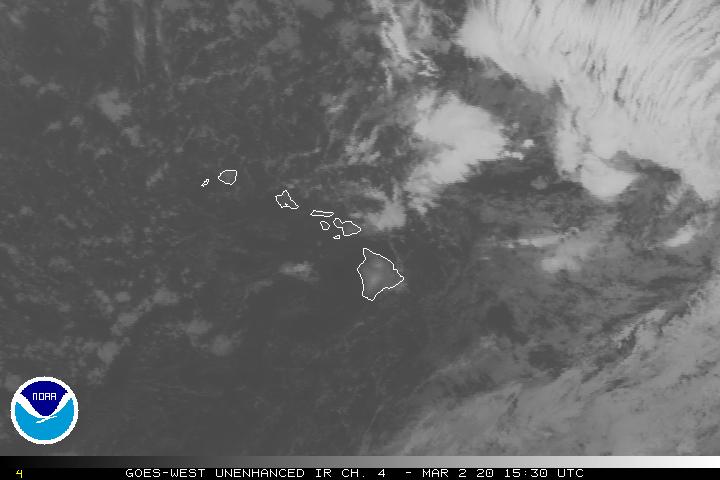
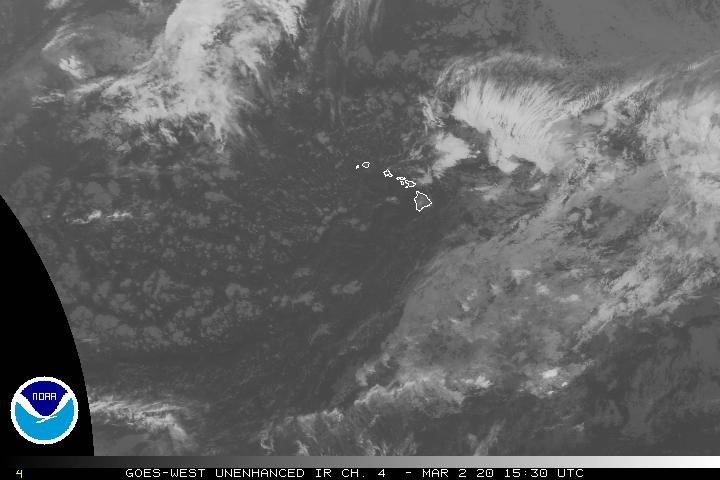
As this satellite image shows, we have more clouds approaching our windward coasts and slopes. The overlying atmosphere is relatively dry and stable now however, so that those clouds had a more difficult time dropping showers on this holiday. Meanwhile, there continues to be a large area of high cirrus clouds over the ocean to our northwest, west, and southwest. If we put this satellite image into motion, we can see that they may eventually spread over the islands with time. This won't be a problem, other than their dimming our famous Hawaiian sunshine a bit…as well as providing potentially colorful sunrise and sunsets. Here's a closer look at our islands using this satellite picture…so we can keep track of whatever showery clouds are upstream of the islands…as they continue to be carried our way on the still gusty trade wind flow.
Here in Kula, Maui at 5pm, it was partly cloudy and lightly breezy…with an air temperature of 75.3F degrees. As noted above, our trade winds will continue blowing, and even increasing some starting tomorrow. We have high cirrus clouds approaching from the west, and lower level cumulus clouds arriving from the east. The NWS has issued a high surf advisory for our south facing leeward beaches through Thursday evening…be careful if there are large waves breaking at the beach you go to! I anticipate that there will be some increase in clouds and showers this evening, starting first on the Big Island and Maui…then migrating westward to other areas during the night into early tomorrow morning. ~~~ I joined my neighbors in a bbq party today, as we grilled hamburgers, adding sliced onion, dill pickles, cheese, lettuce, and some sort of sauce. This was fun, and qualified as one of the two or three hamburgers that I consume during the course of the year. We celebrated our great country's Independence Day! I love the United States, although don't always fully appreciate various aspects of its political system. I'll be back early Thursday morning with your next new weather narrative. I hope you have a great Wednesday night wherever you're spending it! Aloha for now…Glenn.
[World-wide tropical cyclone activity:
Central Pacific Ocean: There are no active tropical cyclones
Eastern Pacific Ocean: Tropical depression 4E is active about 480 miles southwest of Manzanillo, Mexico…with 35 mph sustained winds. Gradual strengthening is expected during the next 12 hours, as it takes on the name tropical storm Daniel. Daniel will move away from the Mexican coast, and is forecast to become a hurricane very briefly by Saturday afternoon. Here's the official NHC graphical track map. Here's what the hurricane models are doing this soon to be storm. Here's a satellite image of this tropical cyclone, and the area of disturbed weather described below. As you can see, this tropical cyclone will be migrating westward away from Mexico, and towards our central Pacific, which starts at 140W longitude. Later this weekend, 4E will get over cooler sea water, and drier air, both of which will begin taking this system downward in strength. At this point, I would anticipate that 4E will dissipate before getting anywhere near our Hawaiian Islands.
DISORGANIZED SHOWER AND THUNDERSTORM ACTIVITY EXTENDS SEVERAL HUNDRED MILES WEST OF COSTA RICA OVER THE FAR EASTERN NORTH PACIFIC OCEAN. ONLY SLOW DEVELOPMENT OF THIS DISTURBANCE IS EXPECTED OVER THE NEXT FEW DAYS AS IT MOVES WESTWARD AT ABOUT 10 MPH. THIS SYSTEM HAS A LOW CHANCE…20 PERCENT…OF BECOMING A TROPICAL CYCLONE DURING THE NEXT 48 HOURS.
ELSEWHERE…TROPICAL CYCLONE FORMATION IS NOT EXPECTED DURING THE NEXT 48 HOURS.
Atlantic Ocean/Gulf of Mexico/Caribbean: There are no active tropical cyclones
A TROPICAL WAVE OVER THE EASTERN CARIBBEAN SEA IS PRODUCING DISORGANIZED SHOWERS AND THUNDERSTORMS AS IT MOVES RAPIDLY WESTWARD AT 20 TO 25 MPH. UPPER-LEVEL WINDS ARE NOT CONDUCIVE FOR DEVELOPMENT…AND THIS SYSTEM HAS A LOW CHANCE…NEAR 0 PERCENT… OF BECOMING A TROPICAL CYCLONE DURING THE NEXT 48 HOURS.
Here's a satellite image showing where this area of disturbed weather is located.
ELSEWHERE…TROPICAL CYCLONE FORMATION IS NOT EXPECTED DURING THE NEXT 48 HOURS.
Western Pacific Ocean: There are no active tropical cyclones
South Pacific Ocean: There are no active tropical cyclones
South and North Indian Oceans: There are no active tropical cyclones
Interesting: World leaders attending the recent Rio+20 conference agreed to promote sustainable consumption and production, but analysts say getting businesses and buyers to do just that will require far more than words on paper. To the immense disappointment of environmental groups and even some multinational corporations, Rio+20 failed to produce binding commitments or a plan on how to strike a balance between consumer demand and the availability of natural resource.
"The current deal on the Rio table is really scraping the barrel — with woolly definitions, old ideas and missing deadlines," said Craig Bennett, Friends of the Earth's director of policy and campaigns. "It doesn't come close to solving the planetary emergency we’re facing."
The stakes are high without some action. Consumers International, a London-based group, says humans are already consuming 50% more than the planet can replenish. The most sober projections from the United Nations suggest there could be shortages of freshwater, food and essential industrial minerals within two generations as the world population lurches towards 9 billion or more from 7 billion today, and as people in today's emerging markets become wealthier and more eager consumers.
Dutch MEP Bas Ecikhout (Greens) says firm actions are needed to address the challenges ahead. "We really have to think about pricing, how we deal with our taxation, what kind of products maybe [should not be] allowed anymore," he told EurActiv.
"We really have to have that discussion, and we need to go further than just labeling." At the UN Conference on Sustainable Development in Rio, there was no commitment to remove fossil fuel subsidies — which environmentalists see as one of the world’s most glaring impediments to sustainable consumption.
The Rio concluding documents signed by more than 100 global leaders promoted sustainable use of natural resources without setting any binding commitments.
 Email Glenn James: