











Air Temperatures – The following maximum temperatures were recorded across the state of Hawaii Monday afternoon:
Lihue, Kauai – 84
Honolulu airport, Oahu – 86
Kaneohe, Oahu – 85
Molokai airport – 81
Kahului airport, Maui – 84
Kona airport – 84
Hilo airport, Hawaii – 76
Air Temperatures ranged between these warmest and coolest spots near sea level – and on the highest mountain top around the state…as of 5pm Monday evening:
Port Allen, Kauai – 84
Hilo, Hawaii – 75
Haleakala Summit – M (near 10,000 feet on Maui)
Mauna Kea Summit – 41 (near 13,800 feet on the Big Island)
Hawaii’s Mountains – Here’s a link to the live web cam on the summit of near 13,800 foot Mauna Kea on the Big Island of Hawaii. This web cam is available during the daylight hours here in the islands…and when there’s a big moon shining down during the night at times. Plus, during the nights you will be able to see stars, and the sunrise and sunset too…depending upon weather conditions. Here's the Haleakala Crater webcam on Maui…although this webcam is not always working correctly.
Tropical Cyclone activity in the eastern and central Pacific – Here’s the latest weather information coming out of the National Hurricane Center, covering the eastern north Pacific. You can find the latest tropical cyclone information for the central north Pacific (where Hawaii is located) by clicking on this link to the Central Pacific Hurricane Center. A satellite image, which shows the entire ocean area between Hawaii and the Mexican coast…can be found here.
Aloha Paragraphs

Gusty trade winds…windward showers
As this weather map shows, we have moderately strong high pressure systems located to the northwest through northeast of the islands. Our local trade winds will remain active…increasing a notch into Wednesday.
The following numbers represent the most recent top wind gusts (mph), along with directions as of Monday evening:
30 Port Allen, Kauai – E
27 Wheeler Field, Oahu – E
37 Molokai – NE
47 Kahoolawe – ENE
37 Kahului, Maui – NE
36 South Point, Big Island – NE
We can use the following links to see what’s going on in our area of the north central Pacific Ocean. Here's the latest NOAA satellite picture – the latest looping satellite image…and finally the latest looping radar image for the Hawaiian Islands.
Here are the latest 24-hour precipitation totals (inches) for each of the islands as of Monday evening:
1.59 Mount Waialeale, Kauai
0.72 Paomoho RG 1, Oahu
0.35 Molokai
0.08 Lanai
0.00 Kahoolawe
1.44 Puu Kukui, Maui
1.81 Kawainui Stream, Big Island
Sunset Commentary:
Our local trade wind speeds will speed up some over the next couple of days…then calming down a notch during the second half of the week. We find several moderately strong high pressure systems located far to the northeast through northwest of Hawaii…providing this gusty wind flow. The trade winds will carry windward biased showers towards us, with a few along our leeward sides locally too. We can use this satellite image to see areas of clouds to our east and northeast, being carried our way by the trades. These clouds will bring showers periodically over the next several days. It still looks like the windward sides of both the Big Island and Maui County will see the most generous rainfall totals, as the northern fringe of moisture, associated with a tropical disturbance…passes by about 450 miles to our south. The trade wind boost, along with these passing showers, will gradually fade by mid-week, with a more typical trade wind weather returning Thursday through the upcoming weekend and beyond.
Here in Kula, Maui at 530pm Monday evening, it was cloudy and near calm…while the air temperature was 71.1F degrees. The trade winds have increased, and will remain elevated into Wednesday…before settling down again after the middle of the week. The NWS forecast office in Honolulu has expanded the small craft wind advisory over those windiest parts of Maui County and the Big Island…up into the area southeast of Oahu. Meanwhile, passing showers will impact our windward sides, with a few being carried over into the leeward sides on the gusty trade wind flow too. The windward sides of Maui and the Big Island will have the best chance to see this increase in showers…especially through Tuesday. We'll grade back into a classic summer trade wind weather pattern by the middle of this week onwards. I'll be back again early Tuesday morning with your next new weather narrative. I hope you have a great Monday night wherever you happen to be spending it! Aloha for now…Glenn.
World-wide tropical cyclone activity:
Central Pacific Ocean: There are no active tropical cyclones
A surface trough about 450 miles south of Honolulu Hawaii is moving toward the west at 15 to 20 mph. Although isolated thunderstorms have been occasionally developing in association with the trough, environmental conditions are not conducive for intensification. There is a low chance, near 0 percent, of this system becoming a tropical cyclone during the next 48 hours.
Elsewhere, no tropical cyclones are expected through Wednesday evening.
Here's the satellite image showing this area of disturbed weather…which isn't threatening Hawaii.
Eastern Pacific Ocean: There are no active tropical cyclones
Atlantic Ocean/Gulf of Mexico/Caribbean: There are no active tropical cyclones
A WEAK AREA OF LOW PRESSURE ASSOCIATED WITH A TROPICAL WAVE LOCATED ABOUT 1100 MILES WEST-SOUTHWEST OF THE CAPE VERDE ISLANDS CONTINUES TO PRODUCE DISORGANIZED SHOWER AND THUNDERSTORM ACTIVITY. ENVIRONMENTAL CONDITIONS APPEAR CONDUCIVE FOR SOME GRADUAL DEVELOPMENT OVER THE NEXT FEW DAYS…AND THIS SYSTEM HAS A LOW CHANCE…20 PERCENT…OF BECOMING A TROPICAL CYCLONE DURING THE NEXT 48 HOURS AS IT MOVES WESTWARD AT 10 TO 15 MPH.
ELSEWHERE…TROPICAL CYCLONE FORMATION IS NOT EXPECTED DURING THE NEXT 48 HOURS.
Here's a satellite image of this area…here's what the hurricane models are showing.
Western Pacific Ocean: Tropical storm Saola (10W) remains active in the Philippine Sea…moving in a north-northwesterly direction offshore to the northeast of Luzon Island. Sustained winds were 55 knots, with gusts to 70 knots. It is expected to slowly increase in strength, peaking in strength over the next three days. The latest JTWC forecast shows the center of Saola remaining just offshore of the northeastern tip Taiwan…and then moving towards mainland China. Here's the JTWC graphical track map, along with a NOAA satellite image. Here's the looping radar from Taiwan.
Meanwhile, trophical storm Damrey (11W) is active in the western Pacific…moving in a west-northwesterly direction to the northeast of Iwo To Island. Sustained winds were 35 knots, with gusts to 45 knots. It is expected to slowly increase in strength a little, although not attaining typhoon status during its life cycle. The latest JTWC forecast shows Damrey moving by over the ocean just to the south southern Japan, and then on towards the mainland China coast, impacting the coast to the north of Shanghai. Here's the JTWC graphical track map, along with a NOAA satellite image.
South Pacific Ocean: There are no active tropical cyclones
South and North Indian Oceans: There are no active tropical cyclones
Interesting: Researchers along the Pacific coastline say that the water has elevated levels of caffeine in the ocean. According to a new study out of Portland State University, researchers tested multiple sites on the Oregon shores of the Pacific Ocean to study caffeine pollution in the waters close to the shoreline. The lead scientists, Zoe Rodriguez del Rey and Elise Granek, collected over twenty samples along the ocean and adjacent bodies of water; they then brought them back to their lab for further analysis.
The samples collected along the shores of the Beaver State were from as north as Astoria, Ore. south to the border with California. The locations, by way of the samples, were classified as potentially polluted as they were situated near waste water treatment plants, rivers or streams emptying into the Pacific, or densely populated areas.
Rodriguez del Rey and Granek's research find that two locations with high caffeine levels were Cape Lookout and Carl Washburne State Park in Florence, Ore. Although these two locations came back as potentially polluted, they are not near any potential pollution sources.
Levels were also found after a late season rain and wind storm brought debris and triggered sewage overflows. In addition, there were low levels of caffeine in heavily populated areas, such as: Astoria, Coos Bay and Warrenton. The team's results also state that the waste water treatment facilities along the Oregon coast were effective in removing caffeine from the water, but heavy rains and sewer overflows brought the contaminants to the shore.
The study also suggests that septic tanks are not as effective at removing caffeine from the waterways along the coastlines. Rodriguez del Rey and Granek's study also suggests that caffeine being present in the water which could potentially signal additional anthropogenic pollution, from but are not limited to: pesticides, pharmaceuticals and other contaminants.
"Our study findings indicate that, contrary to our prediction, the waste water treatment plants are not a major source of caffeine to coastal waters," says Granek. "However, onsite waste disposal systems may be a big contributor of contaminants to Oregon's coastal ocean and need to be better studied to fully understand their contribution to pollution of ocean waters."
The study was published in the July 2012 edition of Marine Pollution Bulletin, "Occurrence and concentration of caffeine in Oregon coastal waters."
Interesting2: Despite recent growth, the US wind industry now fears a sharp slowdown. As the Wall Street Journal reports, domestic demand for wind turbines is falling. With the production tax credit (PTC) set to expire at the end of this year, manufacturers are not receiving many new orders. The CEO of Vestas, the world's largest producer of wind turbines, forecasts that the US market will decline by 80 percent over the next year.
Although the PTC originated during the George H.W Bush administration and originally reflected bipartisan consensus, clean energy policy has become increasingly politicized. A congressional agreement to extend the credit is unlikely during a contentious election year.
Even if policymakers renew the tax credit after the election, the market will remain uncertain and investments in the wind energy sector in 2013 are bound to be much lower than the record levels we have seen in the recent past. Unlike previous instances in which the PTC was temporarily withdrawn, the US now has a manufacturing base for wind turbines which will be negatively impacted by a decline in demand, placing several thousand jobs at risk.
The uncertain future of the PTC is characteristic of a US renewable energy (RE) policy that lacks long-term predictability. No national target for RE development exists, and most programs have traditionally only been extended in one- and two-year intervals.
Unless Congress can agree to extend some of the expiring initiatives, the only federal clean energy policies left after 2014 will be a 30 percent investment tax credit (ITC) for the solar industry, several underfunded RD&D programs, and a few initiatives for energy efficiency and conservation.
Some of the core RE policies passed as part of the 2009 American Recovery and Reinvestment Act expired last year and were not renewed. Examples include the Department of Energy (DOE)'s Section 1705 loan guarantee program, famous for its loans to Solyndra, and Section 1603 treasury grants allowing RE projects to receive an up-front cash grant in lieu of tax credits.
Even with this uncertainty, the RE sector in the US has grown. Without a national target, the main driver of RE deployment in the US has been a combination of these federal financial incentives and a number of state initiatives. For example, 29 US states and the District of Columbia currently employ a mandatory renewable energy portfolio standard (RPS).
A total of 8 states have RE goals and 18 offer additional financial incentives such as feed-in tariffs or tradeable RE credit schemes. The combined impact of these policies has been rather successful. Renewable energy in the United States is maturing, evolving from a niche market to an increasingly competitive alternative to fossil fuel-based generation.
For US sites with the best natural conditions, wind power can already produce power as economically as coal, gas and nuclear generators. Solar photovoltaic (PV) has experienced an unprecedented boom over the past few years and Crystalline silicon PV modules now cost as little as USD 1/watt.
The share of total US electricity generation from non-hydropower RE increased from 3.7 percent in 2009 to 4.7 percent in 2011. Last year, nine states generated more than 10 percent of their electricity with non-hydro RE, up from only two states a decade ago. This dynamic can continue to succeed, but only if the right policy framework is in place.
RE technologies are still far from their full potential — and further substantial cost reductions can be expected. However, various RE technologies require different levels and forms of support to further them on their pathway to competitiveness. The federal policy environment remains a key variable in this. Several effective policy tools are available.
 Email Glenn James: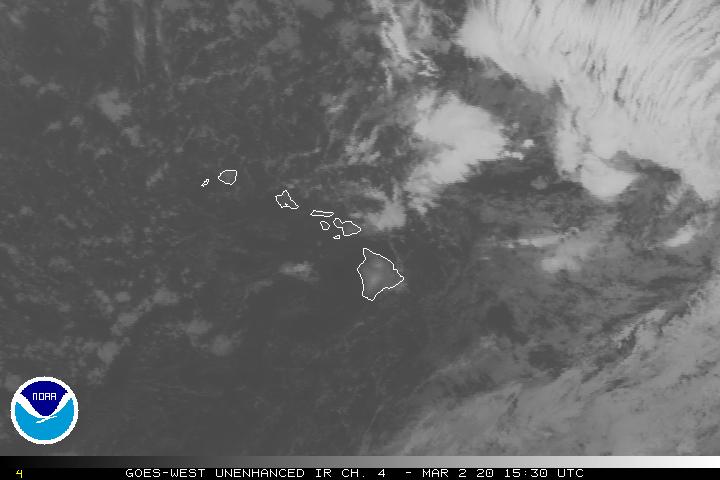


Rey Says:
Hi Glenn,
I am wondering why has it been extremely windy for months on end since 2010. I do not remember the weather being this way ever. Normally the weather is pretty calm after March. What is causing this? I have heard of La NIna, the Pacific Decadal Oscillation and now the Modoki El Nino. ~~~Hi Rey, good to hear from you. Actually, some of our least windy weather occurs between November and March…or at least that’s when our trade winds blow the least regularly. Between April and September we get a very regular flow of air over our latitudes of the central Pacific…our typical northeast to easterly trade winds. The trade winds blow near 95% of the time during the summer months, compared to near 42-65% of the time during the winter season. So, to see the trade winds blowing everyday is common from around March through summer months. These trade winds can slack off during the later autumn and winter months…although often blow even then. So, has it been extremely windy for months on end since 2010? I wouldn’t refer to it as extremely windy, but closer to normal in contrast. What you may want to note is that rather than referring to sustained winds here in the islands (on my website), I provide the top gusts…which I find more relevant. Thanks for your good question, Aloha, Glenn
Bill Slack Says:
Aloha Glenn,
Just wanted to say I appreciate your website here. Your commentary on the local conditions- what is going on, what is coming in the next few days is basically how I plan my activities while in Hawaii. How is that for pressure? 🙂 thanks for including all the links to satellites, surf forecasts, wave models, even snorkeling conditions. there is a wealth of weather info on this site for those who explore it a little.Mahalo Glenn! , Billy~~~Hi Billy, thank you for using my site, and for exploring a bit too…it covers pretty much everything weather related…with limits of course. I appreciate you giving a good strong thumbs up, and taking the time to let others know too! Aloha, Glenn