Air Temperatures – The following maximum temperatures were recorded across the state of Hawaii Wednesday:
Lihue, Kauai – 84
Honolulu airport, Oahu – 86
Kaneohe, Oahu – 86
Molokai airport – 84
Kahului airport, Maui – 87 (Record high temperature for Wednesday / 95 -1951)
Kona airport – 86
Hilo airport, Hawaii – 82
Air Temperatures ranged between these warmest and coolest spots near sea level – and on the highest mountain top around the state…as of 5pm Wednesday evening:
Honolulu, Oahu – 83
Hilo, Hawaii – 81
Haleakala Summit – M (near 10,000 feet on Maui)
Mauna Kea Summit – 50 (near 13,800 feet on the Big Island)
Hawaii’s Mountains – Here’s a link to the live web cam on the summit of near 13,800 foot Mauna Kea on the Big Island of Hawaii. This web cam is available during the daylight hours here in the islands…and when there’s a big moon shining down during the night at times. Plus, during the nights you will be able to see stars, and the sunrise and sunset too…depending upon weather conditions. Here's the Haleakala Crater webcam on Maui…although this webcam is not always working correctly.
Tropical Cyclone activity in the eastern and central Pacific – Here’s the latest weather information coming out of the National Hurricane Center, covering the eastern north Pacific. You can find the latest tropical cyclone information for the central north Pacific (where Hawaii is located) by clicking on this link to the Central Pacific Hurricane Center. A satellite image, which shows the entire ocean area between Hawaii and the Mexican coast…can be found here.
Aloha Paragraphs

Gusty trade winds…a few
windward showers at times
As this weather map shows, we have a strong near 1035 millibar high pressure system located far to the northeast of the islands…with a low pressure system and cold front to our west-northwest. Our local trade winds will remain active well into the future. A small craft wind advisory remains active in those windiest coasts and channels around Maui and the Big Island.
The following numbers represent the most recent top wind gusts (mph), along with directions as of Wednesday evening:
31 Lihue, Kauai – NE
40 Kuaokala, Oahu – NE
33 Molokai – NE
40 Kahoolawe – NE
38 Kahului, Maui – NE
39 Lanai – NE
38 PTA Keamuku, Big Island – NE
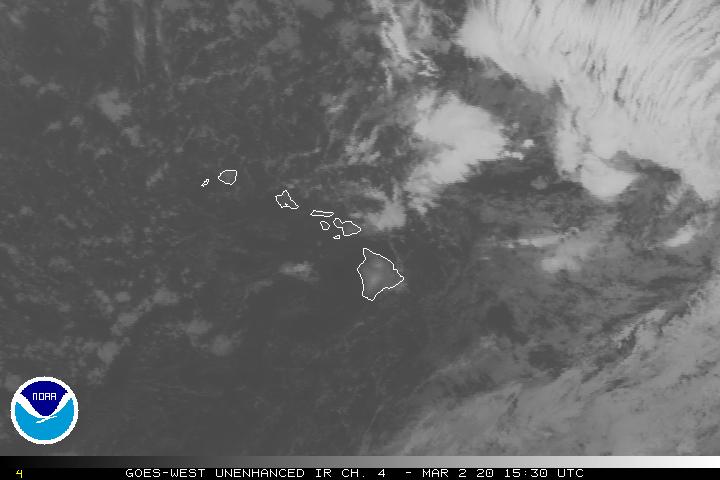
We can use the following links to see what’s going on in our area of the north central Pacific Ocean. Here's the latest NOAA satellite picture – the latest looping satellite image…and finally the latest looping radar image for the Hawaiian Islands.
Here are the latest 24-hour precipitation totals (inches) for each of the islands as of Wednesday evening:
0.77 Mount Waialeale, Kauai
0.07 Pupukea Road, Oahu
0.01 Molokai
0.00 Lanai
0.00 Kahoolawe
0.29 Puu Kukui, Maui
0.85 Kawainui Stream, Big Island
Sunset Commentary:
Our local trade wind speeds will have peaked today…then gradually slow down a little Thursday and Friday into the weekend. We find a strong near 1035 millibar high pressure system to the northeast of Hawaii, along with a weak low pressure system…and its associated cold front to our west-northwest. The trade winds will carry windward showers our way at times, with just a few along our leeward sides. The latest computer model output continues to point out that Kauai and perhaps parts of Oahu will see a possible modest increase in showers this weekend. Then by next Monday and Tuesday, the Big Island end of the island chain should see the northern fringe of a slug of tropical moisture arriving from the southeast…bringing an increase in showers.
Here in Kula, Maui at 545pm, it was clear to partly cloudy and breezy…with an air temperature of 79F degrees. The trade winds have peaked in strength today, reaching 43 mph in a gust on Oahu. These breezy trades will carry passing showers to our windward sides as usual…although not very many for the time being. The leeward sides on the smaller islands will be nearly dry. In sum, trade wind weather pattern well into the future, with the usual passing showers along our north and eastern facing windward sides…with those occasional localized increases and decreases. Air temperatures will match climatology closely, ranging between about 70F and 88F or so as a spread near sea level, depending upon location. ~~~ I'll be back again early Thursday morning, I hope you have a great Wednesday night wherever you happen to be spending it! Aloha for now…Glenn.
[World-wide tropical cyclone activity:
Central Pacific Ocean: There are no active tropical cyclones
Eastern Pacific Ocean: There are no active tropical cyclones
SHOWERS AND THUNDERSTORMS HAVE INCREASED IN ASSOCIATION WITH AN AREA OF LOW PRESSURE LOCATED ABOUT 1400 MILES SOUTHWEST OF THE SOUTHERN TIP OF BAJA CALIFORNIA. ENVIRONMENTAL CONDITIONS ARE MARGINALLY CONDUCIVE FOR SOME SLOW DEVELOPMENT OF THIS DISTURBANCE AS IT MOVES WESTWARD OR WEST-NORTHWESTWARD AT 10 TO 15 MPH DURING THE NEXT COUPLE OF DAYS. THIS SYSTEM HAS A LOW CHANCE…20 PERCENT…OF BECOMING A TROPICAL CYCLONE DURING THE NEXT 48 HOURS.
Here's a satellite image of this area located well offshore from the Mexican coast.
Atlantic Ocean/Gulf of Mexico/Caribbean: There are no active tropical cyclones
Western Pacific Ocean: There are no active tropical cyclones
South Pacific Ocean: There are no active tropical cyclones
South and North Indian Oceans: There are no active tropical cyclones
Interesting: Emerging once every two to seven years in the equatorial Pacific, El Niño causes disorder across the globe and for the global economy. But in the past ten years, it has changed its face. It is increasingly taking the form of Modoki, 'similar but different' as it was baptized by the Japanese team who first discovered this less tumultuous cousin that provokes droughts in India and Australia.
Recent research has described the physical manifestations of this El Niño variant, which is centered in the central pacific, unlike its eastern relative. The impact on marine biology and its probable effects on fishing still need to be examined. To achieve this, IRD researchers and their partners from the Legos and Locean laboratories have studied its effects on the very first links in the food chain.
Less aquatic life in the center of the Pacific
In the same manner as its physical mechanisms, from a biological point of view, Modoki episodes are also characterized by displacement of phenomenal effects.
There is not the same widespread decrease in phytoplankton that is seen in the eastern Pacific during classic El Niño events, rather a more localized version in the central zone of the basin. Oceanographers have observed the coloring of the Pacific using 'water coloration' satellite images taken between 1997 and 2010.
The blue or green color of the ocean seen from space actually reflects variations in the surface levels of chlorophyll. Scientists have thus observed low levels of chlorophyll in the center of the Pacific basin during Modoki events that took place between 2002-3, 2004-5, 2006-7 and 2009-10. The concentration is an indicator of the biomass of phytoplankton at the ocean surface.
In this way, the levels recorded in the central area of the basin during recent El Niño Modoki events convey the scarcity of aquatic nutrients necessary for plant development and thus for marine life forms.
When El Niño fools with the weather
Under 'normal' conditions above the Pacific, the trade winds blow strongly from east to west. They accumulate, thus confining the vast warm waters with little surface activity known as the 'warm pool' to the western part of the ocean. This enormous warm water reservoir with a temperature of over 80F feeds the flows of warmth and humidity that affect the vast majority of the Earth's atmosphere, rather like a planetary heat pump.
When a classic El Niño episode occurs, the trade winds experience a brutal drop in force, and the upwelling phenomenon that is triggered all around the equator by the Coriolis effect slows down. The huge reservoir spreads out into the Pacific towards the east and the water becomes depleted.
But when Modoki occurs, the trade winds hardly drop in force. The result is a minimal slowing down of equatorial upwelling and a blockage of water from the 'warm pool' in the central basin, which in turn explains the depletion being localized in the center of the ocean.
Colder, richer waters to the east
Another recent study, carried out in partnership with researchers from Peru, has recently demonstrated that Modoki type events might encourage the upwelling phenomenon which occurs in this case along the South-American coastline.
As part of their research, the team examined the surface temperature of the ocean, again observed from space and simulated using a high-resolution oceanic model. To achieve this, researchers analyzed satellite images from all across Peru since 1981, and a high-resolution simulation stretching back to 1958.
They thus demonstrated a cooling of the sea nearer the Peruvian coastline, corresponding to an increase in upwelling, linked to an increase in the frequency of Modoki events. This cold water rising from the deep is rich in the nutrients that support new life in the region's seas.
The new face of El Niño could thus have an effect on halieutic resources around the coasts of South America. Initially viewed by scientists as a new phenomenon, Modoki has since been proved by research to be a variant of El Niño. Indeed, Modoki is not a recent phenomenon. Researchers have found evidence of it in climate records dating back 120 years.
However, even though a link to climate change has not yet been firmly established, its frequency may increase five times by 2050. Classic major episodes of El Niño from 1982-3 and 1997-8 led to a drop in fish stocks, particularly in Peru. What will happen with Modoki? The extent to which it will influence fishing resources is still to be determined.
 Email Glenn James: