Air Temperatures – The following maximum temperatures were recorded across the state of Hawaii Thursday:
Lihue, Kauai – 83
Honolulu airport, Oahu – 86 (Record high temperature for Thursday / 91 -1985)
Kaneohe, Oahu – 84
Molokai airport – 82
Kahului airport, Maui – 84
Kona airport – 85
Hilo airport, Hawaii – 82
Air Temperatures ranged between these warmest and coolest spots near sea level – and on the highest mountain top around the state…as of 5pm Thursday evening:
Barking Sands, Kauai – 83
Lihue, Kauai – 78
Haleakala Summit – M (near 10,000 feet on Maui)
Mauna Kea Summit – 45 (near 13,800 feet on the Big Island)
Hawaii’s Mountains – Here’s a link to the live web cam on the summit of near 13,800 foot Mauna Kea on the Big Island of Hawaii. This web cam is available during the daylight hours here in the islands…and when there’s a big moon shining down during the night at times. Plus, during the nights you will be able to see stars, and the sunrise and sunset too…depending upon weather conditions. Here's the Haleakala Crater webcam on Maui…although this webcam is not always working correctly.
Tropical Cyclone activity in the eastern and central Pacific – Here’s the latest weather information coming out of the National Hurricane Center, covering the eastern north Pacific. You can find the latest tropical cyclone information for the central north Pacific (where Hawaii is located) by clicking on this link to the Central Pacific Hurricane Center. A satellite image, which shows the entire ocean area between Hawaii and the Mexican coast…can be found here.
Aloha Paragraphs

Slightly lighter trade winds,
a few windward showers…
generally good weather
As this weather map shows, we have an unusually strong near 1034 millibar high pressure system located far to the north of the islands. Our local winds will remain active from the trade wind direction, moderately strong with some stronger gusts today…slightly lighter Friday. Speaking of lighter trade winds, the NWS forecast
The following numbers represent the most recent top wind gusts (mph), along with directions as of Thursday evening:
30 Lihue, Kauai – NE
38 Kuaokala, Oahu – NE
31 Molokai – NE
29 Kahoolawe – NE
32 Kahului, Maui – NE
42 Lanai – NE
30 PTA Keamuku, Big Island – NE
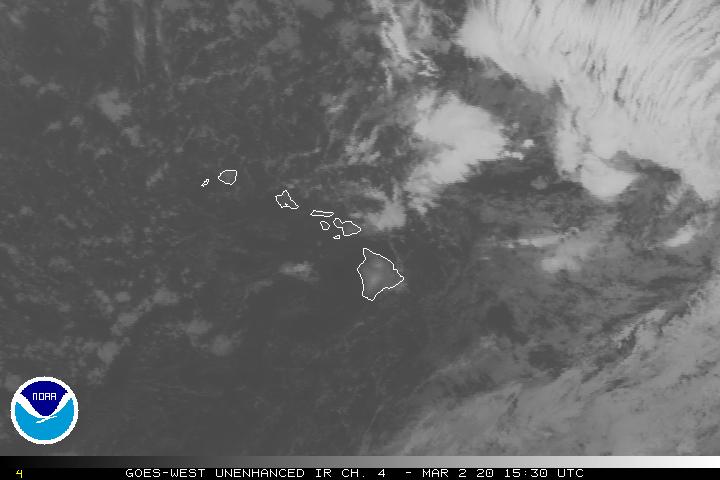
We can use the following links to see what’s going on in our area of the north central Pacific Ocean. Here's the latest NOAA satellite picture – the latest looping satellite image…and finally the latest looping radar image for the Hawaiian Islands.
Here are the latest 24-hour precipitation totals (inches) for each of the islands as of Thursday evening:
0.69 Mount Waialeale, Kauai
0.49 Oahu Forest NWR, Oahu
0.20 Molokai
0.00 Lanai
0.00 Kahoolawe
0.20 Puu Kukui, Maui
0.15 Kawainui Stream, Big Island
Sunset Commentary:
Fairly dry weather conditions for the time being, even along our windward sides…with just a few passing showers here and there. A fairly strong near 1034 millibar high pressure to the north of Hawaii, will continue the locally strong trade wind flow across our islands. These trades will carry a few windward showers our way, with generally dry conditions prevailing along our leeward sides. The gusty trades will taper off some this Friday into the weekend..then pick up a notch again early next week.
Here in Kula, Maui at 540pm, it was clear to partly cloudy…with an air temperature of 79.7F degrees. Our local trade winds will continue blowing, generally in the moderately strong range…then slacking off some Friday into the weekend. Meanwhile, there continue to be clouds around, which will keep our windward sides a little showery at times. The leeward sides on the smaller islands may see a few of these light passing showers, although should remain on the dry side. Here's a satellite image showing the scattered clouds upstream of the islands. There are no threats to our weather here in the islands well out into the future, with the usual increasing and decreasing wind speeds, and windward shower activity through the next week. ~~~ I'll be early Friday morning with your next new weather narrative, I hope you have a great Thursday night wherever you happen to be spending it! Aloha for now…Glenn.
[World-wide tropical cyclone activity:
Central Pacific Ocean: There are no active tropical cyclones
Eastern Pacific Ocean: There are no active tropical cyclones
Atlantic Ocean/Gulf of Mexico/Caribbean: There are no active tropical cyclones
Western Pacific Ocean: There are no active tropical cyclones
South Pacific Ocean: There are no active tropical cyclones
South and North Indian Oceans: There are no active tropical cyclones
Interesting: As the United States suffers a summer of record-shattering heat and the UK experiences record summer rainfall, a University of Michigan report finds that Generation X is lukewarm about climate change – uninformed about the causes and unconcerned about the potential dangers. "Most Generation Xers are surprisingly disengaged, dismissive or doubtful about whether global climate change is happening and they don't spend much time worrying about it," said Jon D. Miller, author of "The Generation X Report."
The new report, the fourth in a continuing series, compares Gen X attitudes about climate change in 2009 and 2011, and describes the levels of concern Gen Xers have about different aspects of climate change, as well as their sources of information on the subject. "We found a small but statistically significant decline between 2009 and 2011 in the level of attention and concern Generation X adults expressed about climate change," Miller said.
"In 2009, about 22 percent said they followed the issue of climate change very or moderately closely. In 2011, only 16 percent said they did so." Miller directs the Longitudinal Study of American Youth at the U-M Institute for Social Research. The study, funded by the National Science Foundation since 1986, now includes responses from approximately 4,000 Gen Xers—those born between 1961 and 1981, and now between 32 and 52 years of age.
Only about 5 percent of those surveyed in 2011 were alarmed about climate change, and another 18 percent said they were concerned about it. But 66 percent said they aren't sure that global warming is happening, and about 10 percent said they don't believe global warming is actually happening. "This is an interesting and unexpected profile," Miller said.
"Few issues engage a solid majority of adults in our busy and pluralistic society, but the climate issue appears to attract fewer committed activists—on either side—than I would have expected." Because climate change is such a complex issue, education and scientific knowledge are important factors in explaining levels of concern, Miller said. Adults with more education are more likely to be alarmed and concerned about climate change, he found.
And those who scored 90 or above on a 100-point Index of Civic Scientific Literacy also were significantly more likely to be alarmed or concerned than less knowledgeable adults. Still, 12 percent of those who were highly literate scientifically were either dismissive or doubtful about climate change, Miller found.
He also found that partisan affiliations predicted attitudes, with nearly half of liberal Democrats alarmed or concerned compared with zero percent of conservative Republicans. "There are clearly overlapping levels of concern among partisans of both political parties," Miller said.
"But for some individuals, partisan loyalties may be helpful in making sense of an otherwise complicated issue." Given the greater anticipated impact of climate change on future generations, Miller expected that the parents of minor children would be more concerned about the issue than young adults without minor children.
"Not so," he said. "Generation X adults without minor children were slightly more alarmed about climate change than were parents. The difference is small, but it is in the opposite direction than we expected." Miller found that Gen X adults used a combination of information sources to obtain information on the complex issue of climate change, with talking to friends, co-workers and family members among the most common sources of information.
"Climate change is an extremely complex issue, and many Generation X adults do not see it as an immediate problem that they need to address," Miller said. "The results of this report suggest that better educated young adults are more likely to recognize the importance of the problem, but that there is a broad awareness of the issue even though many adults prefer to focus on more immediate issues—jobs and schools for their children—than the needs of the next generation.
These results will not give great comfort to either those deeply concerned about climate issues or those who are dismissive of the issue."
 Email Glenn James: