Air Temperatures – The following maximum temperatures were recorded across the state of Hawaii Saturday:
Lihue, Kauai – 82
Honolulu airport, Oahu – 85
Kaneohe, Oahu – 81
Molokai airport – 83
Kahului airport, Maui – 86 (Record high for Saturday / 94 – 1951)
Kona airport – 84
Hilo airport, Hawaii – 81
Air Temperatures ranged between these warmest and coolest spots near sea level – and on the highest mountain tops…as of 5pm Saturday evening:
Honolulu, Oahu – 84
Princeville, Kauai – 79
Haleakala Crater – M (near 10,000 feet on Maui)
Mauna Kea – 50 (near 13,800 feet on the Big Island)
Hawaii’s Mountains – Here’s a link to the live web cam on the summit of near 13,800 foot Mauna Kea on the Big Island of Hawaii. This web cam is available during the daylight hours here in the islands…and when there’s a big moon shining down during the night at times. Plus, during the nights you will be able to see stars, and the sunrise and sunset too…depending upon weather conditions. Here's the Haleakala Crater webcam on Maui…although this webcam is not always working correctly.
Tropical Cyclone activity in the eastern and central Pacific – Here’s the latest weather information coming out of the National Hurricane Center, covering the eastern north Pacific. You can find the latest tropical cyclone information (once the season begins June 1) for the central north Pacific (where Hawaii is located) by clicking on this link to the Central Pacific Hurricane Center. A satellite image, which shows the entire ocean area between Hawaii and the Mexican coast…can be found here. Here's a tropical cyclone tracking map for the eastern and central Pacific.
Aloha Paragraphs

Moderate trade winds, along with
a few passing windward showers
Small craft wind advisory for those
windiest coastal and channel waters
around the Big Island of Hawaii
As this weather map shows, we have a large near 1032 millibar high pressure system far to the northeast of the islands. At the same time, there are two low pressure systems far to our north, with an associated cold front pushing a ridge of high pressure close to Kauai. Our local winds will continue to be from the trade wind direction, remaining active through the weekend…although becoming lighter into the holiday on Monday.
The following numbers represent the most recent top wind gusts (mph), along with directions as of Saturday evening:
24 Port Allen, Kauai – NE
39 Kuaokala, Oahu – NE
31 Molokai – NE
38 Kahoolawe – ESE
35 Kahului, Maui – NE
30 Lanai – NE
28 South Point, Big Island – NE
We can use the following links to see what’s going on in our area of the north central Pacific Ocean. Here's the latest NOAA satellite picture – the latest looping satellite image…and finally the latest looping radar image for the Hawaiian Islands.
Here are the latest 24-hour precipitation totals (inches) for each of the islands as of Saturday evening:
0.25 Mount Waialeale, Kauai
0.04 Kahana, Oahu
0.00 Molokai
0.00 Lanai
0.00 Kahoolawe
0.01 Mahinahina, Maui
0.42 Kawainui Stream, Big Island
Sunset Commentary: The trade winds will remain active…although gradually dropping a notch in strength as we get into the middle of the upcoming week…perhaps even turning southeast with time. The small craft wind advisories are active over just the windiest coastal and channel waters around the Big Island. We'll find just a few showers, restricted to the windward sides for the most part through Monday. Looking a bit further ahead, an upper level trough of low pressure will edge into our area from the east by Tuesday, which will potentially bring more showers our way then into Wednesday…or perhaps a bit longer than that. These showers will spread themselves along the windward sides at night, and along the leeward upcountry slopes during the afternoon hours. The trade winds are expected to strengthen by next weekend, bringing back a more normal trade wind weather pattern then.
I went to see a new film Friday evening, one that I'd been looking forward to for a while. It was called Snow White & The Huntsman, starring Kristen Stewart, Chris Hemsworth, Charlize Theron, and Sam Claflin…among many others. The synopsis: in the epic action-adventure Snow White and the Huntsman, Kristen Stewart plays the only person in the land fairer than the evil queen (Charlize Theron) out to destroy her. But what the wicked ruler never imagined is that the young woman threatening her reign has been training in the art of war with a huntsman (Chris Hemsworth) dispatched to kill her. Sam Claflin joins the cast as the prince long enchanted by Snow White's beauty and power. Looking at the trailer, it certainly suggested strongly that this film was going off the deep end…and that it did! I considered this film very entertaining, both for its large scope, and its fine details. The two leading ladies of course were very beautiful, while the male stars were handsome as would be expected. If large action style films are your thing, then don't miss this one. If on the other hand, you would have a difficult time sitting through such an epic story, with all that fighting and such, give it a pass. I am going to give Snow White & the Huntsman a B+ grade, as it met my expectations and then some. The online critics weren't so generous with their praise, and admittedly the ending was a tad weak in my opinion, although overall…I went away from the theater very satisfied.
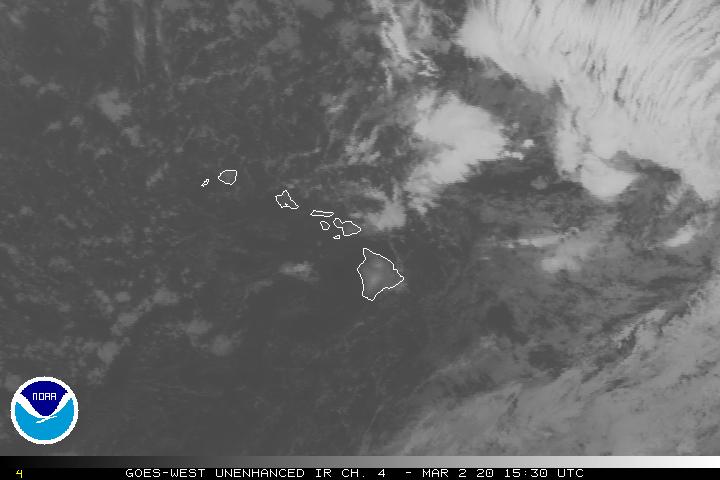
Here in Kula, Maui at 515pm, it was partly cloudy with light winds…and an air temperature of 73.4F degrees. As this satellite image shows, those high cirrus clouds (those brighter white ones) have moved just to the south of Hawaii now…and are reaching the Big Island, and can be seen well south of Maui County too. There are generally stable looking low clouds out and around from the islands, there's nothing unusual about that. Meanwhile the trade winds will continue blowing, although gradually become lighter with time. As a ridge of high pressure gets closer to Kauai, pushed there by a late season cold front to our northwest, our winds may veer around to the east and perhaps all the way around to the southeast. This of course suggests that we may begin to see some volcanic haze shifting up from the Big Island vents…northwest over the other islands in places. Our weather will continue to be favorably inclined, with no major changes on the horizon through the holiday on Monday.
The computer models are still trying to bring some increase in clouds and showers after that, which is quite likely. If this manifests as the models are pointing out, and the winds get as light as expected, we could move into a modified convective weather pattern. This would find clear and slightly cooler than normal early mornings, with daytime sea breezes along our leeward sides, sending clouds into the upcountry areas during the afternoon hours, leading to localized showers. The windward sides too could see a few showers falling there too, although generally during the night and early morning hours. It will be interesting to see how things turn out by Tuesday onwards, as all of this runs against climatology, with June being the driest month of the year in most places here in Hawaii. I'll be back Sunday morning with your next new weather narrative, I hope you have a great Saturday night wherever you're spending it! Aloha for now…Glenn.
Extra: youtube music video, Joni Michell…Both Sides Now
Extra: youtube surfing footage…Rusty Surfing Video
Extra: youtube music video, The Bee Gees…How Deep is your Love
[World-wide tropical cyclone activity:]
Central Pacific Ocean: There are no active tropical cyclones expected through the next 48 hours.
Eastern Pacific Ocean: There are no active tropical cyclones expected through the next 48 hours.
Atlantic Ocean: There are no active tropical cyclones expected through the next 48 hours.
Western Pacific Ocean: There are no active tropical cyclones
South Indian Ocean: There are no active tropical cyclones
Interesting: Forests in the Amazon Basin are expected to be less vulnerable to wildfires this year, according to the first forecast from a new fire severity model developed by university and NASA researchers. Fire season across most of the Amazon rain forest typically begins in May, peaks in September and ends in January. The new model, which forecasts the fire season’s severity from three to nine months in advance, calls for an average or below-average fire season this year within 10 regions spanning three countries: Bolivia, Brazil and Peru.
“Tests of the model suggested that predictions should be possible before fire activity begins in earnest,” said Doug Morton, a co-investigator on the project at NASA’s Goddard Space Flight Center in Greenbelt, Md. “This is the first year to stand behind the model and make an experimental forecast, taking a step from the scientific arena to share this information with forest managers, policy makers, and the public alike.”
The model was first described last year in the journal Science. Comparing nine years of fire data from NASA’s Moderate Resolution Imaging Spectroradiometer (MODIS) on the Terra satellite, with a record of sea surface temperatures from NOAA, scientists established a connection between sea surface temperatures in the Pacific and Atlantic oceans and fire activity in South America.
“There will be fires in the Amazon Basin, but our model predictions suggest that they won’t be as likely in 2012 as in some previous years,” said Jim Randerson of the University of California, Irvine, and principal investigator on the research project. Specifically, sea surface temperatures in the Central Pacific and North Atlantic are currently cooler than normal.
Cool sea surface temperatures change patterns of atmospheric circulation and increase rainfall across the southern Amazon in the months leading up to the fire season. “We believe the precipitation pattern during the end of the wet season is very important because this is when soils are replenished with water,” said Yang Chen of UC Irvine.
“If sea surface temperatures are higher, there is reduced precipitation across most of the region, leaving soils with less water to start the dry season.” Without sufficient water to be transported from the soil to the atmosphere by trees, humidity decreases and vegetation is more likely to burn. Such was the case in 2010, when above-average sea surface temperatures and drought led to a severe fire season.
In 2011, conditions shifted and cooler sea surface temperatures and sufficient rainfall resulted in fewer fires, similar to the forecast for 2012.Building on previous research, the researchers said there is potential to adapt and apply the model to other locations where large-scale climate conditions are a good indicator of the impending fire season, such as Indonesia and the United States.
Amazon forests, however, are particularly relevant because of their high biodiversity and vulnerability to fires. Amazon forests also store large amounts of carbon, and deforestation and wildfires release that carbon back to the atmosphere. Predictions of fire season severity may aid initiatives – such as the United Nation’s Reducing Emissions from Deforestation and forest Degradation program – to reduce the emissions of greenhouse gases from fires in tropical forests.
“The hope is that our experimental fire forecasting information will be useful to a broad range of communities to better understand the science, how these forests burn, and what predisposes forests to burning in some years and not others,” Morton said. “We now have the capability to make predictions, and the interest to share this information with groups who can factor it into their preparation for high fire seasons and management of the associated risks to forests and human health.”
 Email Glenn James: