











Air Temperatures – The following maximum temperatures were recorded across the state of Hawaii Thursday:
Lihue, Kauai – 83
Honolulu airport, Oahu – 86
Kaneohe, Oahu – 82
Molokai airport – 84
Kahului airport, Maui – 88 (Record high for Thursday / 94 – 1953)
Kona airport – 83
Hilo airport, Hawaii – 84
Air Temperatures ranged between these warmest and coolest spots near sea level – and on the highest mountain tops…as of 5pm Thursday evening:
Kahului, Maui – 83
Hilo, Hawaii – 73
Haleakala Crater – 57 (near 10,000 feet on Maui)
Mauna Kea – 45 (near 13,800 feet on the Big Island)
Hawaii’s Mountains – Here’s a link to the live web cam on the summit of near 13,800 foot Mauna Kea on the Big Island of Hawaii. This web cam is available during the daylight hours here in the islands…and when there’s a big moon shining down during the night at times. Plus, during the nights you will be able to see stars, and the sunrise and sunset too…depending upon weather conditions. Here's the Haleakala Crater webcam on Maui…although this webcam is not always working correctly.
Tropical Cyclone activity in the eastern and central Pacific – Here’s the latest weather information coming out of the National Hurricane Center, covering the eastern north Pacific. You can find the latest tropical cyclone information (once the season begins June 1) for the central north Pacific (where Hawaii is located) by clicking on this link to the Central Pacific Hurricane Center. A satellite image, which shows the entire ocean area between Hawaii and the Mexican coast…can be found here. Here's a tropical cyclone tracking map for the eastern and central Pacific.
Aloha Paragraphs

Moderate trade winds, some stronger gusts,
along with a few passing windward showers
Small craft wind advisory for those windiest
coastal and channel waters around Maui
County and the Big Island
Active surf south, west, east facing shores
As this weather map shows, we have a large near 1027 millibar high pressure system to the northeast of the islands. Our local winds will continue to be from the trade wind direction, remaining moderately strong and gusty through the week…somewhat lighter Friday into next week.
The following numbers represent the most recent top wind gusts (mph), along with directions as of Thursday evening:
21 Port Allen, Kauai – ESE
36 Kahuku trng, Oahu – ESE
29 Molokai – ENE
38 Kahoolawe – ESE
32 Kahului, Maui – NE
29 Lanai – NNE
28 Upolu airport, Big Island – NE
We can use the following links to see what’s going on in our area of the north central Pacific Ocean. Here's the latest NOAA satellite picture – the latest looping satellite image…and finally the latest looping radar image for the Hawaiian Islands.
Here are the latest 24-hour precipitation totals (inches) for each of the islands as of Thursday evening:
0.10 Mount Waialeale, Kauai
0.10 Kahuku trng, Oahu
0.00 Molokai
0.00 Lanai
0.00 Kahoolawe
0.01 Kahului airport, Maui
0.52 Kawainui Stream, Big Island
Sunset Commentary: The moderately strong trade winds will remain active through the rest of this week…although gradually dropping a notch into the weekend…and beyond. The NWS forecast office in Honolulu is keeping the small craft wind advisories, to just over the windiest coastal and channel waters around Maui County and the Big Island. We'll find just a few showers, restricted to the windward sides for the most part.
Here in Kula, Maui at 540pm, it was partly to mostly cloudy, light breezes…with an air temperature of 72F degrees. As noted above, there will be just a few windward showers for the time being, becoming even less than that going into the weekend. As this satellite image shows, we have some thin high cirrus clouds (those brighter white ones) to our southwest and west, coming into the state at times. Meanwhile the trade winds will remain somewhat gusty, although be lighter than they have been lately. This trend for gradually lighter winds will continue, with the trade winds becoming even somewhat lighter this weekend into next week. Our weather will continue to be more or less favorably inclined, with no major changes on the horizon for the time being. The models are trying to bring some increase in clouds and showers next week, this prospect will become more clear over the next few days. I'll be back early Friday morning with your next new weather narrative, I hope you have a great Thursday night wherever you're spending it! Aloha for now…Glenn.
Extra: A guest Sunrise Commentary…from a reader on the Hamakua coast of the Big Island:
We had glowing Glenn clouds overhead for our sunrise prelude,
The coffee a blend of Guatemalan and Ethiopian. Deep richness livened
by ephemeral fruit.
The constant movement of the light and clouds, intertwined, then
opening, revealing tones that expand and evaporate, new patterns form
in the unfolding space.
Wind, speaking of change, lightly now, a gentle touch, then rising to
give tongue to the leaves.
I feed the birds, their shifting, bursting clusters of song, movement
and color a perfect expression of the genius of our world.
The same perfection shows in the water vapor imagery that informs each
day. Complex rising and falling swirls, suggestions of even larger
patterns animating all that is.
World-wide tropical cyclone activity:
Central Pacific Ocean: There are no active tropical cyclones expected through the next 48 hours.
Eastern Pacific Ocean: There are no active tropical cyclones expected through the next 48 hours.
Atlantic Ocean: There are no active tropical cyclones expected through the next 48 hours.
Western Pacific Ocean: There are no active tropical cyclones
South Indian Ocean: There are no active tropical cyclones
Interesting: The dramatic melt-off of Arctic sea ice due to climate change is hitting closer to home than millions of Americans might think. That's because melting Arctic sea ice can trigger a domino effect leading to increased odds of severe winter weather outbreaks in the Northern Hemisphere's middle latitudes — think the "Snowmageddon" storm that hamstrung Washington, D.C., during February 2010.
Cornell's Charles H. Greene, professor of earth and atmospheric sciences, and Bruce C. Monger, senior research associate in the same department, detail this phenomenon in a paper published in the June issue of the journal Oceanography. "Everyone thinks of Arctic climate change as this remote phenomenon that has little effect on our everyday lives," Greene said.
"But what goes on in the Arctic remotely forces our weather patterns here." A warmer Earth increases the melting of sea ice during summer, exposing darker ocean water to incoming sunlight. This causes increased absorption of solar radiation and excess summertime heating of the ocean — further accelerating the ice melt.
The excess heat is released to the atmosphere, especially during the autumn, decreasing the temperature and atmospheric pressure gradients between the Arctic and middle latitudes. A diminished latitudinal pressure gradient is associated with a weakening of the winds associated with the polar vortex and jet stream.
Since the polar vortex normally retains the cold Arctic air masses up above the Arctic Circle, its weakening allows the cold air to invade lower latitudes. The recent observations present a new twist to the Arctic Oscillation — a natural pattern of climate variability in the Northern Hemisphere.
Before humans began warming the planet, the Arctic's climate system naturally oscillated between conditions favorable and those unfavorable for invasions of cold Arctic air. "What's happening now is that we are changing the climate system, especially in the Arctic, and that's increasing the odds for the negative AO conditions that favor cold air invasions and severe winter weather outbreaks," Greene said.
"It's something to think about given our recent history." This past winter, an extended cold snap descended on central and Eastern Europe in mid-January, with temperatures approaching minus 22 degrees Fahrenheit and snowdrifts reaching rooftops.
And there were the record snowstorms fresh in the memories of residents from several eastern U.S. cities, such as Washington, New York and Philadelphia, as well as many other parts of the Eastern Seaboard during the previous two years. Greene and Monger did note that their paper is being published just after one of the warmest winters in the eastern U.S. on record.
"It's a great demonstration of the complexities of our climate system and how they influence our regional weather patterns," Greene said. In any particular region, many factors can have an influence, including the El Nino/La Nina cycle.
This winter, La Nina in the Pacific shifted undulations in the jet stream so that while many parts of the Northern Hemisphere were hit by the severe winter weather patterns expected during a bout of negative AO conditions, much of the eastern United States basked in the warm tropical air that swung north with the jet stream.
"It turns out that while the eastern U.S. missed out on the cold and snow this winter, and experienced record-breaking warmth during March, many other parts of the Northern Hemisphere were not so fortunate," Greene said.
Europe and Alaska experienced record-breaking winter storms, and the global average temperature during March 2012 was cooler than any other March since 1999. "A lot of times people say, 'Wait a second, which is it going to be — more snow or more warming?'
Well, it depends on a lot of factors, and I guess this was a really good winter demonstrating that," Greene said. "What we can expect, however, is the Arctic wildcard stacking the deck in favor of more severe winter outbreaks in the future."
Interesting2: Spring in the contiguous U.S. was the warmest on record, capping the hottest 12-month period in data going back 117 years, the National Climatic Data Center said. The national average temperature from March through May was 57.1 degrees Fahrenheit (14 Celsius), 5.2 degrees above the long-term average and 2 degrees warmer than the previous mark set in 1910, said the data center in Asheville, North Carolina.
The period from June 2011 through May was the warmest 12 months on record in the contiguous U.S. The national average temperature was 56 degrees, surpassing the old mark for May 2011 through April by 0.4 degree, the center said in its monthly “State of the Climate” report.
A record high national average temperature for January through May helped send natural gas to a 10-year low as less was needed to warm homes and businesses. “The spring of 2012 was the culmination of the warmest March, third-warmest April, and second-warmest May,” the report said.
“This marks the first time that all three months during the spring season ranked among the 10 warmest since record- keeping began in 1895.” Forty-two states had top-10 warmest springs, with the period setting records in 31 states. Record-keeping began in 1895. Designating Season Meteorologists designate spring as being from March 1 through May 31.
The calendar season starts spring on the equinox, which was March 20 this year, and ends it at the solstice, June 20. For the year ended May 31, every state in the contiguous U.S. had above-average temperatures except Washington, which was near normal.
“The 12-month period encapsulated the second-warmest summer, fourth-warmest winter and the warmest spring on record,” the center said. The average May temperature in the lower 48 states was 64.3 degrees, the highest behind 1934, which was 65.4, according to the center. As of May 29, 37.4 percent of the contiguous U.S. had drought conditions, down from 38.2 percent at the start of the month, the report said.
The U.S. also experienced a record number of extreme weather events, from temperatures to tropical storms, from March through May, according to the report. The U.S. Climate Extremes Index is at 44 percent, more than twice the mean of 20 percent.
 Email Glenn James: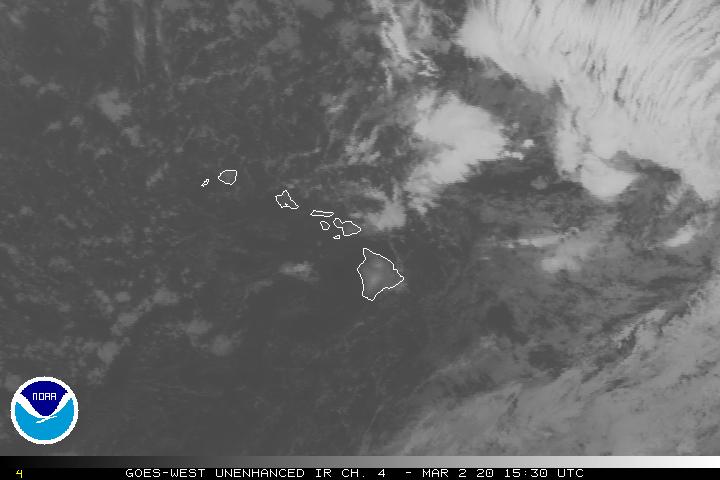
Eliza Says:
Aloha Glenn – Trust this finds you very well and enjoying our warmer nights. I certainly am. Just wondering if you posted a summer weather forecast or a La Nina/El Nino analysis for this year. I was traveling for a few weeks and didn't check in as I usually do. Please direct me to an archived post if there is one. Happy Thursday! ~ Eliza ~~~ Hi Eliza, good to hear from you, and welcome back. As far as El Nino goes, there is a 50% chance that El Nino conditions will develop during the second half of 2012. Thus, we remain in a neutral condition now, although as we get into summer and beyond, El Nino may return. This of course indicates that the sea water temperatures would then be warmer, aiding in the generation of additional tropical cyclones in the eastern Pacific. If El Nino continues into winter here in Hawaii, we could be looking for somewhat drier conditions than normal…which is definitely something we don’t need. I’ll make new updates as they become available. Thanks for checking in, Aloha, Glenn