Air Temperatures – The following maximum temperatures were recorded across the state of Hawaii Wednesday:
Lihue, Kauai – 83
Honolulu airport, Oahu – 84
Kaneohe, Oahu – 81
Molokai airport – 84
Kahului airport, Maui – 86 (Record high for Wednesday / 92 – 1953)
Kona airport – 82
Hilo airport, Hawaii – 82
Air Temperatures ranged between these warmest and coolest spots near sea level – and on the highest mountain tops…as of 5pm Wednesday evening:
Honolulu, Oahu – 82
Hilo, Hawaii – 73
Haleakala Crater – 55 (near 10,000 feet on Maui)
Mauna Kea – 39 (near 13,800 feet on the Big Island)
Hawaii’s Mountains – Here’s a link to the live web cam on the summit of near 13,800 foot Mauna Kea on the Big Island of Hawaii. This web cam is available during the daylight hours here in the islands…and when there’s a big moon shining down during the night at times. Plus, during the nights you will be able to see stars, and the sunrise and sunset too…depending upon weather conditions. Here's the Haleakala Crater webcam on Maui…although this webcam is not always working correctly.
Tropical Cyclone activity in the eastern and central Pacific – Here’s the latest weather information coming out of the National Hurricane Center, covering the eastern north Pacific. You can find the latest tropical cyclone information (once the season begins June 1) for the central north Pacific (where Hawaii is located) by clicking on this link to the Central Pacific Hurricane Center. A satellite image, which shows the entire ocean area between Hawaii and the Mexican coast…can be found here. Here's a tropical cyclone tracking map for the eastern and central Pacific.
Aloha Paragraphs

Moderate to strong trade winds, a few passing windward
showers…moving into the leeward sides on the
smaller islands at times
Small craft wind advisory for those windiest
coastal and channel waters around Maui
County and the Big Island
Active surf south and west facing leeward beaches
As this weather map shows, we have a large near 1030 millibar high pressure system to the northeast of the islands. Our local winds will continue to be from the trade wind direction…remaining moderately strong and gusty through the week.
The following numbers represent the most recent top wind gusts (mph), along with directions as of Wednesday evening:
25 Port Allen, Kauai – NE
35 Kahuku trng, Oahu – NE
31 Molokai – NE
42 Kahoolawe – NE
33 Kahului, Maui – NE
32 Lanai – NE
39 Puu Mali, Big Island – NE
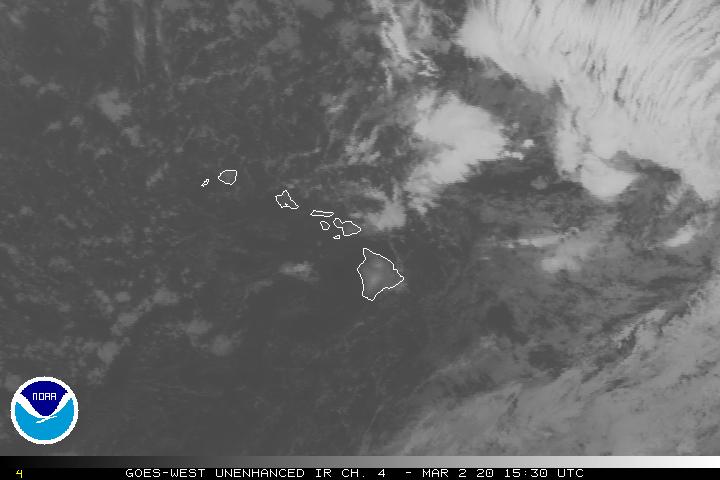
We can use the following links to see what’s going on in our area of the north central Pacific Ocean. Here's the latest NOAA satellite picture – the latest looping satellite image…and finally the latest looping radar image for the Hawaiian Islands.
Here are the latest 24-hour precipitation totals (inches) for each of the islands as of Wednesday evening:
1.54 Mount Waialeale, Kauai
0.68 Manoa Valley, Oahu
0.02 Molokai
0.08 Lanai
0.00 Kahoolawe
0.07 Puu Kukui, Maui
1.40 Kawainui Stream, Big Island
Sunset Commentary: The moderate to locally strong trade winds will remain active through Thursday…then diminish a little by Friday into the weekend. The NWS forecast office in Honolulu is restricting the small craft wind advisories, to just over the windiest coastal and channel waters around Maui County and the Big Island. As this satellite image shows, there are scattered clouds over the windward sides, which will drop a few showers. The leeward sides will find generally dry conditions. Generally drier weather is expected by Friday into the weekend as well.
Here in Kula, Maui at 530pm, it was clear to partly cloudy and near calm…with an air temperature of 79.5F degrees. As noted above, there will be about normal periods of passing windward showers, or somewhat less than that, as we continue through the rest of the week. The trade winds will remain gusty, although have moderated to some degree now. This trend for gradually lighter winds will continue, with the trade winds perhaps becoming even somewhat lighter Friday into the weekend. Our weather will continue to be more or less favorably inclined, with no major changes on the horizon for the time being. I'll be back early Thursday morning with your next new weather narrative, I hope you have a great Wednesday night until then! Aloha for now…Glenn.
World-wide tropical cyclone activity:
Central Pacific Ocean: There are no active tropical cyclones expected through the next 48 hours.
Eastern Pacific Ocean: There are no active tropical cyclones expected through the next 48 hours.
Atlantic Ocean: There are no active tropical cyclones expected through the next 48 hours.
Western Pacific Ocean:There are no active tropical cyclones
South Indian Ocean: Tropical storm Kuena (20S) remains active in the south Indian Ocean. The Joint Typhoon Center Center (JTWC) is calling for this system to start losing strength going forward from here. TS Kuena was located approximately 280 NM south of the Seychelles, with 52 mph sustained winds, and gusts to near 63 mph. It is expected to remain well north of Madagascar.
Interesting: How heavy were the dinosaurs? They were often big but how much did they weigh? Scientists have developed a new technique to accurately measure the weight and size of dinosaurs and discovered they are not as heavy as previously thought. University of Manchester biologists used lasers to measure the minimum amount of skin required to wrap around the skeletons of modern-day mammals, including reindeer, polar bears, giraffes and elephants.
They discovered that the animals had almost exactly 21% more body mass than the minimum skeletal skin and bone wrap volume, and applied this to a giant Brachiosaur skeleton in Berlin’s Museum für Naturkunde. Previous estimates of this Brachiosaur's weight have varied, with estimates as high as 80 tons, but the Manchester team’s calculations — published in the journal Biology Letters — reduced that figure to just 23 tons.
Lead author Dr Bill Sellers said: "One of the most important things palaeobiologists need to know about fossilized animals is how much they weighed. This is surprisingly difficult, so we have been testing a new approach. We laser scanned various large mammal skeletons, including polar bear, giraffe and elephant, and calculated the minimum wrapping volume of the main skeletal sections."
“We showed that the actual volume is reliably 21% more than this value, so we then laser scanned the Berlin Brachiosaur, Giraffatitan brancai, calculating the skin and bone wrapping volume and added 21%. We found that the giant herbivore weighed 23 tons, supporting the view that these animals were much lighter than traditionally thought.
Brachiosauridae are a family of dinosaurs, whose members are known as brachiosaurids. They were herbivorous quadrupeds with longer forelegs than hind legs and long necks. Their masses have been estimated to range from 20 to 90 tons, and their unusually long and upright necks gave them access to the leaves of treetops that would have been inaccessible to other sauropods.
Dr Sellers, based in Manchester’s Faculty of Life Sciences, explained that body mass was a critical parameter used to constrain bio-mechanical and physiological traits of organisms. He said: "Volumetric methods are becoming more common as techniques for estimating the body masses of fossil vertebrates but they are often accused of excessive subjective input when estimating the thickness of missing soft tissue."
"Here, we demonstrate an alternative approach where a minimum convex hull is derived mathematically from the point cloud generated by laser-scanning mounted skeletons. This has the advantage of requiring minimal user intervention and is therefore more objective and far quicker." "We tested this method on 14 large-bodied mammalian skeletons and demonstrated that it consistently underestimated body mass by 21%.
We suggest that this is a robust method of estimating body mass where a mounted skeletal reconstruction is available and demonstrate its usage to predict the body mass of one of the largest, relatively complete sauropod dinosaurs, Giraffatitan brancai, as 23,200 kg."
"The value we got for Giraffatitan is at the low range of previous estimates; although it is still huge, some of the enormous estimates of the past — 80 tons in 1962 — are exaggerated. Our method provides a much more accurate measure and shows dinosaurs, while still huge, are not as big as previously thought."
 Email Glenn James: