











Air Temperatures – The following maximum temperatures were recorded across the state of Hawaii Tuesday:
Lihue, Kauai – 82
Honolulu airport, Oahu – 85 (Record high for Tuesday / 90 – 1987)
Kaneohe, Oahu – M
Molokai airport – 79
Kahului airport, Maui – 83
Kona airport – 85
Hilo airport, Hawaii – 80
Air Temperatures ranged between these warmest and coolest spots near sea level – and on the highest mountain tops…as of 5pm Tuesday evening:
Kailua-kona – 82
Kapalua, Maui – 73
Haleakala Crater – 50 (near 10,000 feet on Maui)
Mauna Kea – 34 (near 13,800 feet on the Big Island)
Hawaii’s Mountains – Here’s a link to the live web cam on the summit of near 13,800 foot Mauna Kea on the Big Island of Hawaii. This web cam is available during the daylight hours here in the islands…and when there’s a big moon shining down during the night at times. Plus, during the nights you will be able to see stars, and the sunrise and sunset too…depending upon weather conditions. Here's the Haleakala Crater webcam on Maui…although this webcam is not always working correctly.
Tropical Cyclone activity in the eastern and central Pacific – Here’s the latest weather information coming out of the National Hurricane Center, covering the eastern north Pacific. You can find the latest tropical cyclone information (once the season begins June 1) for the central north Pacific (where Hawaii is located) by clicking on this link to the Central Pacific Hurricane Center. A satellite image, which shows the entire ocean area between Hawaii and the Mexican coast…can be found here. Here's a tropical cyclone tracking map for the eastern and central Pacific.
Aloha Paragraphs

Moderate to strong trade winds, a few passing windward
showers, especially the Big Island…moving into the
leeward sides on the smaller islands at times
Small craft wind advisory for those windiest
coastal and channel waters across the state
Wind advisory on the Haleakala Crater on Maui
Rising surf south and west facing leeward beaches
As this weather map shows, we have a large near 1029 millibar high pressure system to the northeast of the islands. Our local winds will continue to be from the trade wind direction…remaining locally strong and gusty through this work week.
The following numbers represent the most recent top wind gusts (mph), along with directions as of Tuesday evening:
25 Port Allen, Kauai – NE
33 Kuaokala, Oahu – NE
33 Molokai – NE
38 Kahoolawe – NE
38 Kahului, Maui – NE
35 Lanai – NE
29 Puuanahulu, Big Island – NE
We can use the following links to see what’s going on in our area of the north central Pacific Ocean. Here's the latest NOAA satellite picture – the latest looping satellite image…and finally the latest looping radar image for the Hawaiian Islands.
Here are the latest 24-hour precipitation totals (inches) for each of the islands as of Tuesday evening:
0.01 Mount Waialeale, Kauai
0.04 Nuuanu Upper, Oahu
0.02 Molokai
0.01 Lanai
0.00 Kahoolawe
0.21 Puu Kukui, Maui
1.06 Kawainui Stream, Big Island
Sunset Commentary: The moderate to locally strong trade winds will remain active through the rest of this week. The NWS forecast office in Honolulu is keeping the small craft wind advisories over the windiest coastal and channel waters through 6pm Thursday…at least. As this satellite image shows, there are clouds over the windward sides, with more to come. Those higher brighter white clouds a bit further to the northeast of the Big Island and Maui, are associated with an upper level low pressure system…edging this way. This upper level low doesn't seem to be having as much influence on the lower level clouds as expected. So, a few showers will passing along our windward sides, although not too many more than normal as it turns out. The leeward sides will find a few showers being carried over there on the smaller islands, on the gusty trade wind flow.
Here in Kula, Maui at 525pm, it was partly to mostly cloudy and near calm…with an air temperature of 71.6F degrees. As noted above, there will be periods of passing windward showers as we continue through the week, at least at times. The trade winds will remain gusty through the week as well. Today was cloudier than normal, even here in normally quite cloudy Kula, and somewhat cooler than it has been too. While I was having my lunch outside, as I always do, I had to retreat under an avocado tree, as a very light shower started up.
Now, about that transit of Venus across our sun today, I didn't see it at all. I was disappointed, as I had the proper eye protection, and none of us will ever see again during our life time. Just before noon, the clouds thickened up considerable, and I haven't seen an ounce of sunshine since then. Despite the fact that I didn't see it, I knew that it was happening, and actually still is. Wait just a darn minute here! The sun just came out, and I went and looked, and sure enough…there was that little dot [Venus] on the face of the sun! How exciting, I'm one of those who can say I saw it now, among plenty others of you I hope. Isn't Venus associated with love and all, so perhaps we all got zapped with a love vibe today, anyone feeling it? I'll be back early Wednesday morning with your next new weather narrative, I hope you have a great Tuesday night wherever you happen to be spending it! Aloha for now…Glenn.
Extra: youtube video, Annie Lennox…Why
World-wide tropical cyclone activity:
[Central Pacific Ocean: There are no active tropical cyclones expected through late Saturday night.
Eastern Pacific Ocean: There are no active tropical cyclones through the next 48 hours.
Atlantic Ocean: There are no active tropical cyclones through the next 48 hours.
Western Pacific Ocean: The Joint Typhoon Center Center (JTWC) is maintaining warnings on weakening tropical storm Mawar (04W), which was located 325 NM south-southwest of Yokosuka, Japan. Sustained winds were 63 mph, with gusts to near 81 mph. Here's the JTWC graphical track map, along with a NOAA satellite image.
[Indian Ocean: A newly formed tropical cyclone called 20S has formed in the south Indian Ocean. The Joint Typhoon Center Center (JTWC) is calling for this system to strengthen into a tropical storm within12 hours. 20S is located approximately 600 NM east-northeast of Madagascar, with 40 mph sustained winds, and gusts to near 52 mph. It isn't expected to reach the typhoon status before weakening.
Interesting: Today Venus will pass across the face of the sun, producing a silhouette that no one alive today will likely see again. Transits of Venus are very rare, coming in pairs separated by more than a hundred years. This June's transit, the bookend of a 2004-2012 pair, won't be repeated until the year 2117. Fortunately, the event is widely visible. Observers on seven continents, even a sliver of Antarctica, will be in position to observe it.
The nearly 7-hour transit begins at 3:09 pm Pacific Daylight Time (22:09 UT – 12:09pm HST) on June 5th. The timing favors observers in the mid-Pacific where the sun is high overhead during the crossing. In the USA, the transit will be at its best around sunset. That's good, too. Creative photographers will have a field day imaging the swollen red sun "punctured" by the circular disk of Venus.
Observing tip: Do not stare at the sun. Venus covers too little of the solar disk to block the blinding glare. Instead, use some type of projection technique or a solar filter. A #14 welder's glass is a good choice. Many astronomy clubs will have solar telescopes set up to observe the event; contact your local club for details.
Transits of Venus first gained worldwide attention in the 18th century. In those days, the size of the solar system was one of the biggest mysteries of science. The relative spacing of planets was known, but not their absolute distances. How many miles would you have to travel to reach another world? The answer was as mysterious then as the nature of dark energy is now.
Venus was the key, according to astronomer Edmund Halley. He realized that by observing transits from widely-spaced locations on Earth it should be possible to triangulate the distance to Venus using the principles of parallax. The idea galvanized scientists who set off on expeditions around the world to view a pair of transits in the 1760s.
The great explorer James Cook himself was dispatched to observe one from Tahiti, a place as alien to 18th-century Europeans as the Moon or Mars might seem to us now. Some historians have called the international effort the "the Apollo program of the 18th century." In retrospect, the experiment falls into the category of things that sound better than they actually are.
Bad weather, primitive optics, and the natural "fuzziness" of Venus's atmosphere and other factors prevented those early observers from gathering the data they needed. Proper timing of a transit would have to wait for the invention of photography in the century after Cook's voyage. In the late 1800s, astronomers armed with cameras finally measured the size of the Solar System as Edmund Halley had suggested.
This year's transit is the second of an 8-year pair. Anticipation was high in June 2004 as Venus approached the sun. No one alive at the time had seen a Transit of Venus with their own eyes, and the hand-drawn sketches and grainy photos of previous centuries scarcely prepared them for what was about to happen. Modern solar telescopes captured unprecedented view of Venus's atmosphere backlit by solar fire.
They saw Venus transiting the sun's ghostly corona, and gliding past magnetic filaments big enough to swallow the planet whole. 2012 should be even better as cameras and solar telescopes have improved. Moreover, NASA's Solar Dynamics Observatory is going to be watching too. SDO will produce Hubble-quality images of this rare event.
 Email Glenn James: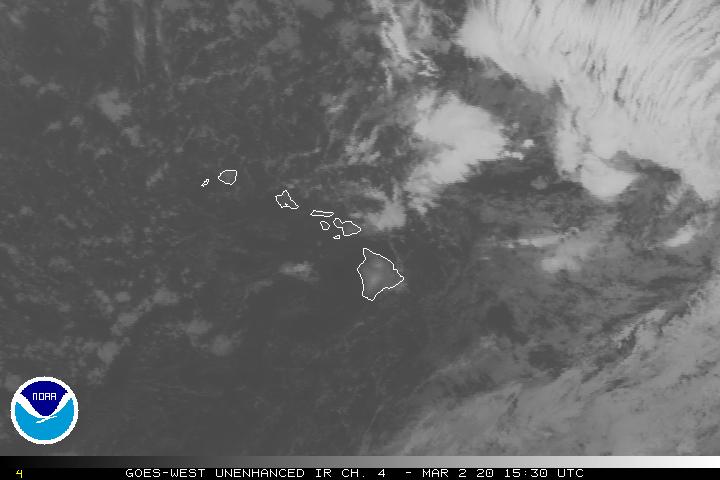


Sharon Says:
Aloha Glenn!
Will the tropospheric low affect the visibility of the Venus transit on Mauna Kea summit?
People all over the world are waiting for the images from Hawaii!~~~Hi Sharon, excellent question. This upper level atmospheric low that is edging up to, and towards your Big Island, may very well bring some haze to our skies..although that would be at lower elevations, closer to the coasts. Here on Maui at mid-morning, looking down towards the central Valley, there is some haze in the air. I’m hoping that in many areas of the state, that the gusty trade winds will keep the haze to a minimum. As for the top of Mauna Kea (http://www5.uhh.hawaii.edu/~webcam/mauna_kea/) it looks a bit hazy over there too, although down below the summit…not many clouds though. Lets hope for the best! I have my eye protection ready to go, and will be checking it out soon myself. Aloha, Glenn