











Air Temperatures – The following maximum temperatures were recorded across the state of Hawaii Sunday:
Lihue, Kauai – 82
Honolulu airport, Oahu – 83
Kaneohe, Oahu – M
Molokai airport – 79
Kahului airport, Maui – 84
Kona airport – 86
Hilo airport, Hawaii – 82
Air Temperatures ranged between these warmest and coolest spots near sea level – and on the highest mountain tops…as of 5pm Sunday evening:
Barking Sands, Kauai – 82
Molokai airport – 74
Haleakala Crater – 46 (near 10,000 feet on Maui)
Mauna Kea – 32 (near 13,800 feet on the Big Island)
Hawaii’s Mountains – Here’s a link to the live web cam on the summit of near 13,800 foot Mauna Kea on the Big Island of Hawaii. This web cam is available during the daylight hours here in the islands…and when there’s a big moon shining down during the night at times. Plus, during the nights you will be able to see stars, and the sunrise and sunset too…depending upon weather conditions. Here's the Haleakala Crater webcam on Maui…although this webcam is not always working correctly.
Tropical Cyclone activity in the eastern and central Pacific – Here’s the latest weather information coming out of the National Hurricane Center, covering the eastern north Pacific. You can find the latest tropical cyclone information (once the season begins June 1) for the central north Pacific (where Hawaii is located) by clicking on this link to the Central Pacific Hurricane Center. A satellite image, which shows the entire ocean area between Hawaii and the Mexican coast…can be found here. Here's a tropical cyclone tracking map for the eastern and central Pacific.
Aloha Paragraphs

Strong and gusty trade winds, passing windward
showers, moving into the leeward sides on the
smaller islands at times…into the new work week
Small craft wind advisory for those windiest
coastal and channel waters across the state
Wind Advisory summits on the Big Island and Maui
Full Moon tonight, with a 30% lunar eclipse…
starting just after midnight!
As this weather map shows, we have a large near 1030 millibar high pressure system far to the north of the islands. Our local winds will continue to be from the trade wind direction…remaining locally strong and gusty into the new work week ahead.
The following numbers represent the most recent top wind gusts (mph), along with directions as of Sunday evening:
30 Port Allen, Kauai – NE
37 Kuaokala, Oahu – NE
32 Molokai – NE
32 Kahoolawe – NE
33 Kahului, Maui – NE
42 Lanai – NE
47 PTA Keamuku, Big Island – NE
We can use the following links to see what’s going on in our area of the north central Pacific Ocean. Here's the latest NOAA satellite picture – the latest looping satellite image…and finally the latest looping radar image for the Hawaiian Islands.
Here are the latest 24-hour precipitation totals (inches) for each of the islands as of Sunday evening:
0.10 Mount Waialeale, Kauai
0.06 St. Stephens, Oahu
0.00 Molokai
0.00 Lanai
0.00 Kahoolawe
0.03 Puu Kukui, Maui
1.16 Kawainui Stream, Big Island
Sunset Commentary: The strong and gusty trade winds will remain active into the new week ahead. The NWS forecast office in Honolulu is keeping the small craft wind advisories over all those windiest coastal and channel waters Sunday night. As this satellite image shows, there continues to be lower level clouds upstream of the islands, being carried our way on the gusty trade wind flow. These clouds will bring windward showers at times. As we move into the new week, these clouds and showers will increase at times…especially in the windward areas. The leeward sides, at least on the smaller islands, can expect to see some of these showers as well.
This past Friday evening I went to see the new film The Best Exotic Marigold Hotel starring Tom Wilkinson, Judi Dench, Dev Patel, Maggie Smith, Bill Nighy, and Celia Imrie…among many others. This obviously wasn't one of my usual action flicks, and in this particular case, far from it! The synopsis: the Best Exotic Marigold Hotel follows a group of British retirees who decide to "outsource" their retirement to less expensive and seemingly exotic India. Enticed by advertisements for the newly restored Marigold Hotel and bolstered with visions of a life of leisure, they arrive to find the palace a shell of its former self. Though the new environment is less luxurious than imagined, they are forever transformed by their shared experiences, discovering that life and love can begin again when you let go of the past.
Critics are being quite generous with their praise, and since two of my friends have also gave a thumbs up…so I went to see it. It turned out to be a sweet film, although with quite a bit of angst along the way. The acting was quite good, and the various shots around India gave a good idea about the hectic nature of the place, mixed in with the deep mellow backdrop as well. It was a long film, and I enjoyed all of it. I could easily give it a favorable and solid B grade to this film. In case you are somewhat interested in getting a sneak peek, here's a trailer for this film.
Here in Kula, Maui at 515pm, it was partly cloudy and breezy, with an air temperature of 78.8F degrees. Glancing over towards the windward side here on east Maui, I see more of those low clouds, with a few embedded showers. As noted above, there will be periods of passing windward showers well into the future, at least at times. This will be due to the periodic arrival of moisture from the east.
There doesn't seem to be anything to interrupt this gusty and at times showery reality, so look for more to come. The models continue to be trending towards at least some increase in showers over the Big Island and Maui County beginning this evening, and lasting in an off and on manner into Monday. Otherwise, it looks like our weather will be just fine, especially along our south and west facing leeward beaches. Meanwhile, the surf along our north and east facing windward shores, will remain rough and choppy. The surf is a slight bit larger along our leeward beaches today, which will remain small Monday and Tuesday, and then rise again by mid-week.
This afternoon I went with a couple of my neighbors to Ulupalakua, to see an outdoor jazz show at the winery. It was good, and I enjoyed the mellow nature of being out in that part of the island. This evening those same neighbors and I saw an indie film called Winter Passing (2005), starring Ed Harris, Will Ferrell, Amy Madigan, Zooey Deschanel, Amelia Warner and Dallas Roberts. I found it to be a strangely moving experience, and actually liked it very much. The synopsis: money and emotions lead to a difficult reunion between a father and daughter in this drama. Reese Holden (Zooey Deschanel) is a struggling stage actress in New York City whose life has become an uphill struggle — her career isn't giving her satisfaction, her relationship with would-be rock star Ray (Dallas Roberts) is stuck in neutral, an affair with her friend Rob (Robert Beitzel) brings no excitement, and her colleague Deirdre (Deirdre O'Connell) simply doesn't understand her problems. Reese is also short on money, which is why she's willing to listen to a proposal from a publisher who wants to release a series of love letters that her mother, a well-known author who died years ago, wrote to her father, Don (Ed Harris), another respected novelist who has fallen out of the limelight but is said to be working on a final major work. Having accepted an advance for the collection, Reese pays a visit to Don in Michigan to get his OK for the project and collect the letters, but discovers two strangers have moved in with Don — Shelly (Amelia Warner), who studied under Don and has installed herself as his business manager, and Corbit (Will Ferrell), a neighborhood sad sack who helps with the housekeeping and runs errands for the reclusive writer. As Reese vies with Shelly for her father's attention, she struggles to come to terms with issues from her childhood and the dissatisfaction with her life. Winter Passing was written and directed by noted playwright Adam Rapp; it was his first feature film. ~~~ I give it a B+ rating, it was touching and edgy at the same time, and oh so wonderful to actually see something that wasn't an action flick for once! Here's the trailer for this film.
I'll be back early Monday morning, I hope you have a great Sunday night wherever you happen to be spending it! By the way, we've got the June full moon coming up tonight, it will surely be a beauty! Aloha for now…Glenn.
World-wide tropical cyclone activity:
Central Pacific Ocean: There are no active tropical cyclones expected through late Saturday night.
~~~ Here in the central part of the Pacific, the hurricane season begins today. The Central Pacific Hurricane Center in Honolulu is forecasting 2-4 tropical cyclones in this part of the Pacific Basin…which is slightly below the average number. An average season has 4-5 tropical cyclones, which include tropical depressions, tropical storms and hurricanes.
Eastern Pacific Ocean: There are no active tropical cyclones through the next 48 hours.
~~~ The NHC has announced that climate conditions point to a near-normal hurricane season in the Eastern Pacific this year. The outlook calls for a 50 percent probability of a near-normal season, a 30 percent probability of a below-normal season and a 20 percent probability of an above-normal season.
Seasonal hurricane forecasters estimate a 70 percent chance of 12 to 18 named storms, which includes 5 to 9 hurricanes, of which 2 to 5 are expected to become major hurricanes (Category 3, 4 or 5 on the Saffir-Simpson Hurricane Wind Scale).
An average Eastern Pacific hurricane season produces 15 named storms, with eight becoming hurricanes and four becoming major hurricanes. The Eastern Pacific hurricane season runs from May 15 through Nov. 30, with peak activity from July through September.
Atlantic Ocean: There are no active tropical cyclones through the next 48 hours.
~~~ Conditions in the atmosphere and the ocean favor a near-normal hurricane season in the Atlantic Basin this season. For the entire six-month season, which begins today, NOAA’s Climate Prediction Center says there’s a 70 percent chance of nine to 15 named storms (with top winds of 39 mph or higher), of which four to eight will strengthen to a hurricane (with top winds of 74 mph or higher) and of those one to three will become major hurricanes (with top winds of 111 mph or higher, ranking Category 3, 4 or 5). Based on the period 1981-2010, an average season produces 12 named storms with six hurricanes, including three major hurricanes.
Western Pacific Ocean: The Joint Typhoon Center Center (JTWC) is maintaining warnings on typhoon (04W) in the northwest Pacific. It is peaking in strength now…and will begin to weaken through the rest of its life. The current wind speeds were 115 mph, with gusts to 143 mph at the time of this writing. Here's the JTWC graphical track map for this system, as well as a NOAA satellite image. Typhoon Mawar (04W) continues moving away well east of Taiwan in the northwestern Pacific, and was located south-southwest of Kadena AFB, Okinawa at the time of this writing.
Indian Ocean: There are no active tropical cyclones.
Interesting: On June 5th, 2012, Venus will pass across the face of the sun, producing a silhouette that no one alive today will likely see again. Transits of Venus are very rare, coming in pairs separated by more than a hundred years. This June's transit, the bookend of a 2004-2012 pair, won't be repeated until the year 2117. Fortunately, the event is widely visible. Observers on seven continents, even a sliver of Antarctica, will be in position to observe it.
The nearly 7-hour transit begins at 3:09 pm Pacific Daylight Time (22:09 UT – 12:09pm HST) on June 5th. The timing favors observers in the mid-Pacific where the sun is high overhead during the crossing. In the USA, the transit will be at its best around sunset. That's good, too. Creative photographers will have a field day imaging the swollen red sun "punctured" by the circular disk of Venus.
Observing tip: Do not stare at the sun. Venus covers too little of the solar disk to block the blinding glare. Instead, use some type of projection technique or a solar filter. A #14 welder's glass is a good choice. Many astronomy clubs will have solar telescopes set up to observe the event; contact your local club for details.
Transits of Venus first gained worldwide attention in the 18th century. In those days, the size of the solar system was one of the biggest mysteries of science. The relative spacing of planets was known, but not their absolute distances. How many miles would you have to travel to reach another world? The answer was as mysterious then as the nature of dark energy is now.
Venus was the key, according to astronomer Edmund Halley. He realized that by observing transits from widely-spaced locations on Earth it should be possible to triangulate the distance to Venus using the principles of parallax. The idea galvanized scientists who set off on expeditions around the world to view a pair of transits in the 1760s.
The great explorer James Cook himself was dispatched to observe one from Tahiti, a place as alien to 18th-century Europeans as the Moon or Mars might seem to us now. Some historians have called the international effort the "the Apollo program of the 18th century." In retrospect, the experiment falls into the category of things that sound better than they actually are.
Bad weather, primitive optics, and the natural "fuzziness" of Venus's atmosphere and other factors prevented those early observers from gathering the data they needed. Proper timing of a transit would have to wait for the invention of photography in the century after Cook's voyage. In the late 1800s, astronomers armed with cameras finally measured the size of the Solar System as Edmund Halley had suggested.
This year's transit is the second of an 8-year pair. Anticipation was high in June 2004 as Venus approached the sun. No one alive at the time had seen a Transit of Venus with their own eyes, and the hand-drawn sketches and grainy photos of previous centuries scarcely prepared them for what was about to happen. Modern solar telescopes captured unprecedented view of Venus's atmosphere backlit by solar fire.
They saw Venus transiting the sun's ghostly corona, and gliding past magnetic filaments big enough to swallow the planet whole. 2012 should be even better as cameras and solar telescopes have improved. Moreover, NASA's Solar Dynamics Observatory is going to be watching too. SDO will produce Hubble-quality images of this rare event.
 Email Glenn James: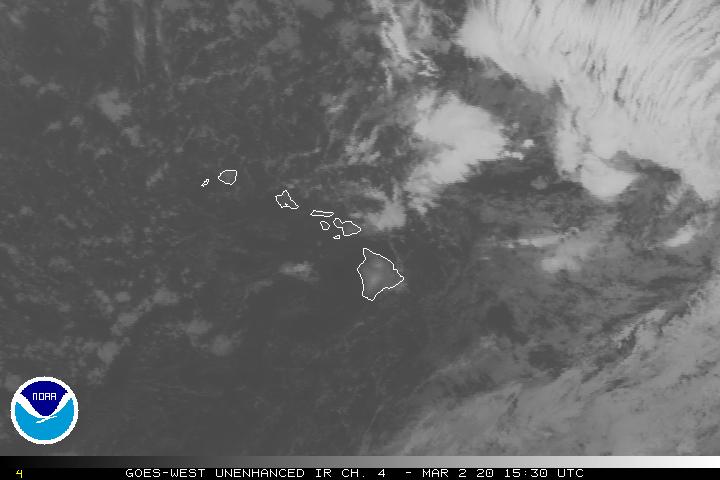





Hokukane Roberto Says:
Aloha Glenn, just thought I'd remind you and your readers about the 30% lunar eclipse tonight (starting just after midnight, deepest at 1am). Even though it is not total, the shading and other subtle changes are fun to watch. At least one of the Oahu TV stations incorrectly reported the eclipse was last night, not so … Happy sky watching!~~~Hi Hokukane, great news, and thanks for reminding us of this good celestial event in our Hawaiian skies tonight! Aloha, Glenn