Hawaiian Islands Weather details & Aloha paragraphs / June 24-25, 2012
Posted by GlennComments Off on Hawaiian Islands Weather details & Aloha paragraphs / June 24-25, 2012
Air Temperatures – The following maximum temperatures were recorded across the state of Hawaii Sunday:
Lihue, Kauai – 83
Honolulu airport, Oahu – 85
Kaneohe, Oahu – M
Molokai airport – 81
Kahului airport, Maui – 86 (Record high for Sunday / 91 – 1969)
Kona airport – 85
Hilo airport, Hawaii – 82
Air Temperatures ranged between these warmest and coolest spots near sea level – and on the highest mountain top around the state…as of 5pm Sunday evening:
Barking Sands, Kauai – 86
Molokai airport – 77
Mauna Kea – 37 (near 13,800 feet on the Big Island)
Hawaii’s Mountains – Here’s a link to the live web cam on the summit of near 13,800 foot Mauna Kea on the Big Island of Hawaii. This web cam is available during the daylight hours here in the islands…and when there’s a big moon shining down during the night at times. Plus, during the nights you will be able to see stars, and the sunrise and sunset too…depending upon weather conditions. Here's the Haleakala Crater webcam on Maui…although this webcam is not always working correctly.
Tropical Cyclone activity in the eastern and central Pacific – Here’s the latest weather information coming out of the National Hurricane Center, covering the eastern north Pacific. You can find the latest tropical cyclone information for the central north Pacific (where Hawaii is located) by clicking on this link to the Central Pacific Hurricane Center. A satellite image, which shows the entire ocean area between Hawaii and the Mexican coast…can be found here. Here's a tropical cyclone tracking map for the eastern and central Pacific.
Aloha Paragraphs

The trade winds will increase a notch into the
early part of the new week ahead…easing up
some as we get into Wednesday onwards
Passing windward showers at times, increasing some
tonight into Monday morning…at times leeward too
Another modest increase in windward showers
will arrive around mid-week…perhaps
As this weather map shows, we have a large near 1033 millibar high pressure system to the north of the islands. At the same time, a ridge of high pressure extends southwest from this high pressure cell…which is located to the northwest of the Aloha state. Our local winds will remain active from the trade wind direction through Saturday…strengthening Monday into Tuesday.
The following numbers represent the most recent top wind gusts (mph), along with directions as of Sunday evening:
31 Port Allen, Kauai – NE
38 Kuaokala, Oahu – NE
37 Molokai – ENE
44 Kahoolawe – NE
43 Kahului – NE
38 Lanai – NE
44 Puhe CS, Big Island – NNE
We can use the following links to see what’s going on in our area of the north central Pacific Ocean. Here's the latest NOAA satellite picture – the latest looping satellite image…and finally the latest looping radar image for the Hawaiian Islands.
Here are the latest 24-hour precipitation totals (inches) for each of the islands as of Sunday evening:
0.30 Mount Waialeale, Kauai
0.39 Oahu Forest NWR, Oahu
0.06 Molokai
0.00 Lanai
0.00 Kahoolawe
0.19 Puu Kukui, Maui
1.11 Glenwood, Big Island
Sunset Commentary: Our trade winds will be on the increase into Tuesday…tapering down some starting Wednesday onwards. As for showers, there will continue to be some, falling generally in the light to moderately heavy range along our windward sides. These showers will stretch over into leeward sides at times too, at least on some of the smaller islands. An old cold front located to our northeast will arrive tonight into Monday…bringing another increase in showers, although likely more so than the one that arrived last night into early this morning. There will be off and on passing showers along those north and east windward coasts and slopes thereafter through the week. An upper level low pressure system, with its associated cold air, may increase our windward showers again around Wednesday…lasting into Thursday.
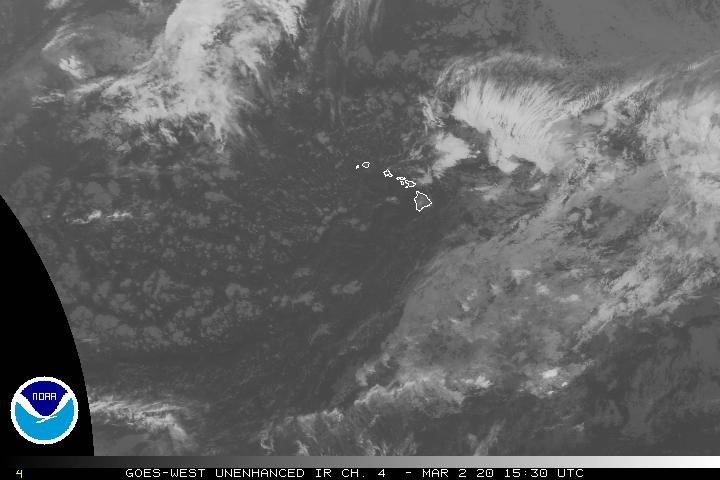
As this large view satellite image shows, we have an elongated retired cold front to the north through northeast of our windward sides…in other words paralleling those coasts. Meanwhile, there are those brighter white high and middle level clouds to our southwest and west. Putting this next satellite image into motion, we can see the trade winds carrying that cloud band our way. Then too, we can see those deeper clouds to our west, the brighter white ones…which remain well offshore from the islands. Finally, here's a closer look at our islands using this satellite picture…so we can get a better idea when it will arrive, and then watching it move through the islands into Monday.
Here in Kula, Maui at 520pm, it was mostly clear to partly cloudy with light breezes…and an air temperature of 76.5F degrees. The last cloud band, which was another minor frontal boundary, brought some showers last night into this morning. The leeward sides saw less of this, and remained quite sunny during the day Sunday. As we move through through the night, another old cold front will arrive, bringing an uptick in windward shower activity into Monday. So, in sum, stronger trade winds will be blowing, carrying periodic passing showers to our windward sides, with a few elsewhere at times to. ~~~ I'll be back early Monday morning with your next new weather narrative, I hope you have a great Sunday night wherever you're spending it! Aloha for now…Glenn.
Extra: youtube video – Dolphins…Earth's most intelligent animals
[World-wide tropical cyclone activity:
Central Pacific Ocean: There are no active tropical cyclones expected through the next 48 hours.
Eastern Pacific Ocean: There are no active tropical cyclones expected through the next 48 hours.
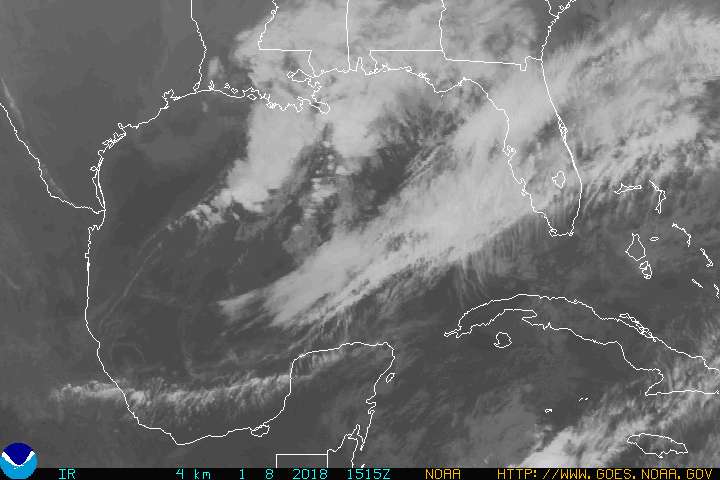
Atlantic Ocean: Tropical storm Debby remains active in the Gulf of Mexico. TS Debby was located approximately 200 miles east-southeast of the mouth of the Mississippi River, with sustained winds of 60 mph. Here's the National Hurricane Center's graphical track map for Debby…along with a satellite image. Debby's tropical storm force winds and heavy rains, are occurring along portions of the northeast Gulf coast. This tropical storm is just inching along, which increases the threat of heavy flooding rains along the Gulf coast, with up to 10" possible…generally from southeast Louisiana to Pensacola, Florida. News agencies are now pointing out that there has been one fatality from this tropical storm.
Debby's formation on June 23 came a full two months ahead of the usual formation date of the season's fourth storm in the Atlantic, August 23. Debby's formation beats by twelve days the previous record for formation of the fourth named storm of the year in the Atlantic, set in 2005, when Hurricane Dennis was named on July 5.
ELSEWHERE…TROPICAL CYCLONE FORMATION IS NOT EXPECTED DURING THE NEXT 48 HOURS.
Here is a graphical tropical weather outlook…showing this tropical storm in the Gulf of Mexico
Western Pacific Ocean: There are no active tropical cyclones
South Indian Ocean: There are no active tropical cyclones
Interesting: The interior of Mars holds vast reservoirs of water, with some spots apparently as wet as Earth's innards, scientists say. The finding upends previous studies, which had estimated that the Red Planet's internal water stores were scanty at best — something of a surprise, given that liquid water apparently flowed on the Martian surface long ago.
"It's been puzzling why previous estimates for the planet's interior have been so dry," co-author Erik Hauri, of the Carnegie Institution of Washington, said in a statement. "This new research makes sense and suggests that volcanoes may have been the primary vehicle for getting water to the surface."
The scientists examined two Martian meteorites that formed in the planet's mantle, the layer under the crust. These rocks landed on Earth about 2.5 million years ago, after being blasted off the Red Planet by a violent impact. Using a technique called secondary ion mass spectrometry, the team determined that the mantle from which the meteorites derived contained between 70 and 300 parts per million (ppm) of water.
Earth's mantle, for comparison, holds roughly 50-300 ppm water, researchers said. "The results suggest that water was incorporated during the formation of Mars and that the planet was able to store water in its interior during the planet's differentiation," Hauri said.
Some of this water apparently made its way to the surface in the ancient past. NASA's Spirit and Opportunity rovers, which landed on the Red Planet in 2004, have found plenty of evidence that Mars was far warmer and wetter billions of years ago than it is today.
The two golf-cart-size robots have even spotted signs of ancient hydrothermal systems, suggesting that some places on the Red Planet once had both water and an energy source — two key ingredients for the existence of life as we know it.
While the new results should help scientists better understand Mars and its history, they could also shed light on the evolution of large, rocky bodies in a more general sense, researchers said.
"Not only does this study explain how Mars got its water, it provides a mechanism for hydrogen storage in all the terrestrial planets at the time of their formation," lead author Francis McCubbin, of the University of New Mexico, said in a statement. The study was published in the journal Geology on June 15.
 Email Glenn James: