Air Temperatures – The following maximum temperatures were recorded across the state of Hawaii Wednesday:
Lihue, Kauai – 81
Honolulu airport, Oahu – 84 (Record high for Wednesday / 90 – 1982)
Kaneohe, Oahu – 81
Molokai airport – 79
Kahului airport, Maui – 80
Kona airport – 83
Hilo airport, Hawaii – 77
Air Temperatures ranged between these warmest and coolest spots near sea level – and on the highest mountain tops…as of 5pm Wednesday evening:
Barking Sands, Oahu – 83
Hilo, Hawaii – 76
Haleakala Crater – M (near 10,000 feet on Maui)
Mauna Kea – 45 (near 13,800 feet on the Big Island)
Hawaii’s Mountains – Here’s a link to the live web cam on the summit of near 13,800 foot Mauna Kea on the Big Island of Hawaii. This web cam is available during the daylight hours here in the islands…and when there’s a big moon shining down during the night at times. Plus, during the nights you will be able to see stars, and the sunrise and sunset too…depending upon weather conditions. Here's the Haleakala Crater webcam on Maui…although this webcam is not always working correctly.
Tropical Cyclone activity in the eastern and central Pacific – Here’s the latest weather information coming out of the National Hurricane Center, covering the eastern north Pacific. You can find the latest tropical cyclone information for the central north Pacific (where Hawaii is located) by clicking on this link to the Central Pacific Hurricane Center. A satellite image, which shows the entire ocean area between Hawaii and the Mexican coast…can be found here. Here's a tropical cyclone tracking map for the eastern and central Pacific.
Aloha Paragraphs

The trade winds will remain active, then
increase a notch later this weekend…
lasting through all of next week
Frequently passing windward showers,
drifting leeward in places…easing up
some as we push through Thursday
Summer started today
As this weather map shows, we have a large near 1029 millibar high pressure system to the north of the islands. At the same time, a ridge of high pressure extends southwest from this high pressure cell…which is located to the northwest of the Aloha state. Our local winds will gradually calm down some from the trade wind direction through Saturday.
The following numbers represent the most recent top wind gusts (mph), along with directions as of Wednesday evening:
29 Port Allen, Kauai – ENE
37 Kuaokala, Oahu – NE
31 Molokai – NE
27 Kahoolawe – NE
17 Lipoa – ENE
35 Lanai – NE
35 Puu Mali, Big Island – NE
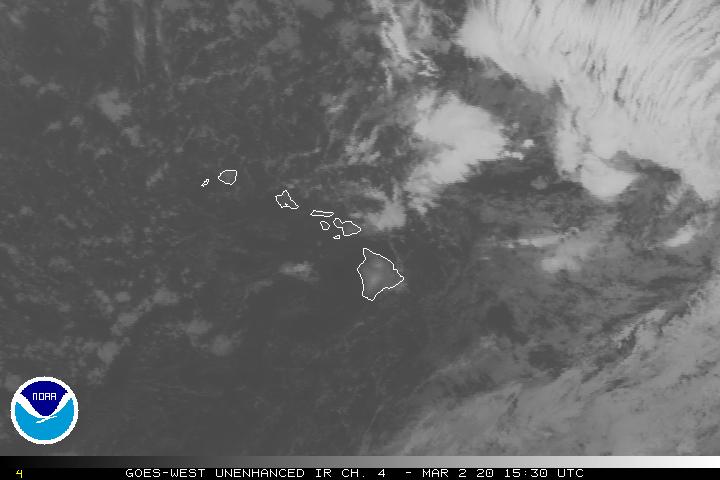
We can use the following links to see what’s going on in our area of the north central Pacific Ocean. Here's the latest NOAA satellite picture – the latest looping satellite image…and finally the latest looping radar image for the Hawaiian Islands.
Here are the latest 24-hour precipitation totals (inches) for each of the islands as of Wednesday evening:
2.62 Mount Waialeale, Kauai
1.68 Oahu Forest NWR, Oahu
0.69 Molokai
0.11 Lanai
0.12 Kahoolawe
2.42 Puu Kukui, Maui
3.56 Kawainui Stream, Big Island
Sunset Commentary: Our trade winds will remain active, blowing in the moderately strong realms…with those common stronger gusts at times locally. These common summer winds will pick up a notch Sunday through all of next week. As for showers, there will continue to be more than the usual tonight into Wednesday morning, most of which will stick pretty close to the windward coasts and slopes. Although, as the winds remain quite gusty, and there's abundant moisture available in our local atmosphere…some of these will stretch over into the leeward sides at times. This rather active period of showery weather will let up as we push into later Thursday, into the upcoming weekend.
Here in Kula, Maui at 510pm, it was cloudy and foggy, with ongoing light showers…and an air temperature of 68.4F degrees. As this satellite image shows, we have low level clouds banked up along our windward sides. We will find off and on passing showers along our windward sides continuing for the time being. The leeward sides will get into this action as well locally, where showers will occur in places. Glancing back at that satellite image, we see a definite break in the clouds just upwind of our islands, suggesting that we'll break into sunnier and drier weather during the day Thursday. Here in Kula, Maui, at the 3,100 foot elevation, with all the clouds and showers today, it felt more like a winter day…than the start of summer! I had to drive down to Kihei for a dermatology appointment, and I was surprised to find light showers falling down there too. ~~~ I'll be back again early Thursday with your next new weather narrative, I hope you have a great Wednesday night wherever you're spending it! Aloha for now…Glenn.
[World-wide tropical cyclone activity:
Central Pacific Ocean: There are no active tropical cyclones expected through the next 48 hours.
Eastern Pacific Ocean: There are no active tropical cyclones expected through the next 48 hours.
A NEARLY STATIONARY AREA OF LOW PRESSURE LOCATED ABOUT 330 MILES SOUTH-SOUTHEAST OF THE SOUTHERN TIP OF BAJA CALIFORNIA IS PRODUCING LIMITED SHOWER ACTIVITY. CONDITIONS ARE NOT FAVORABLE FOR DEVELOPMENT…AND THIS SYSTEM HAS A LOW CHANCE…10 PERCENT…OF BECOMING A TROPICAL CYCLONE DURING THE NEXT 48 HOURS.
ELSEWHERE…TROPICAL CYCLONE FORMATION IS NOT EXPECTED DURING THE NEXT 48 HOURS.
Here's a satellite image showing this tropical disturbance / Here's the computer forecast models for Invest 95E.
Atlantic Ocean: Tropical storm Chris remains active in the Atlantic Ocean. It has 60 mph sustained winds, and was located about 635 miles southeast of Cape Race, New Foundland. Here's the NHC graphical track map, along with a satellite image of this storm…well offshore to the east of the United States. Long looping satellite image of Chris.
A SHARP TROUGH OF LOW PRESSURE OVER THE SOUTHEASTERN GULF OF MEXICO IS PRODUCING A LARGE AREA OF CLOUDINESS…SHOWERS…AND THUNDERSTORMS THAT EXTEND FROM THE NORTHWESTERN CARIBBEAN SEA ACROSS CUBA TO THE BAHAMAS AND FLORIDA. STRONG UPPER-LEVEL WINDS OVER THE GULF OF MEXICO ARE EXPECTED TO GRADUALLY DIMINISH…AND SOME SLOW DEVELOPMENT IS POSSIBLE AS THE DISTURBANCE MOVES SLOWLY NORTHWESTWARD TOWARD THE CENTRAL GULF OF MEXICO OVER THE NEXT COUPLE OF DAYS. THIS SYSTEM HAS A MEDIUM CHANCE…30 PERCENT…OF BECOMING A TROPICAL CYCLONE DURING THE NEXT 48 HOURS. HEAVY RAINS AND LOCALIZED FLOODING ARE POSSIBLE ACROSS WESTERN CUBA…SOUTHERN FLORIDA…THE CENTRAL BAHAMAS…AND THE YUCATAN PENINSULA THROUGH FRIDAY.
ELSEWHERE…TROPICAL CYCLONE FORMATION IS NOT EXPECTED DURING THE NEXT 48 HOURS.
Here is a graphical tropical weather outlook…showing this tropical disturbance
Western Pacific Ocean: Tropical depression Talim (06W) is dissipating in the Taiwan Strait…located approximately 100 NM northeast of Taipei, Taiwan. Sustained winds were near 29 mph, with gusts near 40 mph. This dissipating tropical cyclone remained just offshore from the far northwest Taiwan as it went by…and then weakening even further as it approaches the very southeastern part of Japan. Here is a JTWC graphical track map for this dissipated tropical cyclone, along with a satellite image. – Final Warning
South Indian Ocean: There are no active tropical cyclones
Interesting: Beaches on the West Coast are getting a regular dose of debris from the 2011 tsunami in Japan. The first few items were curiosities — a boat here, a soccer ball there — but as the litter accumulates, officials such as Washington Gov. Chris Gregoire have acknowledged the scale of the problem.
"We are in for a steady dribble of tsunami debris over the next few years, so any response by us must be well-planned — and it will be," she said. Beyond the obvious problem of litter, officials are on the lookout for hidden dangers.
Debris 'Everywhere'
The tsunami swept an estimated 5 million tons of debris into the Pacific Ocean. Japanese scientists guess about 70 percent of that sank right away, which leaves maybe 1.5 million tons still floating around. "It's everywhere," says Carey Morishige, the Pacific Islands coordinator of the marine debris program at the National Oceanic and Atmospheric Administration.
"It's spread out across nearly the entire Pacific Ocean." Morishige says the debris can't really be tracked from above — it's too hard to see. So her agency uses computer models to predict its movement. "All marine debris does not move the same," she says.
"It depends on what the particular item is. If it sticks above the water quite a lot, winds tend to move the item faster." Those are the kinds of objects now littering the beaches at Ocean Shores, Wash. Bev Hughes has been picking up plastic bottles there.
"I think they all clearly have Japanese writing on them," she says. Also on the beach is Lynn Albin, who works for the state. She's there to check debris with a Geiger counter that she holds up to the bottles. Radiation levels are normal, which is what state officials expected.
Most of the radiation from the crippled Fukushima Dai-ichi nuclear plant was released after these objects were already swept out to sea.
Threat From Invasive Species
But some Japanese debris may carry another kind of threat: Earlier this month, a 65-foot-long floating dock washed up near Newport, Ore.
It "felt like looking at a spaceship or something," says John Chapman, an Oregon State University biologist who specializes in invasive species. "It was an island that had drifted across from Asia." Among the dozens of species that hitched a ride, at least three are possible threats — a sea star, a Japanese shore crab and Undaria pinnatifida.
Undaria is the edible seaweed found in Miso soup, but Chapman says if it started growing here, we might not be able to eat our way out of the problem. "If you have mountains of undaria, it's useless, right, it's bad!" he says. "You're playing roulette: Every time you're putting a species into a system, it could take over."
People assume the ocean is a big mixing bowl — that species drift back and forth all the time. In reality, Chapman says, shoreline species usually don't find a way to get across the Pacific, but the combination of the tsunami and man-made objects such as docks and floats meant that Japanese species got a rare chance at a ride to the West Coast.
Chapman says the result may be an unprecedented threat of biological invasion, one reason why Oregon officials decided not to take any chances with that dock. "The consensus of everyone, and I'm not sure where that started, was, 'Kill them as quick as you can, and as dead as possible,' " he says.
"And so they scraped it down, and then they took blowtorches and burned the surface." Chapman says the torching may seem a little excessive, but he was "OK with it," given the risks.
 Email Glenn James: