











Air Temperatures – The following maximum temperatures were recorded across the state of Hawaii Saturday:
Lihue, Kauai – 82
Honolulu airport, Oahu – 83
Kaneohe, Oahu – 82
Molokai airport – 78
Kahului airport, Maui – 84 (Record high temperature for Saturday / 91 – 1951)
Kona airport – 82
Hilo airport, Hawaii – 79
Air Temperatures ranged between these warmest and coolest spots near sea level – and on the highest mountain tops…as of 5pm Saturday evening:
Barking Sands, Kauai – 83
Hilo, Hawaii – 75
Haleakala Crater – 48 (near 10,000 feet on Maui)
Mauna Kea – 41 (near 13,800 feet on the Big Island)
Hawaii’s Mountains – Here’s a link to the live web cam on the summit of near 13,800 foot Mauna Kea on the Big Island of Hawaii. This web cam is available during the daylight hours here in the islands…and when there’s a big moon shining down during the night at times. Plus, during the nights you will be able to see stars, and the sunrise and sunset too…depending upon weather conditions. Here's the Haleakala Crater webcam on Maui…although this webcam is not always working correctly.
Tropical Cyclone activity in the eastern and central Pacific – Here’s the latest weather information coming out of the National Hurricane Center, covering the eastern north Pacific. You can find the latest tropical cyclone information (once the season begins June 1) for the central north Pacific (where Hawaii is located) by clicking on this link to the Central Pacific Hurricane Center. A satellite image, which shows the entire ocean area between Hawaii and the Mexican coast…can be found here. Here's a tropical cyclone tracking map for the eastern and central Pacific.
Aloha Paragraphs

Strong and gusty trade winds, passing windward
showers, moving into the leeward sides on the
smaller islands at times…through Sunday
into the early part of the new week
Small craft wind advisory for coastal and
channel waters…statewide
Wind Advisory summits on the Big Island and Maui
Surf coming up leeward south shores Sunday
As this weather map shows, we have high pressure systems far to the north, and northeast of the islands. Our local winds will continue to be from the trade wind direction…remaining locally strong and gusty through this weekend into the new work week ahead.
The following numbers represent the most recent top wind gusts (mph), along with directions as of Saturday evening:
30 Port Allen, Kauai – NE
50 Makua Ridge, Oahu – NE
31 Molokai – NE
32 Kahoolawe – NE
36 Kahului, Maui – NE
45 Lanai – NE
42 PTA Keamuku, Big Island – NW
We can use the following links to see what’s going on in our area of the north central Pacific Ocean. Here's the latest NOAA satellite picture – the latest looping satellite image…and finally the latest looping radar image for the Hawaiian Islands.
Here are the latest 24-hour precipitation totals (inches) for each of the islands as of Saturday afternoon:
0.36 Mount Waialeale, Kauai
0.21 Oahu Forest NWR, Oahu
0.02 Molokai
0.00 Lanai
0.00 Kahoolawe
0.64 Puu Kukui, Maui
1.98 Kawainui Stream, Big Island
Sunset Commentary: The strong and gusty trade winds will remain active through the rest of this weekend…and then right on into the new week ahead. The NWS forecast office in Honolulu is keeping the small craft wind advisories over all coastal and channel waters Saturday. As this satellite image shows, there continues to be lower level clouds upstream of the islands, being carried our way on the gusty trade wind flow. These clouds will bring windward showers at times. As we move through Sunday into the new week, these clouds and showers will increase at times…especially in the windward areas. The leeward sides, at least on the smaller islands, can expect to see some of these showers as well.
Friday evening I went to see the new film The Best Exotic Marigold Hotel starring Tom Wilkinson, Judi Dench, Dev Patel, Maggie Smith, Bill Nighy, and Celia Imrie…among many others. This obviously wasn't one of my usual action flicks, and in this particular case, far from it! The synopsis: the Best Exotic Marigold Hotel follows a group of British retirees who decide to "outsource" their retirement to less expensive and seemingly exotic India. Enticed by advertisements for the newly restored Marigold Hotel and bolstered with visions of a life of leisure, they arrive to find the palace a shell of its former self. Though the new environment is less luxurious than imagined, they are forever transformed by their shared experiences, discovering that life and love can begin again when you let go of the past.
Critics are being quite generous with their praise, and since two of my friends have also gave a thumbs up…so I went to see it. It turned out to be a sweet film, although with quite a bit of angst along the way. The acting was quite good, and the various shots around India gave a good idea about the hectic nature of the place, mixed in with the deep mellow backdrop as well. It was a long film, and I enjoyed all of it. I could easily give it a favorable and solid B grade to this film. In case you are somewhat interested in getting a sneak peek, here's a trailer for this film.
Here in Kula, Maui at 515pm, it was partly cloudy and lightly breezy, with an air temperature of 75.9F degrees. Glancing over towards the windward side here on east Maui, I continue to see showery clouds in that direction early this evening. As noted above, there will be passing windward showers well into the future, at least at times. This will be due to the periodic arrival of moisture from the east.
There doesn't seem to be anything to interrupt this gusty and at times showery reality, so look for more to come. The one wild card will be where an upper level low pressure system, now to the east of the state…ends up Sunday into Monday. The models are now trending towards an increase in showers over the Big Island, and perhaps Maui County too. I'll continue to monitor this situation, and will write more about it Sunday morning. ~~~ I hope you have a great Saturday night wherever you happen to be spending it! Aloha for now…Glenn.
World-wide tropical cyclone activity:
Central Pacific Ocean: There are no active tropical cyclones expected through late Saturday night.
~~~ Here in the central part of the Pacific, the hurricane season begins today. The Central Pacific Hurricane Center in Honolulu is forecasting 2-4 tropical cyclones in this part of the Pacific Basin…which is slightly below the average number. An average season has 4-5 tropical cyclones, which include tropical depressions, tropical storms and hurricanes.
Eastern Pacific Ocean: There are no active tropical cyclones through the next 48 hours.
~~~ The NHC has announced that climate conditions point to a near-normal hurricane season in the Eastern Pacific this year. The outlook calls for a 50 percent probability of a near-normal season, a 30 percent probability of a below-normal season and a 20 percent probability of an above-normal season.
Seasonal hurricane forecasters estimate a 70 percent chance of 12 to 18 named storms, which includes 5 to 9 hurricanes, of which 2 to 5 are expected to become major hurricanes (Category 3, 4 or 5 on the Saffir-Simpson Hurricane Wind Scale).
An average Eastern Pacific hurricane season produces 15 named storms, with eight becoming hurricanes and four becoming major hurricanes. The Eastern Pacific hurricane season runs from May 15 through Nov. 30, with peak activity from July through September.
Atlantic Ocean: There are no active tropical cyclones through the next 48 hours.
~~~ Conditions in the atmosphere and the ocean favor a near-normal hurricane season in the Atlantic Basin this season. For the entire six-month season, which begins today, NOAA’s Climate Prediction Center says there’s a 70 percent chance of nine to 15 named storms (with top winds of 39 mph or higher), of which four to eight will strengthen to a hurricane (with top winds of 74 mph or higher) and of those one to three will become major hurricanes (with top winds of 111 mph or higher, ranking Category 3, 4 or 5). Based on the period 1981-2010, an average season produces 12 named storms with six hurricanes, including three major hurricanes.
Western Pacific Ocean: The Joint Typhoon Center Center (JTWC) is maintaining warnings on typhoon (04W). It is expected to continue increasing in strength over the next few days. The current wind speeds were 109 mph, with gusts to 132 mph at the time of this writing. Here's the JTWC graphical track map for this system, as well as a NOAA satellite image. Typhoon Mawar (04W) is moving away from the Philippine Islands, and was located approximately 435 NM south-southwest of Kadena AFB, Okinawa at the time of this writing.
Indian Ocean: There are no active tropical cyclones.
Interesting: You might assume getting richer would always make a country safer from drought and famine, but that turns out not to be the case. Instead, the very poorest countries seem to become more vulnerable in the early stages of development. There's a crucial period before the benefits of modernization start to kick in, during which they are more vulnerable to problems like drought than when they started.
'It turns out that the very poor and the relatively wealthy are less vulnerable than the group in the middle,' says Dr Evan Fraser, a researcher specializing in food production and its relation to social and economic conditions who works both in the geography department of the University of Guelph in Canada, and at the School of Earth and Environment at the University of Leeds.
At a broader scale, his research highlights areas that are at particular risk of climate-induced crop failures, including south-eastern South America and the north-eastern Mediterranean. Fraser suggests the counter-intuitive result may be partly because assistance from other nations and NGOs tends to dry up once a country is no longer classed among the very poorest.
But it may also be because moving away from traditional farming practices has a cost, and it takes time for new methods to start paying dividends. For example, switching from pastoral farming to settled agriculture can bring benefits to local people in the long-term, once they can introduce new techniques like higher-yielding, drought-resistant crops and modern machinery.
But these need investment to work, and it takes time for poor farmers to build up the necessary capital. In the meantime, most land has been parceled up into private plots and is now crisscrossed by fences, so people can no longer respond to drought as their pastoralist ancestors would have – by simply moving their herds somewhere with more water.
'There seems to be a dangerous middle ground where the old ways no longer function, but the new ways aren't up and running yet, and people are at their most vulnerable,' says Fraser. 'Development has damaged traditional agriculture, but they can't yet use capital-based adaptation strategies, from fertilizers and bank loans to higher-yielding breeds of cow.'
It's an unexpected result, but it's being found at several different scales and by different teams. Other research by the same group interviewing households in Malawi and Botswana, still in press, reached similar conclusions at a local level. Fraser thinks policy-makers and NGOs should take the findings into account. 'We're finding a real tradeoff between adaptation and development,' Fraser notes.
'That's not to say we should discourage development, but you can't assume that by promoting it you're also helping people adapt to climate change. It's not that traditional is always better, but as people move from traditional to modern they lose things; policy-makers need to think about how to help them make the transition.'
His team devised a two-part process to identify areas that are at particular risk from drought-induced famines over the coming century. First, they used a climate model to predict where rainfall and soil moisture may fall sharply. They then analyzed a range of social and economic data to work out how well different countries could adapt to environmental change.
In part this involved looking at the effects of drought on different countries in the past, and trying to work out why some have coped well and others have been pitched into devastating famines. They ended up with a map of how well different areas were likely to be able to cope with future climate change.
Putting the two results together allowed the scientists to calculate where the risk to food supplies is most serious – areas that will suffer severely from climate change and where societies will be least able to adapt. They focused on wheat and maize production, both because these are two of the most vital crops and because better data is available on them.
It turns out that for wheat, the vulnerable spots are the south-eastern USA, south-eastern South America, the north-eastern Mediterranean and parts of central Asia. For maize, the risks seem to be south-eastern South America, the north-eastern Mediterranean and parts of southern Africa. Fraser notes, though, that the paper's methodology has limitations.
For example, some areas may appear very resilient to drought because in the past they've been able to use groundwater to keep crops alive. If aquifers start running dry, areas like the American Midwest could be much more vulnerable to future droughts than this study suggests.
The study is published in two parts. The first part is in the journal Food Security and the second in Agricultural and Forest Meteorology. This work was funded by NERC under the Quantifying and Understanding the Earth System (QUEST) research program, the Rural Economic and Land Use Program, and the ESRC's Center for Climate Change Economics and Policy.
 Email Glenn James: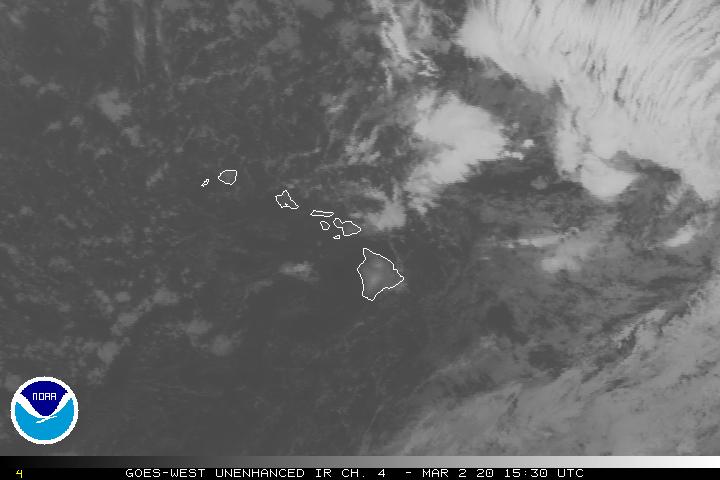





Colt Larsen Says:
Thanks for the link to the webcam, it is working fine for me. We got a trip planned to Hawaaii this month end. Your website seems to have all the information that I need. Thanks for the information and the links.
I agree with Dr Evan Fraser, it is the middle group that is more vulnerable. The very poor group doesn’t have anything to loose, while the wealthy ones can easily protect themselves from the poor climatic situations.~~~Hi Colt, good to hear from you. I’m glad you’re finding what you need in pre-planning for your upcoming vacation Hawaii. Aloha, Glenn