











Air Temperatures – The following maximum temperatures were recorded across the state of Hawaii Monday:
Lihue, Kauai – 83
Honolulu airport, Oahu – 84
Kaneohe, Oahu – 82
Molokai airport – 80
Kahului airport, Maui – 85 (Record high for Monday / 92 – 1969)
Kona airport – 85
Hilo airport, Hawaii – 82
Air Temperatures ranged between these warmest and coolest spots near sea level – and on the highest mountain tops…as of 5pm Monday evening:
Barking Sands, Kauai – 85
Molokai airport – 77
Haleakala Crater – M (near 10,000 feet on Maui)
Mauna Kea – 34 (near 13,800 feet on the Big Island)
Hawaii’s Mountains – Here’s a link to the live web cam on the summit of near 13,800 foot Mauna Kea on the Big Island of Hawaii. This web cam is available during the daylight hours here in the islands…and when there’s a big moon shining down during the night at times. Plus, during the nights you will be able to see stars, and the sunrise and sunset too…depending upon weather conditions. Here's the Haleakala Crater webcam on Maui…although this webcam is not always working correctly.
Tropical Cyclone activity in the eastern and central Pacific – Here’s the latest weather information coming out of the National Hurricane Center, covering the eastern north Pacific. You can find the latest tropical cyclone information for the central north Pacific (where Hawaii is located) by clicking on this link to the Central Pacific Hurricane Center. A satellite image, which shows the entire ocean area between Hawaii and the Mexican coast…can be found here. Here's a tropical cyclone tracking map for the eastern and central Pacific.
Aloha Paragraphs

The very gusty trade winds have peaked now…
although will remain locally active today
High surf advisory east facing beaches…
rising surf along the south shores this week
Windy on the summits of Maui and the Big Island
Passing windward showers…increasing some
Tuesday and Wednesday at times
As this weather map shows, we have a large near 1034 millibar high pressure system far to the northeast of the islands. At the same time, a ridge of high pressure extending southwest of this high pressure cell is located to the north and northwest of Kauai. Our local winds will remain strongfrom the trade wind direction…easing up some Tuesday into Wednesday.
The following numbers represent the most recent top wind gusts (mph), along with directions as of early Monday evening:
31 Port Allen, Kauai – NE
40 Kuaokala, Oahu – NNE
30 Molokai – NE
38 Kahoolawe – NE
70 Kaupo Gap, Maui – NW!
42 Lanai – NE
48 Kawaihae, Big Island – E
We can use the following links to see what’s going on in our area of the north central Pacific Ocean. Here's the latest NOAA satellite picture – the latest looping satellite image…and finally the latest looping radar image for the Hawaiian Islands.
Here are the latest 24-hour precipitation totals (inches) for each of the islands as of Monday evening:
0.02 Mount Waialeale, Kauai
0.04 Nuuanu Upper, Oahu
0.00 Molokai
0.00 Lanai
0.00 Kahoolawe
0.01 Kahului, Maui
0.01 Kawainui Stream, Big Island
Sunset Commentary: Our local winds remained much stronger than normal Monday, although have finally peaked in strength…thank goodness! There have been all sorts of advisories, watches and warnings in relation to this windy episode the last couple of days. Many of these will be pared back overnight into Tuesday, as the winds ease up going forward. These strong, gusty and deep trade winds will taper off Tuesday into the middle of the week…with more normal moderately strong trade winds thereafter.
Here in Kula, Maui at 520pm, it was mostly clear, and actually quite calm for a change (oops, there's another strong gust again)…with an air temperature of 78.8F degrees. As this satellite image shows, we see that large area of high and middle level clouds continuing to slowly migrate westward away from the state. At the lower levels of the atmosphere, we'll find passing showers falling along the windward sides through the night into the morning hours. We should see a modest increase in clouds and showers along those areas at times Tuesday into Wednesday, just about the same time that our abnormally gusty trade winds calm down further. At least part of the increase in moisture coming our way, will be associated with an old cold front that is being carried our way on the trade wind flow.
Speaking of that flow, it was way stronger than anything that we'd normally expect this time of year. There were a few gusts that reached 60+ mph, with even a couple topping 70-80 mph! All the dry weather, coupled with the blasting trade winds, sparked several fires, some of which here on Maui were still being fought early this evening. Let's hope that they are brought under control before darkness sets in. One of those fires occurred not far from my house, and I can still hear the helicopters flying over it at the time of this writing. ~~~ I almost forgot to mention that this morning I drove up to the 7,000 foot elevation, to experience those very strong winds up on the slopes of the Haleakala Crater…and I certainly had no trouble finding them! The weather was so changeable during the couple of hours that I spent up there. It ranged between just kind of breezy, to down right strong and gusty, and from partly cloudy to cloudy and foggy with drizzle. I loved it, and do so each time I get up there for a communing with nature session! I'll be back early Tuesday morning with your next new weather narrative, I hope you have a great Monday night wherever you happen to be spending it! Aloha for now…Glenn.
[World-wide tropical cyclone activity:
Central Pacific Ocean: There are no active tropical cyclones expected through the next 48 hours.
Eastern Pacific Ocean: There are no active tropical cyclones expected through the next 48 hours.
SHOWER AND THUNDERSTORM ACTIVITY ASSOCIATED WITH AN AREA OF LOW PRESSURE LOCATED ABOUT 275 MILES WEST-SOUTHWEST OF MANZANILLO MEXICO HAS CHANGED LITTLE IN ORGANIZATION DURING THE PAST FEW HOURS. HOWEVER…ENVIRONMENTAL CONDITIONS REMAIN FAVORABLE FOR DEVELOPMENT…AND THIS SYSTEM COULD BECOME A TROPICAL DEPRESSION DURING THE NEXT DAY OR SO AS IT BEGINS TO MOVE SLOWLY EASTWARD. THIS SYSTEM HAS A HIGH CHANCE…70 PERCENT…OF BECOMING A TROPICAL CYCLONE DURING THE NEXT 48 HOURS. INTERESTS ALONG THE SOUTHWESTERN COAST OF MEXICO SHOULD MONITOR THE PROGRESS OF THIS SYSTEM…AS A TROPICAL STORM WATCH COULD BE REQUIRED FOR A PORTION OF THE COAST TONIGHT OR EARLY TUESDAY. REGARDLESS OF DEVELOPMENT…LOCALLY HEAVY RAINFALL AND THE THREAT FOR FLASH FLOODS AND MUDSLIDES WILL CONTINUE OVER PORTIONS OF SOUTHWESTERN MEXICO FOR THE NEXT COUPLE OF DAYS.
Here's a satellite image showing this tropical disturbance
Atlantic Ocean: There are no active tropical cyclones expected through the next 48 hours.
SHOWERS AND THUNDERSTORMS ASSOCIATED WITH A NON-TROPICAL LOW LOCATED ABOUT 480 MILES NORTH-NORTHEAST OF BERMUDA HAVE CHANGED LITTLE IN ORGANIZATION THIS EVENING. HOWEVER…THE SYSTEM CONTINUES TO GENERATE GALE-FORCE WINDS…AND ANY INCREASE IN THE ORGANIZATION OF SHOWER AND THUNDERSTORM ACTIVITY NEAR THE CENTER WOULD RESULT IN THE FORMATION OF A TROPICAL OR SUBTROPICAL STORM. THIS SYSTEM HAS A HIGH CHANCE…60 PERCENT…OF BECOMING A TROPICAL OR SUBTROPICAL CYCLONE DURING THE NEXT 24 TO 36 HOURS.
ELSEWHERE…TROPICAL CYCLONE FORMATION IS NOT EXPECTED DURING THE NEXT 48 HOURS.
Here is a graphical tropical weather outlook…showing this tropical disturbance
Western Pacific Ocean: Typhoon Guchol (05W) is located approximately 380 NM south-southwest of Kyoto, Japan. Sustained winds were 81 mph, with gusts to near 98 mph. This quickly weakening typhoon will move northeast, and remain offshore to the east of Okinawa, then over parts of Japan as a weakening tropical storm. Here is a JTWC graphical track map for this tropical cyclone, along with a satellite image.
Meanwhile, tropical storm Talim (06W) remains active in the South China Sea…located approximately 165 NM south-southeast of Hong Kong. Sustained winds were near 52 mph, with gusts near 63 mph. This gradually strengthening cyclone will peak in strength in 24 hours. It is forecast to remain just offshore from China, moving through the Taiwan Strait…brushing far northwest Taiwan, and then move towards Japan…remaining just offshore. Here is a JTWC graphical track map for this tropical cyclone, along with a satellite image.
South Indian Ocean: There are no active tropical cyclones
Interesting: Ancient Leaf Wax Tells the Story of Plant Life in Antarctica. The Southern Continent is so cold, that no substantial plant life can possibly survive, but this was not always so. A university-led study with participation from the National Aeronautic and Space Administration (NASA), has found evidence showing that ancient Antarctica was much warmer and wetter than previously believed.
Sediment core samples were drilled beneath the Ross Ice Shelf, where they found remnants of plant leaf wax from 15 to 20 million years ago. From these remnants, the scientists could calculate that Antarctic temperatures used to be 20 degrees warmer than today and precipitation was higher.
This glimpse into Antarctica's ancient past will help give clues as to what to expect in a warmer future. Temperatures on the Antarctic coast possibly reached as high as 45 degrees F in the distant past. This was enough to support substantial vegetation, including stunted trees along the edges farther from the South Pole.
The research team hypothesized that temperatures during the middle of the Miocene epoch were warmer than previously believed. This is due to the discovery of large quantities of pollen and algae in previously taken sediment cores around Antarctica by co-author Sophie Warny, assistant professor at LSU.
Team leader, Sarah J. Feakins of the University of Southern California in Los Angeles, then decided to examine the leaf wax remnants, which act as a record of climate change because they can document the hydrogen isotope ratios of the water the plant took up while it was alive.
The leaf wax found suggested a much warmer Antarctic climate in the past. The peak of the warm period took place in the middle of the Miocene, about 16 million years ago. At the time, carbon dioxide levels were around 400-600 parts per million (ppm).
Today's level is 393 ppm, the highest it has been in the past several million years. At the current pace, carbon dioxide levels will reach the Miocene level by the end of the 21st century. "The ultimate goal of the study was to better understand what the future of climate change may look like," said Feakins, an assistant professor of Earth sciences at the USC Dornsife College of Letters, Arts and Sciences.
"Just as history has a lot to teach us about the future, so does past climate. This record shows us how much warmer and wetter it can get around the Antarctic ice sheet as the climate system heats up. This is some of the first evidence of just how much warmer it was."
 Email Glenn James: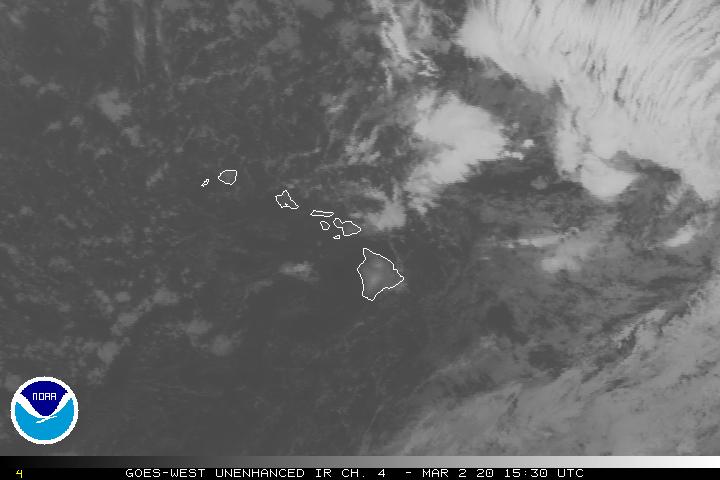


Shawn Says:
I want to be in hawaii~~~Hi Shawn, I certainly can’t blame you for that! Aloha, Glenn
Dick Thompson Says:
Hi Glenn,
Looking at a fire 1/2 mi SW of the top of Hapapa Rd at 4000' in Kula. The trades are blasting N to S, blowing the fire away. However the prevailng trades vortex blows in the opposite direction, from the S. How long til the trades decrease, return to ENE, the counterflow vortex returns and the fire blows toward me?
Anyone warning the residences downwind? Dont hear it on the radio.
Aloha, Dick~~~Hello Dick, yes I am aware of the fire, and the helicopters and fire trucks are working feverishly to control it. How long until the trade winds decrease? It looks like later Tuesday into Wednesday…before they get down to more normal levels. Kaupo Gap this afternoon has reported 80+ mph gusts, so we are still in for more very strong winds on the western slope of the Haleakala Crater. Best of luck everyone! Aloha, Glenn