Air Temperatures – The following maximum temperatures were recorded across the state of Hawaii Sunday:
Lihue, Kauai – 82
Honolulu airport, Oahu – 85
Kaneohe, Oahu – 82
Molokai airport – 84
Kahului airport, Maui – 87 (Record high for Sunday / 93 – 1953)
Kona airport – 84
Hilo airport, Hawaii – 83
Air Temperatures ranged between these warmest and coolest spots near sea level – and on the highest mountain tops…as of 1am Monday morning:
Kailua-kona – 76
Molokai airport – 72
Haleakala Crater – M (near 10,000 feet on Maui)
Mauna Kea – 27 (near 13,800 feet on the Big Island)
Hawaii’s Mountains – Here’s a link to the live web cam on the summit of near 13,800 foot Mauna Kea on the Big Island of Hawaii. This web cam is available during the daylight hours here in the islands…and when there’s a big moon shining down during the night at times. Plus, during the nights you will be able to see stars, and the sunrise and sunset too…depending upon weather conditions. Here's the Haleakala Crater webcam on Maui…although this webcam is not always working correctly.
Tropical Cyclone activity in the eastern and central Pacific – Here’s the latest weather information coming out of the National Hurricane Center, covering the eastern north Pacific. You can find the latest tropical cyclone information (once the season begins June 1) for the central north Pacific (where Hawaii is located) by clicking on this link to the Central Pacific Hurricane Center. A satellite image, which shows the entire ocean area between Hawaii and the Mexican coast…can be found here. Here's a tropical cyclone tracking map for the eastern and central Pacific.
Aloha Paragraphs

Strengthening trade winds, with small craft
wind advisories over all coasts and channels
Gale warning parts of Maui County/Big Island
Wind advisory over all islands Monday
15-30 mph…with gusts to near 60 mph
Windy on the summits of Maui and the Big Island…
high wind warning – gusting to 81 mph atop the Big
Island early Monday morning!
A few showers, drier than normal through
Monday…increasing showers Tuesday
High and middle clouds locally
As this weather map shows, we have a large near 1034 millibar high pressure system far to the northeast of the islands. At the same time, a ridge of high pressure extending southwest of this high pressure cell is located to the north and northwest of Kauai. Our local winds will strengthen Monday from the trade wind direction…somewhat lighter Tuesday.
The following numbers represent the most recent top wind gusts (mph), along with directions as of Monday morning:
29 Port Allen, Kauai – NE
50 Waianae Valley, Oahu – NW
37 Molokai – ENE
29 Kahoolawe – NW
56 Kaupo Gap, Maui – NNE
37 Lanai – NE
56 Kealakomo, Big Island – NE!
We can use the following links to see what’s going on in our area of the north central Pacific Ocean. Here's the latest NOAA satellite picture – the latest looping satellite image…and finally the latest looping radar image for the Hawaiian Islands.
Here are the latest 24-hour precipitation totals (inches) for each of the islands as of Sunday evening:
1.17 Mount Waialeale, Kauai
0.40 Kahuku trng area, Oahu
0.15 Molokai
0.00 Lanai
0.00 Kahoolawe
0.18 Puu Kukui, Maui
1.61 Kawainui Stream, Big Island
Sunset Commentary: Our local winds will remain stronger than usual into Monday, and remain elevated through Tuesday. Small craft wind advisories have now spread to all the coasts and channels across the state now. Gale warning flags have been hoisted across the windiest coastal and channel waters around Maui County and the Big Island now too. Winds across the higher elevations of Maui and the Big Island will potentially become stronger into Monday as well…necessitating a high wind warning for these elevations. These strong, gusty and deep trade winds will taper off by the middle of the new week ahead, with more normal moderately strong trade winds then.
I took in a new film this past Friday evening, recommended by a good friend of mine, and I might add…a person who I trust in these matters. So, I went to see Men In Black, starring Will Smith, Tommy Lee Jones, Josh Brolin, Emma Thompson, and Jemaine Clement…among many others. The synopsis: agents J and K are back. J has seen some inexplicable things in his 15 years with the Men in Black, but nothing, not even aliens, perplexes him as much as his wry, reticent partner. But when K's life and the fate of the planet are put at stake, Agent J will have to travel back in time to put things right. J discovers that there are secrets to the universe that K never told him — secrets that will reveal themselves as he teams up with the young Agent K to save his partner, the agency, and the future of humankind. As usual, I enjoyed this film more than I thought I was going to, and actually liked it quite a bit. It was different than I thought it was going to be, which turned out to be a good thing. In sum, this film was an old-fashioned, alien-hunting story, with all the silly but great sci-fi special effects I like. As such, I feel it deserves a strong B grade…an entertaining film to say the least. Here's a trailer, just in case you had the slightest interest in taking a quick look.
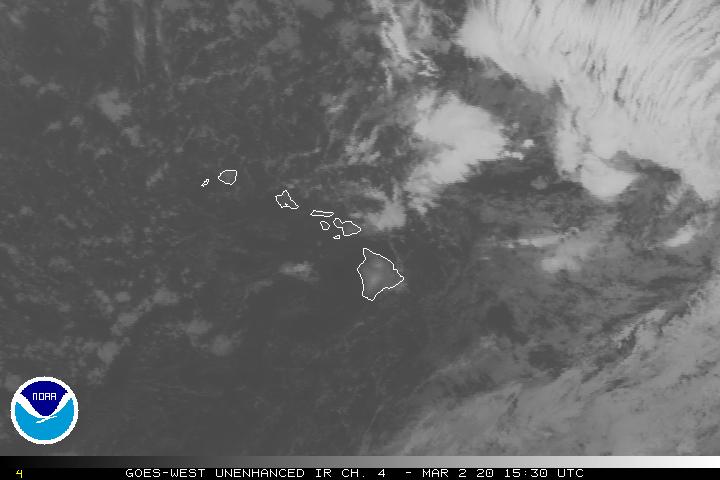
Here in Kula, Maui at 515pm, it was partly cloudy…with an air temperature of 76.6F degrees. As this satellite image shows, we see that same large swath of high and middle level clouds over the islands…although it continues to slowing migrate westward. These clouds certainly dimmed and filtered our sunshine today. There will likely be good colors in our skies at sunset this evening. We'll find a few passing showers falling along the windward sides at times, although there will be fewer than normal through Monday. We may see an increase in clouds and showers along our windward sides by Tuesday, just about the same time that our abnormally gusty trade winds begin to falter a bit. ~~~ Today is Father's Day, and as such, I'd like to put out special wishes to all you Dad's! My own Father, Mr. Edward E. James of Long Beach, California, passed away earlier this year. At the same time, yesterday would have been his 90th birthday as well. So, obviously, I have him on my mind now…I miss him! At any rate, again, wanting to celebrate this day for all you men you have had kids. ~~~ I'll be back again early Monday morning with your next new weather narrative from paradise, I hope you have a great Sunday night wherever you happen to be spending it! Aloha for now…Glenn.
[World-wide tropical cyclone activity:
Central Pacific Ocean: There are no active tropical cyclones expected through the next 48 hours.
Eastern Pacific Ocean: There are no active tropical cyclones expected through the next 48 hours.
A TROUGH OF LOW PRESSURE EXTENDING FROM NEAR THE COAST OF MEXICO SOUTHWESTWARD INTO THE EASTERN PACIFIC OCEAN FOR SEVERAL HUNDRED MILES CONTINUES TO PRODUCE A LARGE AREA OF DISORGANIZED SHOWERS AND THUNDERSTORMS. ANY DEVELOPMENT OF THIS SYSTEM SHOULD BE SLOW TO OCCUR DURING THE NEXT COUPLE OF DAYS AS IT REMAINS NEARLY STATIONARY. THIS SYSTEM HAS A LOW CHANCE…20 PERCENT…OF BECOMING A TROPICAL CYCLONE DURING THE NEXT 48 HOURS. REGARDLESS OF DEVELOPMENT…HEAVY RAINFALL AND THE THREAT FOR FLASH FLOODS AND MUDSLIDES WILL CONTINUE OVER PORTIONS OF SOUTH-CENTRAL MEXICO FOR THE NEXT COUPLE OF DAYS.
Here's a satellite image showing this tropical disturbance
Atlantic Ocean: There are no active tropical cyclones expected through the next 48 hours.
A NON-TROPICAL AREA OF LOW PRESSURE LOCATED ABOUT 100 MILES EAST- NORTHEAST OF BERMUDA IS PRODUCING DISORGANIZED SHOWERS AND THUNDERSTORMS AS IT INTERACTS WITH A MID- TO UPPER-LEVEL LOW. ANY DEVELOPMENT OF THIS SYSTEM AS A SUBTROPICAL OR TROPICAL CYCLONE IS EXPECTED TO BE SLOW TO OCCUR AS IT MOVES NORTH-NORTHEASTWARD AT ABOUT 15 MPH DURING THE NEXT COUPLE OF DAYS. THIS SYSTEM HAS A LOW CHANCE…10 PERCENT…OF BECOMING A SUBTROPICAL OR TROPICAL CYCLONE DURING THE NEXT 48 HOURS.
ELSEWHERE…TROPICAL CYCLONE FORMATION IS NOT EXPECTED DURING THE NEXT 48 HOURS.
Here is a graphical tropical weather outlook…showing this tropical disturbance
Western Pacific Ocean: Typhoon Guchol (05W) is located approximately 265 NM south of Kadena AB, Okinawa. Sustained winds were 132 mph, with gusts to near 161 mph. This gradually weakening typhoon will move north-northeast and then northeast. Guchol is forecast to remain offshore to the east of Okinawa, then over parts of Japan…close to or right over the major city of Tokyo as a weakening tropical storm. Here is a JTWC graphical track map for this tropical cyclone, along with a satellite image.
Meanwhile, a new tropical depression called Talim (06W) has formed in the South China Sea…located approximately 240 NM south-southwest of Hong Kong. Sustained winds were near 35 mph, with gusts near 46 mph. This gradually strengthening cyclone will soon become a tropical storm…although isn't being forecast by the JTWC to reach typhoon strength during its life cycle. It is forecast to remain offshore from China, although moving over at least part of Taiwan, and then many days from now, move right over the same parts of Japan, that typhoon Guchol is forecast to move over. Here is a JTWC graphical track map for this tropical cyclone, along with a satellite image.
South Indian Ocean: There are no active tropical cyclones
Interesting: Recent years' warming in the Arctic has caused local changes in vegetation, reveals new research by biologists from the University of Gothenburg and elsewhere published in the journals Nature Climate Change and Ecology Letters. The results show that most plants in the Arctic have grown taller, and the proportion of bare ground has decreased.
Above all, there has been an increase in evergreen shrubs."We've managed to link the vegetation changes observed at the different sites to the degree of local warming," explains researcher and biologist Robert Björk from the University of Gothenburg.
Shrubs and plants more widespread
Comparisons show that the prevalence of vascular species, such as shrubs and plants, is increasing as temperatures rise. The degree of change depends on climate zone, soil moisture and the presence of permafrost. Researchers working on the International Tundra Experiment (ITEX) have been gathering data for almost 30 years.
By analyzing changes in vegetation in 158 plant communities at 46 locations across the Arctic between 1980 and 2010, they have been able to identify a number of general trends. "We've managed to show that the vegetation changes in our fixed plots are a result of local warming at numerous sites across the world's tundra," Robert Björk says.
Summer temperatures and soil moisture implicated
ITEX was started up in the USA in 1990 when agreement was reached on a joint manual with standardised protocols which have since been used throughout the Arctic.
"The response of different plant groups to rising temperatures often varied with summer ambient temperature, soil moisture content and experimental duration, with shrubs expanding with warming only where the ambient temperature was already high, and grasses expanding mostly in the coldest areas studied," explains Ulf Molau, professor of plant ecology at the University of Gothenburg and for many years a member of the Intergovernmental Panel on Climate Change (IPCC).
Major changes The results indicate strong regional variation in the response of tundra vegetation to rising temperatures. "This means that particularly sensitive regions following the combined effects of long-term warming in the Arctic may see much greater changes than we have observed to date," Ulf Molau says.
 Email Glenn James: