Air Temperatures – The following maximum temperatures were recorded across the state of Hawaii Tuesday:
Lihue, Kauai – 83
Honolulu airport, Oahu – 83
Kaneohe, Oahu – 82
Molokai airport – 83
Kahului airport, Maui – 88 (Record high for Tuesday / 94 – 1996)
Kona airport – 82
Hilo airport, Hawaii – 83
Air Temperatures ranged between these warmest and coolest spots near sea level – and on the highest mountain tops…as of 5pm Tuesday evening:
Kailua-kona – 81
Molokai airport – 77
Haleakala Crater – M (near 10,000 feet on Maui)
Mauna Kea – 37 (near 13,800 feet on the Big Island)
Hawaii’s Mountains – Here’s a link to the live web cam on the summit of near 13,800 foot Mauna Kea on the Big Island of Hawaii. This web cam is available during the daylight hours here in the islands…and when there’s a big moon shining down during the night at times. Plus, during the nights you will be able to see stars, and the sunrise and sunset too…depending upon weather conditions. Here's the Haleakala Crater webcam on Maui…although this webcam is not always working correctly.
Tropical Cyclone activity in the eastern and central Pacific – Here’s the latest weather information coming out of the National Hurricane Center, covering the eastern north Pacific. You can find the latest tropical cyclone information (once the season begins June 1) for the central north Pacific (where Hawaii is located) by clicking on this link to the Central Pacific Hurricane Center. A satellite image, which shows the entire ocean area between Hawaii and the Mexican coast…can be found here. Here's a tropical cyclone tracking map for the eastern and central Pacific.
Aloha Paragraphs

Trade winds quite light through Friday, then strengthening
this weekend into next week…with passing windward
showers tonight…and localized showers along the leeward
slopes during the afternoon hours Wednesday
As this weather map shows, we have a large near 1030 millibar high pressure system far to the northeast of the islands. At the same time, a ridge of high pressure extending southwest of this high pressure cell is located to the north and northwest of Kauai. Our local winds will continue to be from the trade wind direction…although becoming slightly lighter into Thursday.
The following numbers represent the most recent top wind gusts (mph), along with directions as of Tuesday evening:
15 Princeville, Kauai – E
18 Honolulu, Oahu – SE
04 Molokai
25 Kahoolawe – SE
24 Kahului, Maui – NE
08 Lanai – NW
21 South Point, Big Island – ENE
We can use the following links to see what’s going on in our area of the north central Pacific Ocean. Here's the latest NOAA satellite picture – the latest looping satellite image…and finally the latest looping radar image for the Hawaiian Islands.
Here are the latest 24-hour precipitation totals (inches) for each of the islands as of Tuesday evening:
0.80 Mount Waialeale, Kauai
0.55 Oahu Forest NWR, Oahu
0.03 Molokai
0.08 Lanai
0.00 Kahoolawe
0.38 Kula Branch Station, Maui
0.28 Puu Mali, Big Island
Sunset Commentary: The trade winds will continue blowing…although remain lighter than normal as we move through this work week. We'll find passing showers restricted to the windward sides, which will increase some tonight into Wednesday morning…as a band of clouds arrives along those sides of the islands. Meanwhile, the leeward upcountry slopes will find a chance of showers falling during the afternoon hours…especially on the larger islands of Maui and the Big Islands. The trade winds are expected to gradually strengthen this coming weekend, bringing back a more normal trade wind weather pattern into next week. Small craft wind advisories will remain down until Sunday or next Monday, when they will be issued around those windiest parts of Maui County and the Big Island.
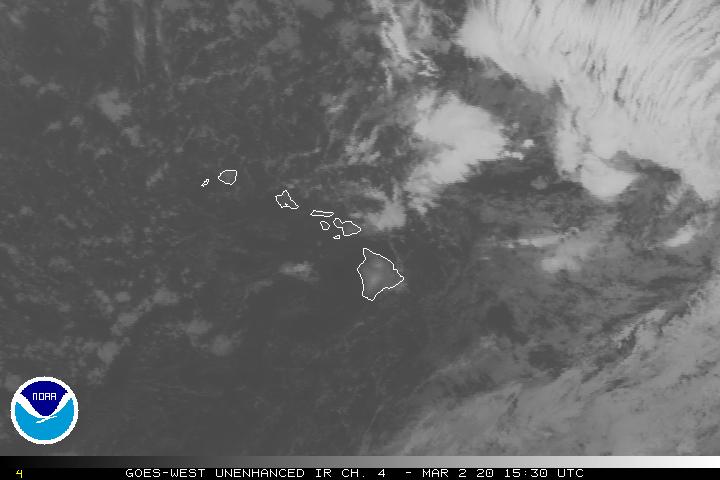
Here in Kula, Maui at 515pm, it was mostly cloudy with light winds…and an air temperature of 69.8F degrees. As this satellite image shows, there is a band of clouds moving towards the windward sides of the islands…which will bring increasing showers tonight. There are some light cirrus clouds in the southern part of the state, generally over the Big Island at the time of this writing. There were a few showers over the interior sections on both Maui and the Big Island Tuesday afternoon, although were less dynamic than on Monday. Here in Kula, it clouded up later in the morning, and besides a few light sprinkles, we didn't get much water falling from the sky. This is an update at 535pm: it finally let loose, and is coming down pretty good at the moment! ~~~ I'll be back early Wednesday morning with your next new weather narrative. I hope you have a great Tuesday night until then! Aloha for now…Glenn.
Extra: great video of a bulldog ridin'
[World-wide tropical cyclone activity:]
Central Pacific Ocean: There are no active tropical cyclones expected through the next 48 hours.
Eastern Pacific Ocean: There are no active tropical cyclones expected through the next 48 hours.
SHOWERS AND THUNDERSTORMS HAVE INCREASED IN ASSOCIATION WITH AN AREA OF LOW PRESSURE LOCATED ABOUT 500 MILES SOUTH-SOUTHEAST OF THE BORDER OF GUATEMALA AND EL SALVADOR. THIS DISTURBANCE HAS THE POTENTIAL TO DEVELOP INTO A TROPICAL DEPRESSION DURING THE NEXT DAY OR TWO AS IT MOVES WEST-NORTHWESTWARD OR NORTHWESTWARD. THIS SYSTEM HAS A MEDIUM CHANCE…50 PERCENT…OF BECOMING A TROPICAL CYCLONE DURING THE NEXT 48 HOURS.
A BROAD AREA OF LOW PRESSURE LOCATED SEVERAL HUNDRED MILES SOUTH-SOUTHWEST OF ACAPULCO MEXICO IS PRODUCING DISORGANIZED CLOUDINESS AND SHOWERS. ENVIRONMENTAL CONDITIONS APPEAR FAVORABLE FOR SLOW DEVELOPMENT OF THIS LOW DURING THE NEXT COUPLE OF DAYS. THIS SYSTEM HAS A LOW CHANCE…20 PERCENT…OF BECOMING A TROPICAL CYCLONE DURING THE NEXT 48 HOURS.
Here's a satellite image showing these two tropical disturbances
Atlantic Ocean: There are no active tropical cyclones expected through the next 48 hours.
Western Pacific Ocean: Tropical storm Guchol (05W) is active around 135 NM east of Yap. Sustained winds were 35 knots, with gusts to near 45 knots. This TS will move westward and gradually turn northwest over the next several days…attaining typhoon status in about 48 hours. Guchol is forecast to remain well east of the Philippine Islands, and Taiwan too…as it moves over the open ocean. Here is a JTWC graphical track map for this storm.
South Indian Ocean: There are no active tropical cyclones
Interesting: Night owls often wake up for work or school with a scowl on their faces and wishing for an IV drip of coffee, while morning people come skipping in 15 minutes early. However, morning people aren't chipper just as the sun is coming up; they are happier and more satisfied with life overall, a new study suggests.
Teenagers' night owl tendencies fade as they age, and the study says this switch to a morning-focused schedule could be why older adults are happier than younger ones.
"Past research has suggested that morning-type people report feeling happier than evening-type people, and this research was only on young adults," study researcher Renee Biss, a graduate student at the University of Toronto, told LiveScience.
Early birds The new study looked across the lifespan to see if the morning habits of older individuals contributed to their overall life outlook. The researchers studied two populations: a group of 435 adults ages 17 to 38, and a group of 297 older adults, ages 59 to 79.
Both groups filled out questionnaires about their emotional state, how healthy they feel and their preferred "time of day." By age 60, most people are morning types, the researchers found. Only about 7 percent of young adults are morning larks, but as the population ages, this switches — in the older years only about 7 percent of the population are still night owls.
Interesting2: The most inhospitable land in the entire world, the Arctic Tundra, is now undergoing an amazing transformation. Rising temperatures in the Arctic circle has caused changes in vegetation in the last few decades. Plants are growing taller, there is less bare ground devoid of vegetation, and even some shrubs are growing. It is far from being an agricultural breadbasket, but is well on its way to becoming a more lively ecosystem.
A recent study from biologists at the University of Gothenburg, Sweden documents the dramatic changes that are occurring. Their study analyzed data across the Arctic from 1980 to 2010 collected by the International Tundra Experiment (ITEX). Changes in 158 plant communities from 46 locations were observed and their trends were recorded.
They found that vascular species (shrubs and plants) have become more prevalent. The cause of the prevalence was linked directly to locally warmer temperatures. The degree of vegetation change was not uniform throughout the Arctic tundra. Some areas grew more or less depending on factors such as climate zone, soil moisture, and the presence of permafrost.
"The response of different plant groups to rising temperatures often varied with summer ambient temperature, soil moisture content and experimental duration, with shrubs expanding with warming only where the ambient temperature was already high, and grasses expanding mostly in the coldest areas studied," explains Ulf Molau, professor of plant ecology at the University of Gothenburg and for many years a member of the Intergovernmental Panel on Climate Change (IPCC).
Northern communities are adapting to their surroundings by taking advantage of the previously barren land. However, new challenges may present themselves like erosion of the newly loosened soil. The land could become so unstable that construction of permanent structures can be made impossible. Plus, melting permafrost is a major producer of greenhouse gases, further exacerbating the warming climate.
 Email Glenn James: