











Air Temperatures – The following maximum temperatures were recorded across the state of Hawaii Monday:
Lihue, Kauai – 83
Honolulu airport, Oahu – 86
Kaneohe, Oahu – 82
Molokai airport – 82
Kahului airport, Maui – 87 (Record high for Monday / 93 – 1996)
Kona airport – 83
Hilo airport, Hawaii – 82
Air Temperatures ranged between these warmest and coolest spots near sea level – and on the highest mountain tops…as of 5pm Monday evening:
Honolulu, Oahu – 83
Princeville, Kauai – 79
Haleakala Crater – M (near 10,000 feet on Maui)
Mauna Kea – 43 (near 13,800 feet on the Big Island)
Hawaii’s Mountains – Here’s a link to the live web cam on the summit of near 13,800 foot Mauna Kea on the Big Island of Hawaii. This web cam is available during the daylight hours here in the islands…and when there’s a big moon shining down during the night at times. Plus, during the nights you will be able to see stars, and the sunrise and sunset too…depending upon weather conditions. Here's the Haleakala Crater webcam on Maui…although this webcam is not always working correctly.
Tropical Cyclone activity in the eastern and central Pacific – Here’s the latest weather information coming out of the National Hurricane Center, covering the eastern north Pacific. You can find the latest tropical cyclone information (once the season begins June 1) for the central north Pacific (where Hawaii is located) by clicking on this link to the Central Pacific Hurricane Center. A satellite image, which shows the entire ocean area between Hawaii and the Mexican coast…can be found here. Here's a tropical cyclone tracking map for the eastern and central Pacific.
Aloha Paragraphs

Trade winds, becoming lighter through the rest of
this week…with a few passing windward showers
at night, and localized showers along the leeward
slopes during the afternoon hours
As this weather map shows, we have a large near 1029 millibar high pressure system far to the northeast of the islands. At the same time, a ridge of high pressure is located to the north of Kauai. Our local winds will continue to be from the trade wind direction, remaining active…although becoming slightly lighter today into Tuesday.
The following numbers represent the most recent top wind gusts (mph), along with directions as of Monday evening:
20 Port Allen, Kauai – ENE
27 Kuaokala, Oahu – N
21 Molokai – NE
27 Kahoolawe – ENE
30 Kahului, Maui – NE
27 Lanai – NE
24 Kealakomo, Big Island – ENE
We can use the following links to see what’s going on in our area of the north central Pacific Ocean. Here's the latest NOAA satellite picture – the latest looping satellite image…and finally the latest looping radar image for the Hawaiian Islands.
Here are the latest 24-hour precipitation totals (inches) for each of the islands as of Monday evening:
0.31 Kapahi, Kauai
0.60 Kahuku trng area, Oahu
0.00 Molokai
0.00 Lanai
0.00 Kahoolawe
0.30 Ulupalakua, Maui
0.37 Kawainui Stream, Big Island
Sunset Commentary: The trade winds will remain active…although gradually dropping a notch in strength as we move through this work week. We'll find passing showers restricted to the windward sides, with a few elsewhere. These showers will spread themselves along the windward sides at night, and along the leeward upcountry slopes during the afternoon hours. The trade winds are expected to strengthen later this coming weekend, bringing back a more normal trade wind weather pattern into next week.
Here in Kula, Maui at 535pm, it was mostly cloudy with light winds, along with off an on light showers (.13")…and an air temperature of 67.6F degrees. As this satellite image shows, there were clouds over Maui and the Big Island, although much of the rest of the state was clear. There were showers over the interior sections on both Maui and the Big Island, which should clear up later this evening into the night. Meanwhile the trade winds will continue blowing, although gradually become lighter as a ridge of high pressure gets closer to Kauai, pushed there by a late season cold front to our northwest. This unusually light wind regime will last through this work week, then pick up again during the weekend…into next week.
This lighter wind event will move us into a modified convective weather pattern. This will find clear and slightly cooler than normal early mornings, with daytime sea breezes along our leeward sides, sending clouds into the upcountry areas during the afternoon hours, leading to localized showers…as there were today locally. The windward sides too will see a few showers falling there, although generally during the night and early morning hours at times. I'll be back early Tuesday morning with your next new weather narrative, I hope you have a great Monday night wherever you're spending it! Aloha for now…Glenn.
Extra: great video of a bulldog ridin'
[World-wide tropical cyclone activity:]
Central Pacific Ocean: There are no active tropical cyclones expected through the next 48 hours.
Eastern Pacific Ocean: There are no active tropical cyclones expected through the next 48 hours. A BROAD AREA OF LOW PRESSURE LOCATED ABOUT 800 MILES SOUTH OF THE SOUTHERN TIP OF BAJA CALIFORNIA HAS WEAKENED. DEVELOPMENT OF THIS SYSTEM IS NOT EXPECTED…AND IT HAS A LOW CHANCE…NEAR 0 PERCENT…OF BECOMING A TROPICAL CYCLONE DURING THE NEXT 48 HOURS AS IT DRIFTS WESTWARD OR WEST-NORTHWESTWARD.
Atlantic Ocean: There are no active tropical cyclones expected through the next 48 hours.
Western Pacific Ocean: There are no active tropical cyclones
South Indian Ocean: There are no active tropical cyclones
Interesting: Groundwater depletion will soon be as important a factor in contributing to sea-level rise as the melting of glaciers other than those in Greenland and Antarctica, scientists say. That's because water pumped out of the ground for irrigation, industrial uses, and even drinking must go somewhere after it's used—and, whether it runs directly into streams and rivers or evaporates and falls elsewhere as rain, one likely place for it to end up is the ocean.
To find out how much of an effect this has on sea level, a team of Dutch scientists led by hydrologist Yoshihide Wada, a Ph.D. researcher at Utrecht University, divided the Earth's land surface into 31-by-31-mile squares on a grid to calculate present and future groundwater usage. To make the calculation as precise as possible, they used not only current groundwater-use statistics from each country, but also economic growth and development projections.
They also took into account the impact of climate change on regional water needs, considering "all the major factors that contribute," Wada said. Because aquifers can be refilled, the scientists also used climate, rainfall, and hydrological models to calculate the rate of groundwater recharge for each region. From this, they projected the net rate of groundwater depletion.
The Reservoir Connection
Newly constructed reservoirs above ground can offset the net loss of water underground. These, Wada said, trap water that would otherwise reach the sea. Before 1990 or so, he added, that offset was large enough that the United Nations' Intergovernmental Panel on Climate Change never took groundwater depletion into account in predicting 21st-century sea-level rise.
But that offset is no longer as significant as it once was, Wada said. "There are not so many places where people can build new reservoirs," he said. "They are already built."Already, he and his colleagues have found, groundwater depletion is adding about 0.6 millimeters per year (about one-fortieth of an inch) to the Earth's sea level.
By 2050, he said, the triple pressures of growing population, economic development, and higher irrigation needs due to a warming climate will increase that to 0.82 millimeters per year—enough to raise sea levels by 1.6 inches above 1990 levels. Between 2050 and 2100, according to some estimates, sea levels would rise even faster.
To put that in perspective, he said, groundwater depletion adds about 25 percent to projected rates of sea-level rise, making it the largest contributor from land to sea-level rise other than the melting of the Greenland and Antarctic ice sheets. Even the melting of glaciers in the world's high mountains won't contribute more to rising sea levels, Wada said.
Multiple Challenges
What's more, groundwater depletion isn't the only way in which water now stored on land can find its way into the sea. The draining of wetlands, Wada said, has the same effect, as do declining water levels in bodies of water from the Dead Sea to Asia's giant Caspian Sea. Even deforestation adds to the effect, he said, because trees hold large quantities of water that evaporates when the wood is used for lumber, paper, and other manufactured goods. "This water goes to the oceans, as well," Wada said. Overall, he calculated, these minor factors add nearly another 6 percent to the total effect from non-ice, land-based sources.
The Bigger Picture
Other scientists are skeptical. "This is an interesting study," said Ken Caldeira, a climate scientist at the Carnegie Institution for Science's Department of Global Ecology, in Stanford, California. In an email, he said, the researchers might have overstated their findings by failing to realize that groundwater seeps into rivers, increasing their flow. Lowering the groundwater table will reduce this seepage, he said, partially offsetting the effect by reducing the amount of river water reaching the sea. Also, he noted, the study projects that groundwater depletion and related effects could produce as much as a 4-inch rise in sea level by 2100.
"Since land covers only about 30 percent of the planet, this means that you would need to deplete an average of about 13 inches of water from all the land on our planet. This is a huge amount of water." Another problem is that the study does not take into account the increasing difficulty of pumping water from depleted aquifers, said Leonard Konikow, a hydro-geologist at the U.S. Geological Survey's office in Reston, Virginia.
"The rate of pumping will have to decrease." Wada agrees this is a potential problem in the study. "We don't have good data on [that]," he said. "If the groundwater table becomes too low, the farmer with low technology might not be able to pump anymore." But, Konikow said, his own research suggests that Wada's team's estimates are still too high by about 30 to 35 percent.
"Their method of estimating depletion is based on indirect calculations based on global climate models," he said. "My own estimates are based on volumetric analyses of aquifer systems throughout the world, in which we're actually looking at water-level changes in as many aquifers as possible."Still, he noted, it's an important effect. "I think it has to be considered in predicting future sea level," he said.
Wada said the solution is to find ways of improving the efficiency of water in agriculture: in essence learning to grow more, with less. Caldeira agreed. "I think this says more about the mismanagement of our land than it does about the threat from sea-level rise," he said.
The new research was published earlier this month in Geophysical Research Letters.
 Email Glenn James: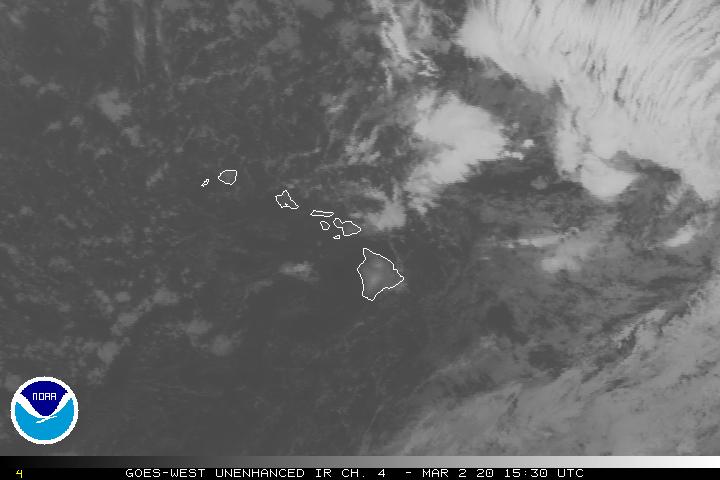

Jay Says:
what a blessing…rain in Ulpalakua…soooo dry here…hopefully a couple of more days of this….~~~Hi Jay, yes, finally the rains have arrived, all the way from you area, around to Keokea and onto my place here in Kula. Those afternoon showers lasted quite a while, and I expect to see more of them over the next several afternoons! Aloha, Glenn