Air Temperatures – The following maximum temperatures were recorded across the state of Hawaii Monday:
Lihue, Kauai – 80
Honolulu airport, Oahu – 83 (Record high temperature for Monday – 88 / 2005)
Kaneohe, Oahu – M
Molokai airport – 81
Kahului airport, Maui – 83 (Record high temperature for Monday – 90 / 2003)
Kona airport – 83
Hilo airport, Hawaii – 80
Air Temperatures ranged between these warmest and coolest spots near sea level – and on the highest mountain tops…as of 5pm Monday evening:
Barking Sands, Kauai – 82
Hilo, Hawaii – 70
Haleakala Crater – 50 (near 10,000 feet on Maui)
Mauna Kea – 36 (near 13,800 feet on the Big Island)
Hawaii’s Mountains – Here’s a link to the live web cam on the summit of near 13,800 foot Mauna Kea on the Big Island of Hawaii. This web cam is available during the daylight hours here in the islands…and when there’s a big moon shining down during the night at times. Plus, during the nights you will be able to see stars, and the sunrise and sunset too…depending upon weather conditions. Here's the Haleakala Crater webcam on Maui…although this webcam is not always working correctly.
Aloha Paragraphs

Gusty trades – windward showers at times…
with generally dry leeward areas
As this weather map shows, we have a near 1032 millibar high pressure system located to the northeast of Hawaii, with a second near 1036 millibar high pressure far northwest. Our local winds will remain moderately strong, although stronger at times through this first half of the work week.
The following numbers represent the most recent wind gusts (mph), along with directions as of Monday evening:
25 Waimea Heights, Kauai – NE
37 Kuaokala, Oahu – NE
32 Molokai – NE
36 Kahoolawe – NE
32 Kahului, Maui – NE
44 Lanai – NE
39 Puu Mali, Big Island – NE
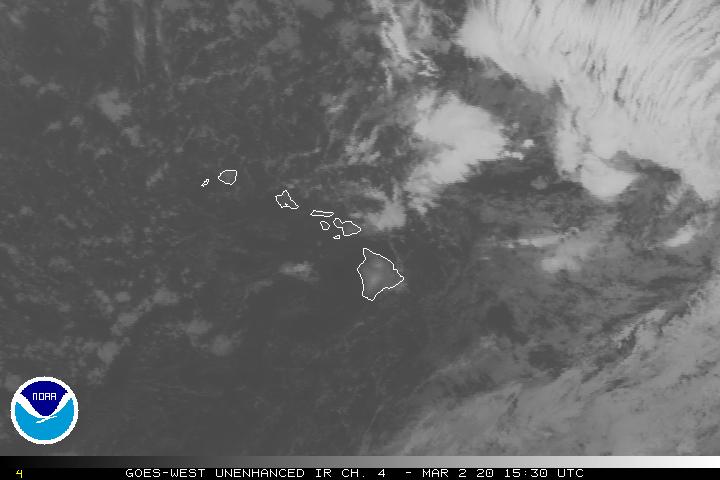
We can use the following links to see what’s going on in our area of the north central Pacific Ocean. Here's the latest NOAA satellite picture – the latest looping satellite image…and finally the latest looping radar image for the Hawaiian Islands.
Here are the latest 24-hour precipitation totals (inches) for each of the islands as of Monday evening:
1.28 Mount Waialeale, Kauai
0.51 Oahu Forest NWR, Oahu
0.14 Molokai
0.09 Lanai
0.00 Kahoolawe
1.69 Puu Kukui, Maui
0.65 Kawainui Stream, Big Island
Sunset Commentary: As we move through this first half of the week, high pressure to our north will keep the trade winds blowing. These trades will blow in the moderately strong realms, although there will be gusts that approach 40 mph in those windiest locations through Tuesday evening. These windiest areas will include parts of Maui County and the Big Island, where a small craft wind advisory continues until 6am Wednesday morning. Weather circumstances will likely bring the trade wind speeds down during the second half of the week, at which point they will fall into the light to moderately strong category by Thursday.
The long range forecast continues to show a trough of low pressure with an associated cold front approaching the Hawaiian Islands this coming weekend. This is late in the spring season for such an event, so we'll have to take a wait and see attitude for the moment. However, if it did manifest as the computer forecast models are suggesting, there would be several consequences. The first would be for our winds to veer around to the southeast…and falter in strength quite a bit too. If this were to happen, we would likely see the advent of volcanic haze over some parts of the island chain, coming up from the vents on the Big Island. Then, we could see some increase in precipitation too, depending upon whether the precipitation source intrudes into the island chain or not.
Here in Kula, Maui at 545pm, skies were clear to partly cloudy with light winds, and an air temperature of 75.2F degrees. As noted above, our trade winds will persist, and continue unabated through the rest of this new week. These trades will more than likely taper off some after mid-week, and remain lighter for several days into the weekend. They won't stop altogether, but will be noticeably less strong than anytime that we've seen during the last several weeks. Then, and this would be a big change…the models point out an area of low pressure edging this way Sunday into early next week. I'm certainly not placing any large bets on this happening, although stranger things have happened. I'll be following this prospect closely during the week, and will write more about it as things develop one way or the other.
Meanwhile, glancing at this satellite image, we see yet another cloud band that's moving our way from the east. These patches of showery clouds will bring more showers to the state this evening into early Tuesday morning. At the same time, we see those whiter and brighter high cirrus clouds approaching from the west, on the upper winds aloft. ~~~ I'll be early Tuesday morning with your next new weather narrative. I hope you have a great Monday night wherever you're spending it! Aloha for now…Glenn.
Extra: Youtube video of a very fast car…allows us to get a true feeling for what race cars are built to do!
Extra: Youtube video of another very fast ride…showing what we would be going through as a passenger!
More fun: Youtube video…a fun ride!
Interesting: Researchers at the University of Hull are developing a way to produce constant supplies of sterile water, powered simply by sunlight and air. The device is aimed at remote communities where conventional systems using chemicals or electricity are not a viable option. The research — funded by the Sir Halley Stewart Trust — will make use of molecules which, in response to sunlight, produce a form of oxygen that is highly toxic.
Lead researcher from Hull’s Department of Chemistry, Dr Ross Boyle, originally developed these molecules to attack cancer cells, but has spotted a new application for their use in the developing world. “We know from earlier work that the same technique which works on cancer cells will destroy many species of bacteria including MRSA and E. Coli,” says Dr Boyle.
“It can also knock out at least one common parasite. And a major advantage is that it doesn’t create resistance in micro-organisms.” The molecules – known as porphyrins – will be attached to small glass beads, which are packed inside a transparent tube.
As water flows through the tube in natural light, the porphyrins on the beads react to create the toxic form of oxygen, killing the bacteria and parasites in the water to render it sterile. Dr Boyle already knows how to fix his molecules to a glass surface, so is confident that production of the beads will be straightforward.
“The device needs to be very simple, low-cost and easy to transport in order to be a realistic and practical option for remote rural communities,” says Dr Boyle. “No special materials beyond the glass beads will be needed; an up-turned plastic drinking bottle may even be enough to hold them.
The beads won’t need refrigeration or special storage conditions, and will keep indefinitely if stored in the dark.” The system will also have no by-products, other than the used glass beads, as the toxic form of oxygen converts back to normal oxygen spontaneously and rapidly if it does not react with the microorganisms.
The beads will have a set lifespan, but once spent can be recycled as ordinary glass or can be taken away to be recoated with the light-sensitive molecules for re-use. Sterile water is vital for communities with limited access to healthcare services, to help wounds and sores heal effectively.
It is usually made using chemicals such as hydrogen peroxide or chlorine – which are toxic and heavy to transport – or ultra-violet, which requires electricity. Other systems, such as filtration, tend to have limited use as filters clog with other particles present in the water.
Because Dr Boyle’s device brings together existing technologies, he hopes to have a basic system up and running in his laboratory within a few months. He will then need to optimize the device under controlled laboratory conditions using cultured bacteria, to determine how fast the water should flow through the device and how long the lifetime of the beads will be.
Once he has a working prototype, this will go into trials in South Africa to ensure the final design is effective in the field.
 Email Glenn James: