Air Temperatures – The following maximum temperatures were recorded across the state of Hawaii Friday:
Lihue, Kauai – 79
Honolulu airport, Oahu – 82 (Record high temperature for Friday – 88 / 1974)
Kaneohe, Oahu – 73
Molokai airport – 80
Kahului airport, Maui – 81
Kona airport – 82
Hilo airport, Hawaii – 78
Air Temperatures ranged between these warmest and coolest spots near sea level – and on the highest mountain tops…as of 5pm Friday evening:
Kailua-kona – 79
Kapalua, Maui – 73
Haleakala Crater – 46 (near 10,000 feet on Maui)
Mauna Kea – 37 (near 13,800 feet on the Big Island)
Hawaii’s Mountains – Here’s a link to the live web cam on the summit of near 13,800 foot Mauna Kea on the Big Island of Hawaii. This web cam is available during the daylight hours here in the islands…and when there’s a big moon shining down during the night at times. Plus, during the nights you will be able to see stars, and the sunrise and sunset too…depending upon weather conditions. Here's the Haleakala Crater webcam on Maui…although this webcam is not always working correctly.
Aloha Paragraphs

Gusty trades – less windward showers…
with just a few leeward showers
As this weather map shows, we have a near 1034 millibar high pressure system to the north-northeast of Hawaii, with its associated ridge to the northwest through west of the islands. Our local winds will remain moderately strong and gusty this weekend…and beyond.
The following numbers represent the most recent wind gusts (mph), along with directions as of Friday evening:
15 Princeville, Kauai – NE
27 Wheeler AFB, Oahu – SE
28 Molokai – NE
40 Kahoolawe – NE
31 Kahului, Maui – NE
13 Lanai – NE
33 Kawaihae, Big Island – NE
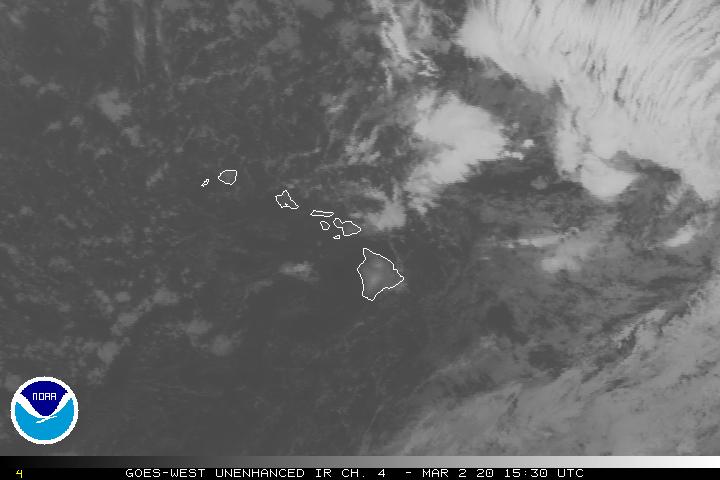
We can use the following links to see what’s going on in our area of the north central Pacific Ocean. Here's the latest NOAA satellite picture – the latest looping satellite image…and finally the latest looping radar image for the Hawaiian Islands.
Here are the latest 24-hour precipitation totals (inches) for each of the islands as of Friday evening:
1.88 Mount Waialeale, Kauai
1.12 Oahu Forest NWR, Oahu
0.11 Molokai
0.06 Lanai
0.00 Kahoolawe
8.78 Puu Kukui, Maui
0.53 Hilo airport, Big Island
Sunset Commentary: There will be small fluctuations in trade wind speeds, although they will continue to blow well into the future. They will be strongest around Maui County and the Big Island, thus the small craft wind advisory continues around the windiest parts of those eastern islands Friday night, which will likely continue to be posted through the weekend. These trade winds will carry showers into the windward sides, although not as frequent as we've seen the last several days. The leeward sides in contrast should remain drier, although a few showers will fall in these areas on the smaller islands locally.
This afternoon a couple of friends asked if I wanted to see the new Avengers film, which of course I do. I turned them down however, as I'm pretty sure it will be sold out, or at least be super crowded…as its opening night. I do want to see a film though, and settled on one called Safe, which is a rough and tumble action film, starring Jason Statham, Chris Sarandon and Catherine Chan…among many others. This isn't going to be nearly as good as The Avengers, but much less crowded I'm sure. My friends agreed with me, and so we'll meet in Kahului for dinner, and then see the film together. The synopsis: a second-rate cage fighter on the mixed martial arts circuit, Luke Wright lives a numbing life of routine beatings and chump change…until the day he blows a rigged fight. Wanting to make an example of him, the Russian Mafia murders his family and banishes him from his life forever, leaving Luke to wander the streets of New York destitute, haunted by guilt, and tormented by the knowledge that he will always be watched, and anyone he develops a relationship with will also be killed. I know, I know, this is an edgy film about guns and killing, pure and simple, what can I say. At any rate, this trailer shows a lot of that, and I'm sure I'll get my fill at the theater…perhaps even a bit more than that!
Here in Kula, Maui at 515pm, skies were partly cloudy, with light winds and an air temperature of 68.7F degrees. As noted above, our trade winds will persist through the upcoming weekend, into the new week ahead. As for precipitation, there will be showers along the windward sides in an off and on manner. The computer models and satellite imagery is suggesting that we should turn a bit drier along those north and east facing sides of our islands into this weekend. In sum, continued breezy trade winds, and a gradual easing up of our windward biased showers going forward. Otherwise, generally pleasant springtime weather will prevail, with no big surprises expected. ~~~ I'll be back Saturday morning with your next new weather narrative, I hope you have a great Friday night until then! Aloha for now…Glenn.
Extra: Youtube video…The Super Moon of May 5 2012 (Saturday night)
Interesting: A new analysis of streams in the western United States with long-term monitoring programs has found that despite a general increase in air temperatures over the past several decades, streams are not necessarily warming at the same rate. Several factors may influence the discrepancy, researchers say, including snowmelt, interaction with groundwater, flow and discharge rates, solar radiation, wind and humidity. But even after factoring out those elements, the scientists were surprised by the cooler-than-expected maximum, mean and minimum temperatures of the streams.
Results of the research, which was supported by the U.S. Geological Survey, the U.S. Forest Service and Oregon State University, have been published online in Geophysical Research Letters. "Individually, you can find streams that seem to be getting warmer and others that are getting cooler," said Ivan Arismendi, a post-doctoral researcher at Oregon State University and lead author on the study.
"Some streams show little effect at all. But the bottom line is that recent trends in overall stream temperature do not parallel climate-related trends." The researchers caution that the findings don't mean that climate change will not have an impact on stream temperature, which is a fundamental driver of ecosystem processes in streams.
However, the relationship between air temperatures and stream temperatures may be more complex than previously realized and require additional monitoring. Alternatively, there may be a time lag between air temperature and stream temperature, they say.
"One surprise was how few stream gauging stations have the necessary long-term records for evaluating climate-related trends in water temperatures," said coauthor Jason Dunham, an aquatic ecologist with the U.S. Geological Survey. "Most of them are located in streams with high human influence, which makes it difficult to separate climate effects from local human impacts."
"In those areas where human impact was minimal, the variability in trends was impressive," added Dunham, who has a courtesy appointment in OSU's Department of Fisheries and Wildlife. "It suggests to us that a variety of local influences may strongly affect how stream temperatures respond to climate." Arismendi and his colleagues considered more than 600 gauging stations for the study but only 20 of the stations had a sufficiently lengthy period of monitoring — and lacked human influence.
These long-term monitoring sites are operated primarily by the U.S. Geological Survey and U.S. Forest Service, and were located in Oregon, Washington, Idaho, California, Nevada and Alaska. Coauthor Roy Haggerty, a professor in OSU's College of Earth, Ocean, and Atmospheric Sciences, said warming temperatures can create more rapid or earlier snowmelt and affect stream temperatures in some locations.
Another explanation for the lack of warming in many streams can be a time lag that can occur between precipitation entering underground aquifers and entering the stream. "Groundwater can influence stream temperatures as well as streamflow and in some cases, it can take many years for that groundwater to make it to the stream," noted Haggerty, the Hollis M. Dole Professor of Environmental Geology at OSU.
"This and the other physics processes of a stream need to be considered when analyzing its heat budget — from the geology and stream bed, to the amount of shading in the riparian zone." Sherri Johnson, a research ecologist with the U.S. Forest Service and coauthor on the study, said stream temperatures can be important for a variety of reasons.
"Temperature is a key indicator of water quality and many streams throughout the Northwest have increased stream temperatures associated with human activity," Johnson said. "Generally speaking, cooler stream temperatures are beneficial, and are a crucial factor in maintaining healthy ecosystems and populations of salmon, steelhead, trout and other cold-water species." Arismendi, who did his doctoral work at the Universidad Austral de Chile before coming to OSU, said the study points out the value of long-term data from streams that have had minimal human impacts.
"The fact that stream temperatures don't correlate to climate trends in a predicable way indicates we need to study the relationship further to better appreciate the complexity," Arismendi said. "Our knowledge of what influences stream temperatures is limited by the lack of long-term monitoring sites, and previous lumping of results among streams with relatively low and high levels of human impacts. "Local variability is really important in driving climate sensitivity of streams," he added.
 Email Glenn James: