Air Temperatures – The following maximum temperatures were recorded across the state of Hawaii Thursday:
Lihue, Kauai – 81
Honolulu airport, Oahu – 84 (Record high temperature for Thursday / 93 – 1988)
Kaneohe, Oahu – 82
Molokai airport – 79
Kahului airport, Maui – 84 (Record high temperature for Thursday / 91 – 1952)
Kona airport – 82
Hilo airport, Hawaii – 80
Air Temperatures ranged between these warmest and coolest spots near sea level – and on the highest mountain tops…as of 5pm Thursday evening:
Barking Sands, Kauai – 82
Lihue, Kauai – 75
Haleakala Crater – 45 (near 10,000 feet on Maui)
Mauna Kea – 41 (near 13,800 feet on the Big Island)
Hawaii’s Mountains – Here’s a link to the live web cam on the summit of near 13,800 foot Mauna Kea on the Big Island of Hawaii. This web cam is available during the daylight hours here in the islands…and when there’s a big moon shining down during the night at times. Plus, during the nights you will be able to see stars, and the sunrise and sunset too…depending upon weather conditions. Here's the Haleakala Crater webcam on Maui…although this webcam is not always working correctly.
Tropical Cyclone activity in the eastern and central Pacific – Here’s the latest weather information coming out of the National Hurricane Center, covering the eastern north Pacific. You can find the latest tropical cyclone information (once the season begins June 1) for the central north Pacific (where Hawaii is located) by clicking on this link to the Central Pacific Hurricane Center. A satellite image, which shows the entire ocean area between Hawaii and the Mexican coast…can be found here. Here's a tropical cyclone tracking map for the eastern and central Pacific.
Aloha Paragraphs

Strong and gusty trade winds, passing windward
showers, moving into the leeward sides on the
smaller islands at times…through the weekend
into early next week
Small craft wind advisory for coastal and channel
waters…active from southeast of Oahu
to Maui County and the Big Island
Wind Advisory over summits on the Big Island
As this weather map shows, we have two near 1026 millibar high pressure systems to the north and northeast of the islands…with an associated ridge extending far to the west across the International Dateline. Our local winds will continue to be from the trade wind direction…remaining locally strong and gusty.
The following numbers represent the most recent top wind gusts (mph), along with directions as of Thursday evening:
23 Port Allen, Kauai – NE
45 Kuaokala, Oahu – NE
31 Molokai – NE
31 Kahoolawe – NE
32 Kahului, Maui – NE
43 Lanai – NE
44 PTA West, Big Island – NW
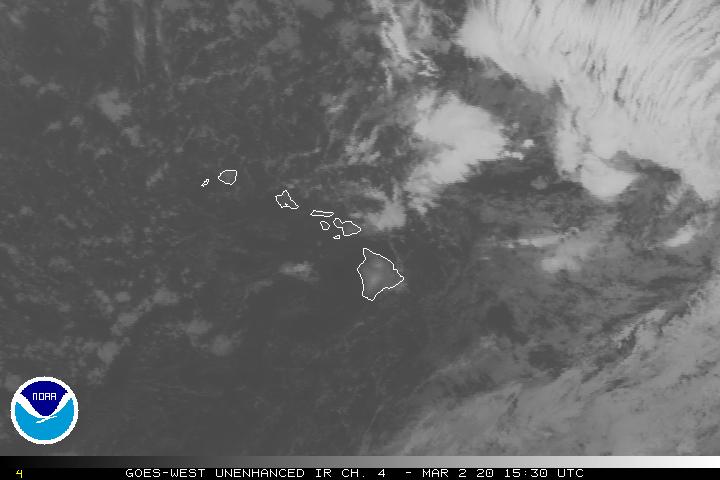
We can use the following links to see what’s going on in our area of the north central Pacific Ocean. Here's the latest NOAA satellite picture – the latest looping satellite image…and finally the latest looping radar image for the Hawaiian Islands.
Here are the latest 24-hour precipitation totals (inches) for each of the islands as of Thursday evening:
0.73 Mount Waialeale, Kauai
0.41 Manoa Lyon Arboretum, Oahu
0.10 Molokai
0.00 Lanai
0.01 Kahoolawe
2.04 Puu Kukui, Maui
0.71 Pahoa, Big Island
Sunset Commentary: The trade winds will remain active through the rest of the week…lasting into next week. The NWS forecast office in Honolulu continues the small craft wind advisories over those windiest locations southeast of Oahu to around Maui County…and the Big Island. As this satellite image shows, there continues to be lower level clouds upstream of the islands, being carried our way on the gusty trade wind flow. These cumulus and stratocumulus clouds will bring windward showers our way at times. As we move through the rest of the week into early next week, these clouds and showers will increase at times…especially in the windward areas. The leeward sides, at least on the smaller islands, can expect to see some of these showers at times too.
Here in Kula, Maui at 520pm, it was partly cloudy and hazy, with generally light breezes, and an air temperature of 74.8F degrees. Glancing over towards the windward side here on east Maui, I can see showery looking clouds in that direction early this evening, as there were this morning. As noted above, there will be passing windward showers into early next week, at least at times. This will be due to the periodic arrival of moisture from the east, and the crossing of the islands by an upper level low pressure system later this weekend into early next week…which will enhance our local showers more so then. As the cold air aloft, associated with that upper level low pressure system gets closer by Sunday, we'll see a corresponding increase in showers along our windward sides. Perhaps the most notable chance for added precipitation will occur around the eastern islands of Maui County and the Big Island. ~~~ During the day today here in Kula, the winds got strong and gusty, which is unusual, due to the sheltering that the Haleakala Crater provides these leeward slopes. The small island offshore from Maui, Lanai, experienced winds today, strong enough to trigger a wind advisory, which has since been cancelled. The summits on the Big Island have now gotten windier, where a wind advisory is now in effect until 6pm Friday evening. ~~~ I'll be back early Friday morning with your next new weather narrative. I hope you have a great Thursday night wherever you happen to be spending it! Aloha for now…Glenn.
World-wide tropical cyclone activity:
Atlantic Ocean: There are no active tropical cyclones.
~~~ Conditions in the atmosphere and the ocean favor a near-normal hurricane season in the Atlantic Basin this season. For the entire six-month season, which begins June 1, NOAA’s Climate Prediction Center says there’s a 70 percent chance of nine to 15 named storms (with top winds of 39 mph or higher), of which four to eight will strengthen to a hurricane (with top winds of 74 mph or higher) and of those one to three will become major hurricanes (with top winds of 111 mph or higher, ranking Category 3, 4 or 5). Based on the period 1981-2010, an average season produces 12 named storms with six hurricanes, including three major hurricanes.
Eastern Pacific: There are no active tropical cyclones.
~~~ The NHC has announced that climate conditions point to a near-normal hurricane season in the Eastern Pacific this year. The outlook calls for a 50 percent probability of a near-normal season, a 30 percent probability of a below-normal season and a 20 percent probability of an above-normal season.
Seasonal hurricane forecasters estimate a 70 percent chance of 12 to 18 named storms, which includes 5 to 9 hurricanes, of which 2 to 5 are expected to become major hurricanes (Category 3, 4 or 5 on the Saffir-Simpson Hurricane Wind Scale).
An average Eastern Pacific hurricane season produces 15 named storms, with eight becoming hurricanes and four becoming major hurricanes. The Eastern Pacific hurricane season runs from May 15 through Nov. 30, with peak activity from July through September.
Central Pacific: There are no active tropical cyclones.
~~~ Here in the central part of the Pacific, the hurricane season begins as of June 1. The Central Pacific Hurricane Center in Honolulu is forecasting 2-4 tropical cyclones in this part of the Pacific Basin…which is slightly below the average number. An average season has 4-5 tropical cyclones, which include tropical depressions, tropical storms and hurricanes.
Western Pacific Ocean: The Joint Typhoon Center Center (JTWC) has initiated warnings on newly formed tropical depression 04W…in the Philippine Sea. It is expected to increase in strength, becoming a typhoon by June 2nd. The current wind speeds were 35 mph, with gusts to 46 mph at the time of this writing. Here's the JTWC graphical track map for this system, as well as a NOAA satellite image. TD 04W is expected to remain offshore from the Philippine Islands, and was located approximately 290 NM east of Manila, Philippines at the time of this writing.
Indian Ocean: There are no active tropical cyclones.
Interesting: Modern day birds may simply be dinosaurs that never grew up, researchers say. A comparison of fossilized skulls of juvenile dinosaurs with those of birds shows remarkable similarities, adding further evidence to the growing consensus that birds are evolutionary descendants of dinosaurs.
A team from Harvard University reported online in the journal Nature that for some as-yet-unknown reason, some dinosaur infants began to mature much more rapidly than normal. That rapid maturation altered the expression of genes, changing the physical characteristics of the animals and keeping them much smaller in size.
Those changes allowed the development of a relatively bigger brain and the development of flight. A variety of evidence suggests an evolutionary link between the two species. At least 22 bones are found only in birds and dinosaurs, and in no other animals.
Researchers have found fossils of feathered dinosaurs, fossils of dinosaurs with other bird-like features, and fossils of primitive birds with dinosaur-like features. Evolutionary biologist Arkhat Abzhanov of Harvard University noted an apparent resemblance between the skulls of juvenile dinosaurs and adult birds and decided to do a more comprehensive study. With graduate student Bhart-Anjan Bhullar, he used CT scanners to examine dozens of skulls, including modern birds, theropods — the dinosaurs most closely related to birds — and earlier dinosaur species.
By identifying various landmarks on the skulls, they were able to track how the skull shapes had changed over the years."We examined skulls form the entire lineage that gave rise to modern birds," Abzhanov said. "We looked back approximately 250 million years, to the Archosaurs, the group which gave rise to crocodiles and alligators as well as modern birds.
Our goal was to look at these skulls to see how they changed, and try to understand exactly what happened during the evolution of the bird skull." What they found was surprising. Early dinosaurs underwent vast morphological changes as they aged.
Among other things, their snouts grew longer and their heads grew flatter. The skulls of juvenile and adult birds, in contrast, are remarkably similar. They concluded that the evolutionary changes that produced birds were a phenomenon known as paedomorphosis.
"We can see that the adults of a species look increasingly like the juveniles of their ancestors," Abzhanov said. In the case of birds, he added, the phenomenon is caused by a process called progenesis, in which the descendants reach sexual maturity earlier.
Birds can take as little as 12 weeks to reach maturity, while dinosaurs required months or years. Concluded Abzhanov: "When we look at birds, we are actually looking at juvenile dinosaurs."
 Email Glenn James: