











Air Temperatures – The following maximum temperatures were recorded across the state of Hawaii Monday:
Lihue, Kauai – 82
Honolulu airport, Oahu – 84 (Record high for Monday / 90 – 2005)
Kaneohe, Oahu – 77
Molokai airport – 81
Kahului airport, Maui – 82
Kona airport – 83
Hilo airport, Hawaii – 81
Air Temperatures ranged between these warmest and coolest spots near sea level – and on the highest mountain tops…as of 5pm Monday evening:
Barking Sands, Kauai – 83
Kapalua, Maui – 73
Haleakala Crater – 46 (near 10,000 feet on Maui)
Mauna Kea – 34 (near 13,800 feet on the Big Island)
Hawaii’s Mountains – Here’s a link to the live web cam on the summit of near 13,800 foot Mauna Kea on the Big Island of Hawaii. This web cam is available during the daylight hours here in the islands…and when there’s a big moon shining down during the night at times. Plus, during the nights you will be able to see stars, and the sunrise and sunset too…depending upon weather conditions. Here's the Haleakala Crater webcam on Maui…although this webcam is not always working correctly.
Tropical Cyclone activity in the eastern and central Pacific – Here’s the latest weather information coming out of the National Hurricane Center, covering the eastern north Pacific. You can find the latest tropical cyclone information (once the season begins June 1) for the central north Pacific (where Hawaii is located) by clicking on this link to the Central Pacific Hurricane Center. A satellite image, which shows the entire ocean area between Hawaii and the Mexican coast…can be found here. Here's a tropical cyclone tracking map for the eastern and central Pacific.
Aloha Paragraphs

Strong and gusty trade winds, just a few passing
windward showers…very few leeward
Small craft wind advisory coastal and channel
waters statewide, wind advisories on the upper
slopes of the Haleakala Crater on Maui…and
the upper slopes on the Big Island too
High surf advisory east facing beaches
Remembering and honoring those
who risked their lives to protect our
country on Memorial Day!
As this weather map shows, we have a large near 1032 millibar high pressure system to the north-northeast of the islands, with elongated high pressure ridges extending far southeast and northwest of the state. Our local winds will continue to be from the trade wind direction…remaining locally strong and gusty.
The following numbers represent the most recent top wind gusts (mph), along with directions as of Monday evening:
32 Waimea Heights, Kauai – NE
40 Kahuku trng, Oahu – ESE
40 Molokai – NE
44 Kahoolawe – ENE
47 Kaupo Gap, Maui – NE
42 Lanai – NE
42 Pali 2, Big Island – NE
We can use the following links to see what’s going on in our area of the north central Pacific Ocean. Here's the latest NOAA satellite picture – the latest looping satellite image…and finally the latest looping radar image for the Hawaiian Islands.
Here are the latest 24-hour precipitation totals (inches) for each of the islands as of Monday afternoon:
0.94 Mount Waialeale, Kauai
0.29 Oahu Forest NWR, Oahu
0.01 Molokai
0.00 Lanai
0.00 Kahoolawe
1.03 Puu Kukui, Maui
1.65 Kawainui Stream, Big Island
Sunset Commentary: The trade winds will remain stronger than normal through mid-week. The NWS forecast office in Honolulu is keeping the small craft wind advisories active across all the marine zones statewide through Tuesday morning. Meanwhile, the winds are strong on the upper slopes of the Haleakala Crater, Maui, and now the Big Island summits too, warranting the current wind advisory through 6am Tuesday morning. These gusty winds will gradually taper off…becoming more moderate as we push past the middle of this week.
As far as precipitation goes, there will be incoming showers at times, carried by the stronger than usual trade wind flow. Although as this satellite image shows, there are less showery clouds upstream of the islands, compared to the last several days. This should translate to fewer clouds and showers through mid-week. At the same time, some of the leewards areas will find just a few clouds being carried over there on the blustery trade winds…although with very few showers expected. As we get into later Wednesday, and lasting perhaps 24 hours or so, our clouds and showers will increase.
Here in Kula, Maui at 515pm, it was mostly clear with breezy conditions (with lots of haze and dust down in the central valley), with an air temperature of 78.8F degrees. It still looks somewhat hazy down in the central valley this evening, along with some light cirrus clouds overhead too. These high clouds should make for a nice sunset, with some potential good colors at sunset. Looking ahead, the winds will remain in place through the rest of this week, and probably right on into next week…which of course will be next month by then. It appears that they will remain on the strong and gusty side of the wind spectrum through Wednesday, and then drop a notch Thursday a bit onwards. Off and on generally light showers will continue to arrive along our windward sides at times, mostly during the night and early morning hours. ~~~ I'll be back early Tuesday morning with your next new weather narrative, I hope you all have a good Monday night until then! Aloha for now…Glenn.
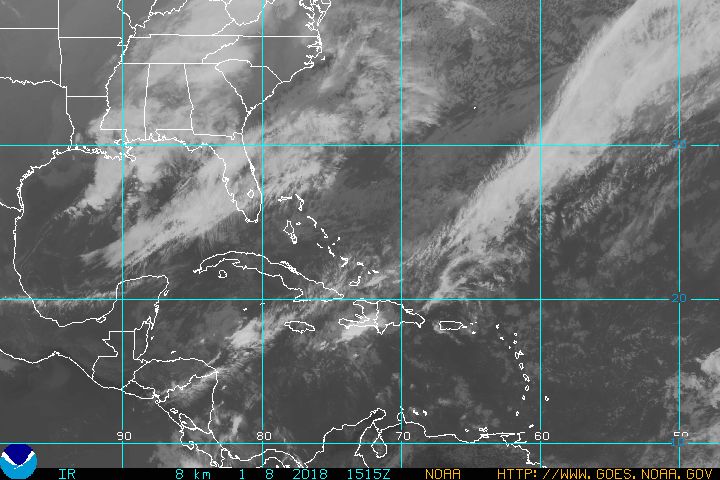
Atlantic Ocean: Tropical depression Beryl is moving over northern Florida and southeastern Georgia. This recently downgraded tropical system will remain inland into Tuesday…and now is a classic rainmaker. It was located 150 miles southwest of Savannah, Georgia, and 10 miles east of Valdosta, Georgia, with 30 mph winds. Here is the NHC graphical track map, along with a satellite image of this area. This dissipating tropical system will bring rain, gusty winds, and thunderstorms to the area. The latest forecast shows this system moving back over the Atlantic in 72 hours, and if it does before retirement…it could strengthen again then. Here's a looping radar image of the rainfall associated with tropical depression Beryl.
Conditions in the atmosphere and the ocean favor a near-normal hurricane season in the Atlantic Basin this season. For the entire six-month season, which begins June 1, NOAA’s Climate Prediction Center says there’s a 70 percent chance of nine to 15 named storms (with top winds of 39 mph or higher), of which four to eight will strengthen to a hurricane (with top winds of 74 mph or higher) and of those one to three will become major hurricanes (with top winds of 111 mph or higher, ranking Category 3, 4 or 5). Based on the period 1981-2010, an average season produces 12 named storms with six hurricanes, including three major hurricanes.
Eastern Pacific: There are no active tropical cyclones. The NHC has announced that climate conditions point to a near-normal hurricane season in the Eastern Pacific this year. The outlook calls for a 50 percent probability of a near-normal season, a 30 percent probability of a below-normal season and a 20 percent probability of an above-normal season.
Seasonal hurricane forecasters estimate a 70 percent chance of 12 to 18 named storms, which includes 5 to 9 hurricanes, of which 2 to 5 are expected to become major hurricanes (Category 3, 4 or 5 on the Saffir-Simpson Hurricane Wind Scale).
An average Eastern Pacific hurricane season produces 15 named storms, with eight becoming hurricanes and four becoming major hurricanes. The Eastern Pacific hurricane season runs from May 15 through Nov. 30, with peak activity from July through September.
Central Pacific: There are no active tropical cyclones. Here in the central part of the Pacific, the hurricane season begins as of June 1. The Central Pacific Hurricane Center in Honolulu is forecasting 2-4 tropical cyclones in this part of the Pacific Basin…which is slightly below the average number. An average season has 4-5 tropical cyclones, which include tropical depressions, tropical storms and hurricanes.
Western Pacific Ocean: There are no active tropical cyclones.
Interesting: It took some 10 million years for Earth to recover from the greatest mass extinction of all time, latest research has revealed. Life was nearly wiped out 250 million years ago, with only 10 per cent of plants and animals surviving. It is currently much debated how life recovered from this cataclysm, whether quickly or slowly.
Recent evidence for a rapid bounce-back is evaluated in a new review article by Dr Zhong-Qiang Chen, from the China University of Geosciences in Wuhan, and Professor Michael Benton from the University of Bristol. They find that recovery from the crisis lasted some 10 million years, as explained May 27 in Nature Geoscience.
The end-Permian crisis, by far the most dramatic biological crisis to affect life on Earth, was triggered by a number of physical environmental shocks — global warming, acid rain, ocean acidification and ocean anoxia. These were enough to kill off 90 per cent of living things on land and in the sea.
Dr Chen said: "It is hard to imagine how so much of life could have been killed, but there is no doubt from some of the fantastic rock sections in China and elsewhere round the world that this was the biggest crisis ever faced by life." Current research shows that the grim conditions continued in bursts for some five to six million years after the initial crisis, with repeated carbon and oxygen crises, warming and other ill effects.
Some groups of animals on the sea and land did recover quickly and began to rebuild their ecosystems, but they suffered further setbacks. Life had not really recovered in these early phases because permanent ecosystems were not established. Professor Benton, Professor of Vertebrate Palaeontology at the University of Bristol, said: "Life seemed to be getting back to normal when another crisis hit and set it back again.
The carbon crises were repeated many times, and then finally conditions became normal again after five million years or so." Finally, after the environmental crises ceased to be so severe, more complex ecosystems emerged. In the sea, new groups, such as ancestral crabs and lobsters, as well as the first marine reptiles, came on the scene, and they formed the basis of future modern-style ecosystems.
Professor Benton added: "We often see mass extinctions as entirely negative but in this most devastating case, life did recover, after many millions of years, and new groups emerged. The event had re-set evolution. However, the causes of the killing — global warming, acid rain, ocean acidification — sound eerily familiar to us today. Perhaps we can learn something from these ancient events."
 Email Glenn James: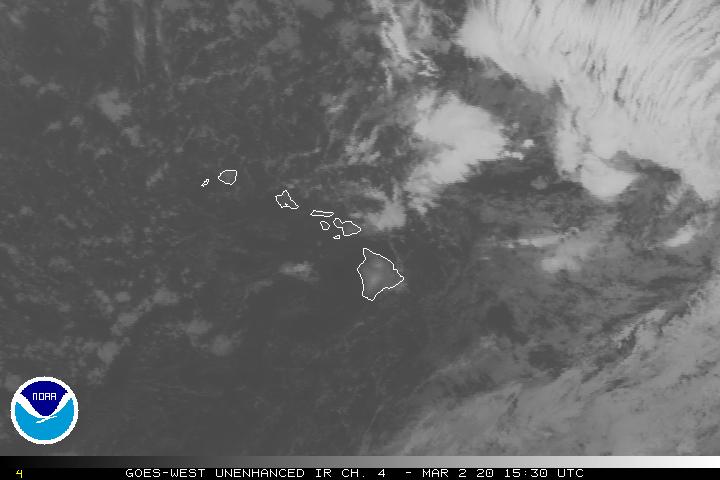


peter mac Says:
Good program on Democracynow.org showing Iraq and Afghan and Vietnam Vets returning their medals in protest against unlawful war making by NATO and the US. Heavy.
Brave Men and Women! In their own words…~~~Thanks Peter, always enjoy Democracynow.org when I see it at my friends house on the mainland. Aloha, Glenn