











Air Temperatures – The following maximum temperatures were recorded across the state of Hawaii Tuesday:
Lihue, Kauai – 82
Honolulu airport, Oahu – 85 (Record high for Tuesday / 91 – 1996 )
Kaneohe, Oahu – 82
Molokai airport – 82
Kahului airport, Maui – 85 (Record high for Tuesday / 94 – 1953 )
Kona airport – 83
Hilo airport, Hawaii – 83
Air Temperatures ranged between these warmest and coolest spots near sea level – and on the highest mountain tops…as of 5pm Tuesday evening:
Honolulu, Oahu – 82
Molokai airport – 77
Haleakala Crater – 46 (near 10,000 feet on Maui)
Mauna Kea – 32 (near 13,800 feet on the Big Island)
Hawaii’s Mountains – Here’s a link to the live web cam on the summit of near 13,800 foot Mauna Kea on the Big Island of Hawaii. This web cam is available during the daylight hours here in the islands…and when there’s a big moon shining down during the night at times. Plus, during the nights you will be able to see stars, and the sunrise and sunset too…depending upon weather conditions. Here's the Haleakala Crater webcam on Maui…although this webcam is not always working correctly.
Tropical Cyclone activity in the eastern and central Pacific – Here’s the latest weather information coming out of the National Hurricane Center, covering the eastern north Pacific. You can find the latest tropical cyclone information (once the season begins June 1) for the central north Pacific (where Hawaii is located) by clicking on this link to the Central Pacific Hurricane Center. A satellite image, which shows the entire ocean area between Hawaii and the Mexican coast…can be found here. Here's a tropical cyclone tracking map for the eastern and central Pacific.
Aloha Paragraphs

Strong and gusty trade winds, passing showers
at times…almost all on the windward
sides – locally very hazy
Strong winds atop the summits on Maui
and the Big Island of Hawaii
As this weather map shows, we have a a near 1030 millibar high pressure system located to the northeast of the islands, with an elongated high pressure ridge extending far westward…to the north of the state. Our local winds will continue to be from the trade wind direction…picking up further Wednesday onwards.
The following numbers represent the most recent top wind gusts (mph), along with directions as of Tuesday evening:
32 Port Allen, Kauai – ENE
42 Kahuku, Oahu – ESE
37 Molokai – ENE
44 Kahoolawe – NE
42 Kaupo Gap, Maui – NE
38 Lanai – NE
42 PTA Keamuku, Big Island – SE
We can use the following links to see what’s going on in our area of the north central Pacific Ocean. Here's the latest NOAA satellite picture – the latest looping satellite image…and finally the latest looping radar image for the Hawaiian Islands.
Here are the latest 24-hour precipitation totals (inches) for each of the islands as of Tuesday evening:
0.07 Mount Waialeale, Kauai
0.50 Kahuku, Oahu
0.00 Molokai
0.00 Lanai
0.00 Kahoolawe
0.01 Kahului airport, Maui
0.13 Kawainui Stream, Big Island
Sunset Commentary: The trade winds will strengthen…becoming a notch stronger Wednesday. This will be a long lasting trade wind weather pattern, keeping our trades blowing through the next week at least. The NWS forecast office in Honolulu is keeping the small craft wind advisories active in those windiest areas from Oahu, down through Maui County and the Big Island…well into the future. At higher elevations on Maui and the Big Island, stronger winds are keeping wind advisories in force on Maui, with an unusual high wind warning on the Big Island.
As far as precipitation goes, there will be just a few incoming showers at times, although the overlying atmosphere is dry and stable, which will act to limit shower intensities and coverage across the board. As the trade winds increase in strength, there may be some increase in windward shower activity…depending upon available moisture Wednesday evening into Thursday perhaps. The leeward sides of the islands should remain nice, although some areas, like Maui County at least, covered by volcanic haze.
Here in Kula, Maui, it was clear early Tuesday evening, although still quite hazy, with an air temperature of 79.7F degrees. It was one of those amazingly clear days here on Maui, with hardly a cloud around at all. The vog is still a fairly major issue, and has been thick in our local atmosphere for the last three days! It was so clear, or should I say cloud free, that I decided to head up to the 7000 foot elevation, on the western slope of the Haleakala Crater. It's just a hop, skip and a jump from where I live here in Kula. There was hardly a soul up there, which made it very nice for communing with nature, which I did. I also whipped my skateboard out, and hit the road, although not literally for crying out loud. I was lucky once again (not falling), and had a great time carving turns on the pavement up there. When I got down here again this afternoon, the thermometer was reading 82F degrees, the warmest I've seen perhaps since last summer! I'll be back early Wednesday morning with your next new weather narrative, I hope you have a great Tuesday night wherever you happen to be spending it! Aloha for now…Glenn.
Tropical cyclone reports / Eastern Pacific: The second tropical cyclone of the 2012 hurricane season, in the eastern Pacific, became active this past Sunday. This tropical storm called Bud (2E), is forecast to remain a tropical storm through the remainder of his life cycle…not attaining hurricane strength. Bud was located approximately 435 miles south of Manzanillo, Mexico, with 40 mph sustained winds. Here's the NHC storm track map, along with a satellite image. There is absolutely no threat to the Hawaiian Islands from this developing tropical system as it curves back towards the Mexican coast this weekend.
Atlantic Ocean: There are no active tropical cyclones
Western Pacific Ocean: There's a second tropical cyclone in the tropical waters of the world, this one in the western Pacific. It is tropical storm Sanvu (03W), forecast by the Joint Typhoon Warning Center (JTWC) to become a typhoon Wednesday. It was located approximately 495 nautical miles south of Iwo To, Japan. Here's the latest JTWC graphical track map. Here's a NOAA satellite image of Sanvu. At the moment, this tropical cyclone isn't expected to impact any island areas in the western Pacific…although is forecast to get within just 69 miles from the small Japanese island of Iwo To. Top sustained winds at the time of this writing was 50 knots, with gusts to 65 knots.
Interesting: Environmental scientists have known that high levels of the toxic element, mercury, have been accumulating in the Arctic Ocean for some time. It was believed to be mostly caused by atmospheric sources stemming from the combustion of coal. However, a new study from the Harvard School of Engineering and Applied Sciences and the Harvard School of Public Health has found that the great majority of Arctic mercury arrives via circumpolar rivers.
Some of the largest rivers in the world flow north into the Arctic in Eurasia and North America.The implications of this finding are significant for predicting future levels of the toxic heavy metal. The levels in the Artic will likely be increasing from the thawing of Arctic soils, releasing mercury into the hydrological cycle.
"The Arctic is a unique environment because it's so remote from most anthropogenic (human-influenced) sources of mercury, yet we know that the concentrations of mercury in Arctic marine mammals are among the highest in the world," says lead author Jenny A. Fisher, a postdoctoral fellow at Harvard.
"This is dangerous to both marine life and humans." Mercury is a naturally occurring element that has been enriched in the environment by human activities. It is considered a persistent bio-accumulative toxin because it does not break down in the environment.
It travels through the food chain from the lowly plankton all the way up to humans. As it travels up, it becomes more concentrated and lethal. The greatest concern is for the indigenous people of the Arctic who consume large amounts of locally-caught fish and marine mammals.
Through combustion, mercury is emitted into the atmosphere. Once chemical processes make it soluble, it falls back to Earth as rain or show. Some fall directly into the Arctic Ocean, but most fall on the large watersheds of the far north. The largest rivers flowing into the Arctic are in Siberia: the Lena, the Ob, and Yenisei.
They are three of the ten largest rivers in the world and account for 10% of all freshwater discharge into the world's oceans. Other major rivers include the Kolyma in eastern Siberia, the Mackenzie in Canada, and the Yukon in Canada and Alaska.
The Harvard researchers found that rivers contributed more than double the mercury than the atmosphere by noticing a spike in mercury concentrations during the summer. This could only be explained by the increased river flow from circumpolar melting.
"At this point we can only speculate as to how the mercury enters the river systems, but it appears that climate change may play a large role," says co-author, Daniel Jacob. "As global temperatures rise, we begin to see areas of permafrost thawing and releasing mercury that was locked in the soil; we also see the hydrological cycle changing, increasing the amount of runoff from precipitation that enters the rivers.
Another contributing factor could be runoff from gold, silver, and mercury mines in Siberia, which may be polluting the water nearby. We know next to nothing about these pollution sources."
Interesting2: The kind of deluges that in recent years washed out Cedar Rapids, IA, forced the Army Corps of Engineers to intentionally blow up levees to save Cairo, IL, and sent the Missouri River over its banks for hundreds of miles are part of a growing trend, according to a new report released today by the Rocky Mountain Climate Organization (RMCO) and the Natural Resources Defense Council (NRDC). Big storms, leading to big floods, are occurring with increasing frequency in the Midwest, with incidences of the most severe downpours doubling over the last half century, the report finds.Stephen Saunders, the president of the Rocky Mountain Climate Organization and the report's lead author, said: "Global studies already show that human-caused climate change is driving more extreme precipitation, and now we've documented how great the increase has been in the Midwest and linked the extreme storms to flooding in the region.
A threshold may already have been crossed, so that major floods in the Midwest perhaps now should no longer be considered purely natural disasters but instead mixed natural/unnatural disasters. And if emissions keep going up, the forecast is for more extreme storms in the region."
In addition to region-wide trends, the report presents trends in the eight Midwestern states. For the worst storms (three inches or more of rain in 24 hours) from 1961-2011, the report outlines the following state-level trends: Indiana (+160 percent); Wisconsin (+203 percent); Missouri (+81 percent); Michigan (+180 percent); Minnesota (+104 percent); Illinois (+83 percent); Ohio (+40 percent); and Iowa (+32 percent).
Titled, "Doubled Trouble: More Midwestern Extreme Storms," the new NRDC-RMCO report adds several years of data to previous reports tracking the issue of Midwestern storms. Key findings include:
– Since 1961, the Midwest has had an increasing number of large storms. The largest of storms, those of three inches or more of precipitation in a single day, increased the most, with their annual frequency having increased by 103 percent over the roughly half century period through 2011. For storms of at least two inches but less than three inches in a day, the trend was a 81 percent increase; for storms of one to two inches, a 34 percent increase.
Smaller storms did not have a significant increase.
– The rates of increase for all large storms accelerated over time, with the last analyzed decade, 2001-2010, showing the greatest jumps. For the largest storms, in 2001-2010 there were 52 percent more storms per year than in the baseline period.
– The frequency of extreme storms has increased so much in recent years that the first 12 years of this century included seven of the nine top years (since 1961) for the most extreme storms in the Midwest.
– With more frequent extreme storms, the average return period between two such storms has become shorter. In 1961-1970, extreme storms averaged once every 3.8 years at an individual location in the Midwest. That is two to four times more frequent than a major hurricane making landfall at a typical location along the U.S. coast from North Carolina to Texas. By 2001-2010, the average return period for Midwestern extreme storms at a single location was down to 2.2 years—or four to eight times more frequent than land falling major hurricanes.
Interesting3: A chick's chances throughout life will depend on a good environment and good parenting in its earliest months. One of the ways that chicks can get ahead is to have an extra relative looking after them. New research shows that the benefits of having a 'helper at the nest' extend even into adulthood.
'It is a paradox that individuals help to rear others instead of breeding on their own,' explains Dr Lyanne Brouwer of the Australian National University. 'But classic theory explains this by 'kin-selection'; by helping to raise relatives, helpers indirectly pass on a part of their own genes.
The benefits that an individual gains can be calculated in terms of the number of genes that they pass on to the next generation.' Calculations like this can help us understand why some species of bird help out at relatives' nests whilst other species do not.
In their article in PLoS One, Brouwer and her colleagues argue that the long-term benefits to bird survival from having a friendly relative on hand need to be borne in mind when making these calculations. The scientists studied the Seychelles warbler, found only in a few islands in the Republic of Seychelles in the Indian Ocean.
This is one of the nine per cent of bird species that are classed as cooperative breeders. Their limited habitat, bounded on every side by the sea, often forces related birds to share the territory they grew up in.
'Once all the habitat on the island is occupied, new young have nowhere to go to, so they stay with their parents and often help to rear the next brood,' says Brouwer. 'The Seychelles warbler is a typical example of a cooperative breeder.'
Interesting4: A marine expedition of environmentalists has confirmed the bad news it feared — the "Great Pacific Garbage Patch" extends even further than previously known. Organized by two non-profit groups — the Algalita Marine Research Foundation and the 5 Gyres Institute — the expedition is sailing from the Marshall Islands to Japan through a "synthetic soup" of plastic in the North Pacific Ocean on a 72-feet yacht called the Sea Dragon, provided by Pangaea Exploration.
The area is part of one of the ocean's five tropical gyres — regions where bodies of water converge, with currents delivering high concentrations of plastic debris. The Sea Dragon is visiting the previously unexplored western half of the North Pacific gyre — situated below the 35th parallel, and home to a massive expanse of plastic particles known as the "Great Pacific Garbage Patch" — to look for plastic pollution and study its effect on marine life.
Leading the expedition is Marcus Eriksen, a former U.S. marine and Ph.D student from University of Southern California."We've been finding lots of micro plastics, all the size of a grain of rice or a small marble," Eriksen said via satellite phone.
"We drag our nets and come up with a small handful, like confetti — 10, 20, 30 fragments at a time. That's how it's been, every trawl we've done for the last thousand miles." Eriksen, who has sailed through all five gyres, said this confirmed for him "that the world's oceans are 'plasticized.'
Everywhere you go in the ocean, you're going to find this plastic waste."Besides documenting the existence of plastic pollution, the expedition intends to study how long it takes for communities of barnacles, crabs and molluscs to establish, whether the plastic can serve as a raft for species to cross continents, and the prevalence of chemical pollutants.
On a second leg from Tokyo to Hawaii departing May 30, the team expect to encounter material dislodged by the Japanese tsunami. "We'll be looking for debris that's sub-surface: overturned boats, refrigerators, things that wind is not affecting," Eriksen said.
"We'll get an idea of how much is out there, what's going on and what it's carrying with it, in terms of toxins." Scripps Institute graduate Miriam Goldstein was chief scientist on a similar expedition to the Great Pacific Garbage Patch in 2009. According to her research, there has been a 100-fold increase in plastic garbage in the last 40 years, most of it broken down into tiny crumbs to form a concentrated soup.
The particles are so small and profuse that they can't be dredged out. "You need a net with very fine mesh and then you're catching baby fish, baby squid — everything," Goldstein says. "For every gram of plastic you're taking out, you probably take out more or less the equivalent of sea life."Scientists are worried that the marine organisms that adapt to the plastic could displace existing species.
Goldstein said this was a major concern, as organisms that grow on hard surfaces tend to monopolize already scarce food, to the detriment of other species. "Things that can grow on the plastic are kind of weedy and low diversity — a parallel of the things that grow on the sides of docks," she says.
"We don't necessarily want an ocean stuffed with barnacles." Sea-level rise: Impacts and mitigation measures around the world Eriksen says the mood on the Sea Dragon has been upbeat, with crew members playing a ukulele and doing yoga, "but the sobering reality is that we're trawling through a synthetic soup."
Also on board is Valerie Lecoeur, founder of a company that makes eco-friendly baby and children's products, including biodegradable beach toys made from corn, and Michael Brown from Packaging 2.0, a packaging consultancy.
Eriksen says they have been discussing the concept of "extended producer responsibility". "As the manufacturer of any good in the world today, you really can't make your product without a plan for its entire use, because you could eventually have 7 billion customers buy your product," he said.
"If one little button has no plan, the world now has a mountain of buttons to deal with. There is no room for waste, as a concept or a place — there's just no place to put it anymore. That's the reality we need to face. We've got this plastic everywhere."
 Email Glenn James: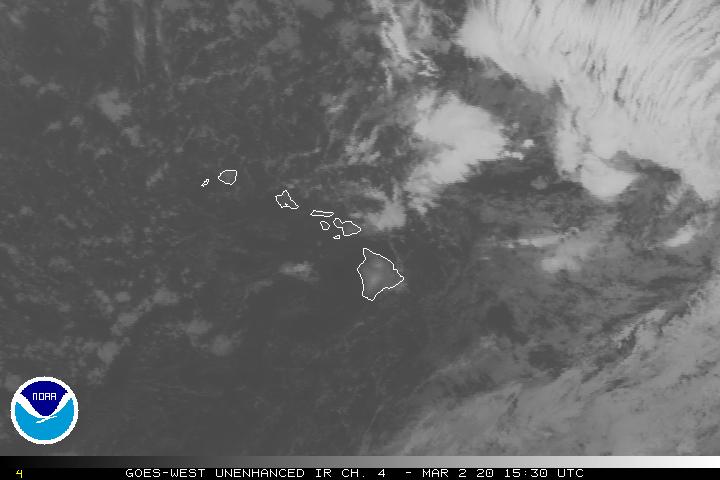


louise Says:
i am confused. I live in Napili. The wind is currently out of the northeast (according to weather report at Kapalua airport). There are white caps in the channel.
Why is there so much vog with the trades blowing?
It appears that the vog does not have a lot to do with the wind direction (lately)
This is not the first time I have noted these conditions.
I know the vog content is high when the wind is out of the south or when the winds are light to variable….
Please can you help me to understand why i am confused?
mahalo
louiserockett@aol.com~~~Louise, I am confused too, as the trade winds are blowing now, strongly in fact! The wind direction is not from the south or southeast, but rather the east and northeast. I am as confused as you, never sure what the correct answer is, when the vog or haze comes to us when the classic trade winds are blowing! I’ll write something about this if I can clear on it. Aloha, Glenn
Bill Says:
Hi Glen: I live in Maui Meadows and have also noticed the haze the last couple of days…It seems like vog, but, the wind doesn't appear to be blowing from the Big Island..Is it because of the upper elevation wind putting dust in the air? Something else? The reason I ask is I have a new solar photovoltaic system installed on my roof and it is not putting out any where near its' rated full power during "peak sun hours". Thanks for your input, tired of paying the highest electric rates on the planet. Bill~~~Hi Bill, sorry to hear of your high bill costs! As for the haze, or vog, or whatever it is, it certainly has been in our air for the last several days…no doubt about that. Aloha, Glenn